




If a graph is plotted with the atomic number on x-axis and the square root of the frequency of a spectral line of characteristic X-rays on the y-axis, then it will be
A) A straight line passing through the origin
B) A parabola
C) A straight line not passing through the origin
D) A rectangular hyperbola
Answer
 Verified
270.6k+ views
Hint: The atomic number or proton number is the number of protons found in the nucleus. A spectral line is a characteristic line in the entire continuous spectrum of an element, resulting from light emission and absorption in a narrow range of frequency when compared with the nearby frequencies.
Complete step by step solution:
The atomic number of an element can be related to the square root of the frequency of a spectral line of characteristic X-rays using Moseley’s law. Moseley’s law is an empirical law concerning the characteristic X-rays emitted by atoms. It states that the square root of the frequency of emitted X-rays is approximately proportional to the atomic number.
Mathematically, the law can be represented using the equation \[\sqrt{\upsilon }\propto Z\] where \[\upsilon \] is the frequency of the emitted X-ray.
The final equation of Moseley’s law can be written as \[\upsilon =A{(Z-b)}^2\] where and are constants depending upon the X-ray emission. Moseley measured and plotted the X-ray frequencies of about 40 elements of the periodic table following his law and observed the graph to be a straight line. The plot of the graph with atomic numbers on the x-axis and the square root of frequencies on the y-axis furnished a straight line not passing through the origin.
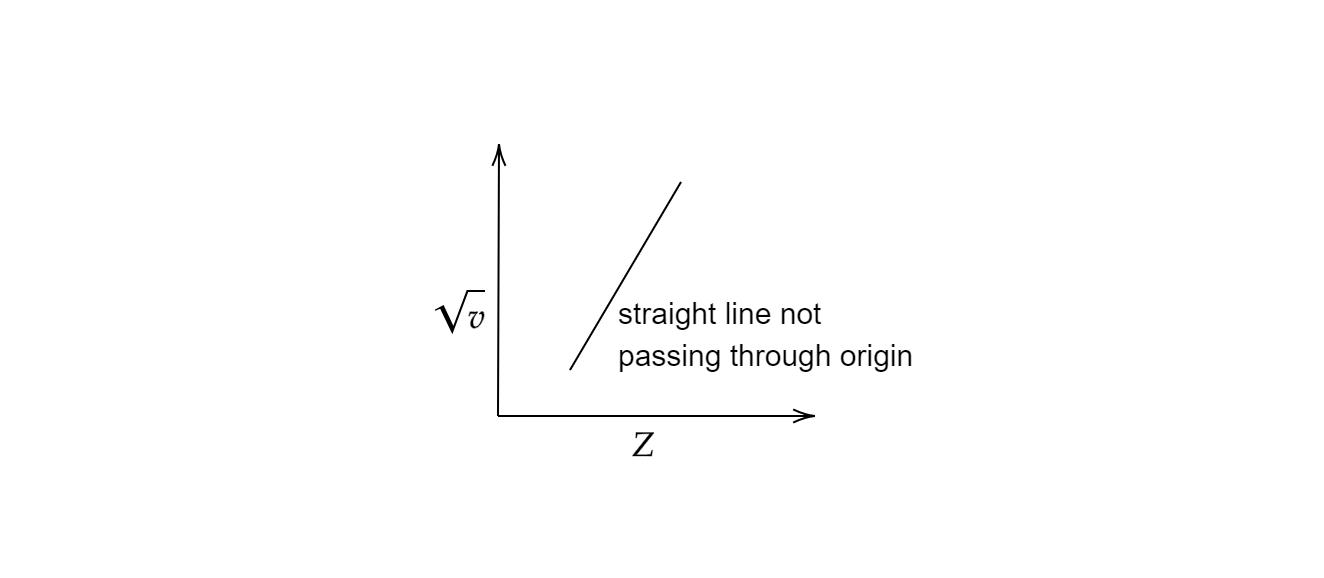
Hence, option (C) is the correct option.
Note: Moseley’s law was the first law to associate the atomic number of elements with any known physical quantity. It established the atomic number as a measurable experimental quantity and also gave it a viable physical meaning. Henry Moseley, the physicist behind this law, has also made major contributions to the periodic table.
Complete step by step solution:
The atomic number of an element can be related to the square root of the frequency of a spectral line of characteristic X-rays using Moseley’s law. Moseley’s law is an empirical law concerning the characteristic X-rays emitted by atoms. It states that the square root of the frequency of emitted X-rays is approximately proportional to the atomic number.
Mathematically, the law can be represented using the equation \[\sqrt{\upsilon }\propto Z\] where \[\upsilon \] is the frequency of the emitted X-ray.
The final equation of Moseley’s law can be written as \[\upsilon =A{(Z-b)}^2\] where and are constants depending upon the X-ray emission. Moseley measured and plotted the X-ray frequencies of about 40 elements of the periodic table following his law and observed the graph to be a straight line. The plot of the graph with atomic numbers on the x-axis and the square root of frequencies on the y-axis furnished a straight line not passing through the origin.
Hence, option (C) is the correct option.
Note: Moseley’s law was the first law to associate the atomic number of elements with any known physical quantity. It established the atomic number as a measurable experimental quantity and also gave it a viable physical meaning. Henry Moseley, the physicist behind this law, has also made major contributions to the periodic table.
Recently Updated Pages
Circuit Switching vs Packet Switching: Key Differences Explained

JEE General Topics in Chemistry Important Concepts and Tips
JEE Extractive Metallurgy Important Concepts and Tips for Exam Preparation
JEE Atomic Structure and Chemical Bonding important Concepts and Tips
JEE Amino Acids and Peptides Important Concepts and Tips for Exam Preparation
Electricity and Magnetism Explained: Key Concepts & Applications
Trending doubts
JEE Main 2026: Exam Dates, Session 2 Updates, City Slip, Admit Card & Latest News
JEE Main Participating Colleges 2026 - A Complete List of Top Colleges
Kinematics Mock Test for JEE Main 2025-26: Comprehensive Practice
Understanding the Electric Field of a Uniformly Charged Ring
Understanding Atomic Structure for Beginners
Derivation of Equation of Trajectory Explained for Students
Other Pages
CBSE Class 12 Physics Question Paper 2026: Download SET-wise PDF with Answer Key & Analysis
JEE Advanced 2026 Notification Out with Exam Date, Registration (Extended), Syllabus and More
JEE Advanced Percentile vs Marks 2026: JEE Main Cutoff, AIR & IIT Admission Guide
JEE Advanced 2026 Marks vs Rank: Estimate IIT Rank from Your Score
JEE Advanced Weightage Chapter Wise 2026 for Physics, Chemistry, and Mathematics
JEE Main Marking Scheme 2026- Paper-Wise Marks Distribution and Negative Marking Details