




Identify meso compounds:
(A) 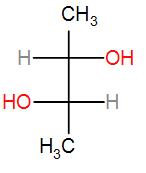
(B) 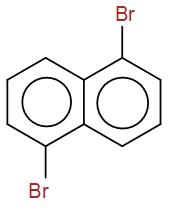
(C) 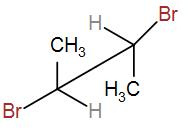
(D) 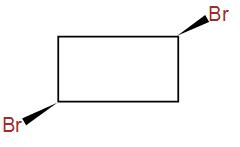
Answer
 Verified
265.2k+ views
Hint: Meso compounds are compounds that do not show optical activity even though they have chiral centres. They have a plane of symmetry. To solve this, find the plane of symmetry in the given structures and then identify their stereochemistry.
Complete step by step solution:
To answer this question, we have to understand what meso compounds are.
Meso compounds are compounds which have multiple stereocenters i.e. chiral centres but are optically inactive. The chiral centre is an atom to which 4 different groups of atoms are bonded so that they can form a non-superimposable mirror image.
Meso compounds have multiple chiral centres but are achiral.
To identify a meso compound, we can follow the steps below-
- A meso compound will have two or more chiral centres.
- After you have determined the chiral centres, look for an internal plane that can be passed through the compound.
- Then look for the stereochemistry of the compound i.e. determine whether it is R or S. If there are two chiral centres and RS = SR, then it is a meso compound.
Meso compound is optically inactive so the R cancels out S in a meso compound.
Basically, if you can find out a plane of symmetry and two or more chiral centres in a compound then it is a meso compound.
Now, let us go through the options given to us.
Firstly, we have –

If we pass a plane in between and determine the stereochemistry of the two chiral centres, both will come out to be R. So this is not a meso compound.
Then we have-
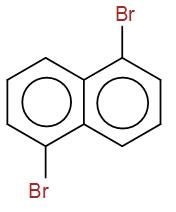
It is not a meso compound as it has no plane of symmetry.
Next, we have-
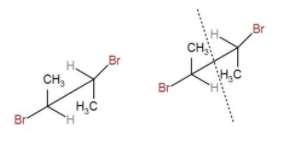
In Fischer projection, we can draw it as-
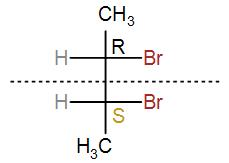
Here, we can see that RS = SR. Therefore, this is a meso compound.
And lastly, we have –
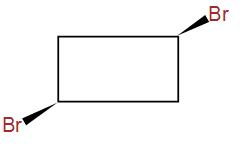
It has a plane of symmetry but it has no chiral centres.
Therefore, the correct answer is option (C).
Note: We know that optical isomers are compounds having the same atoms and bonds but in different spatial arrangements and will have non-superimposable mirror images. However, meso compounds are also optical isomers, but they contain a plane of symmetry. All molecules irrespective of their chirality exhibit optical activity when they are not superimposable on their mirror images.
Complete step by step solution:
To answer this question, we have to understand what meso compounds are.
Meso compounds are compounds which have multiple stereocenters i.e. chiral centres but are optically inactive. The chiral centre is an atom to which 4 different groups of atoms are bonded so that they can form a non-superimposable mirror image.
Meso compounds have multiple chiral centres but are achiral.
To identify a meso compound, we can follow the steps below-
- A meso compound will have two or more chiral centres.
- After you have determined the chiral centres, look for an internal plane that can be passed through the compound.
- Then look for the stereochemistry of the compound i.e. determine whether it is R or S. If there are two chiral centres and RS = SR, then it is a meso compound.
Meso compound is optically inactive so the R cancels out S in a meso compound.
Basically, if you can find out a plane of symmetry and two or more chiral centres in a compound then it is a meso compound.
Now, let us go through the options given to us.
Firstly, we have –
If we pass a plane in between and determine the stereochemistry of the two chiral centres, both will come out to be R. So this is not a meso compound.
Then we have-
It is not a meso compound as it has no plane of symmetry.
Next, we have-
In Fischer projection, we can draw it as-
Here, we can see that RS = SR. Therefore, this is a meso compound.
And lastly, we have –
It has a plane of symmetry but it has no chiral centres.
Therefore, the correct answer is option (C).
Note: We know that optical isomers are compounds having the same atoms and bonds but in different spatial arrangements and will have non-superimposable mirror images. However, meso compounds are also optical isomers, but they contain a plane of symmetry. All molecules irrespective of their chirality exhibit optical activity when they are not superimposable on their mirror images.
Recently Updated Pages
JEE Main Mock Test 2025-26: Principles Related To Practical

JEE Main 2025-26 Organic Compounds Containing Nitrogen Mock Test
JEE Main Chemical Kinetics Mock Test 2025-26: Free Practice Online
JEE Main 2025-26 Organic Compounds Containing Oxygen Mock Test
JEE Main 2025-26 Mock Test: Organic Compounds Containing Oxygen
JEE Main 2025-26 Organic Compounds Containing Halogens Mock Test
Trending doubts
Understanding Atomic Structure for Beginners
How to Convert a Galvanometer into an Ammeter or Voltmeter
Ideal and Non-Ideal Solutions Explained for Class 12 Chemistry
Degree of Dissociation: Meaning, Formula, Calculation & Uses
Understanding the Electric Field Due to Infinite Linear Charge and Cylinders
Understanding the Angle of Deviation in a Prism