




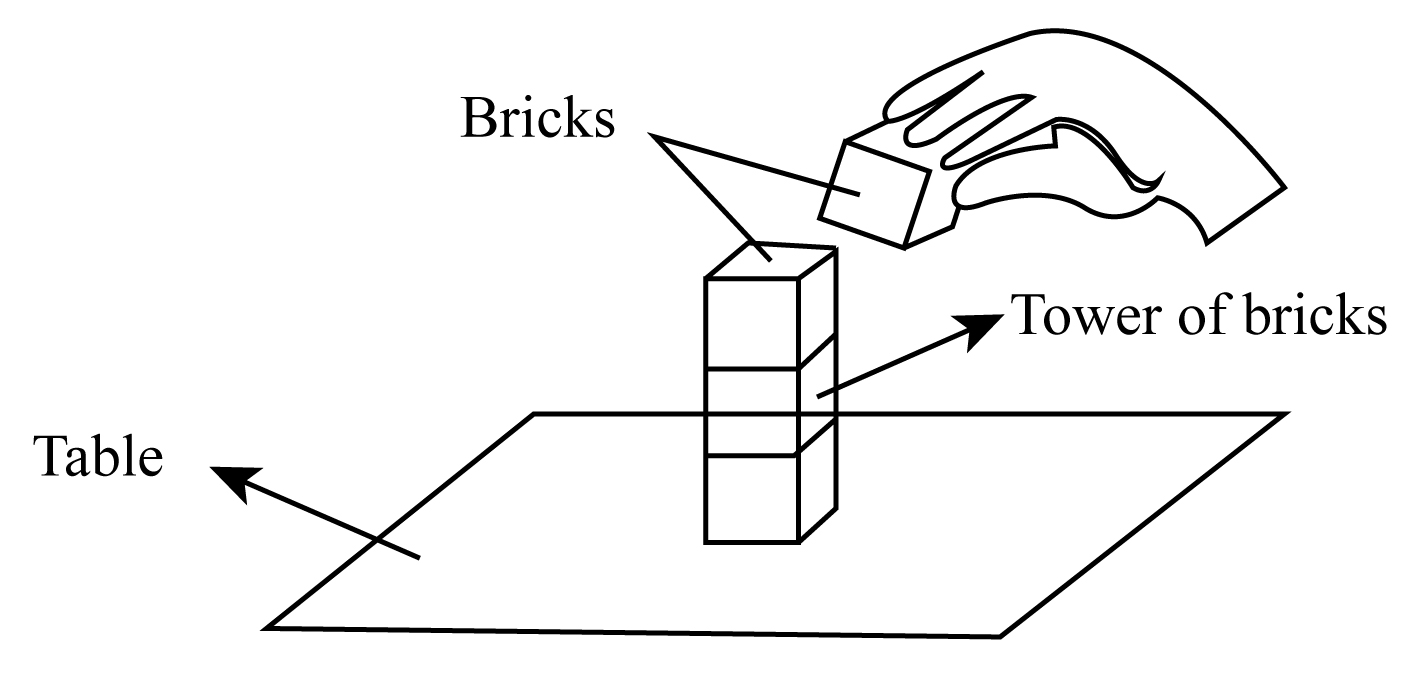
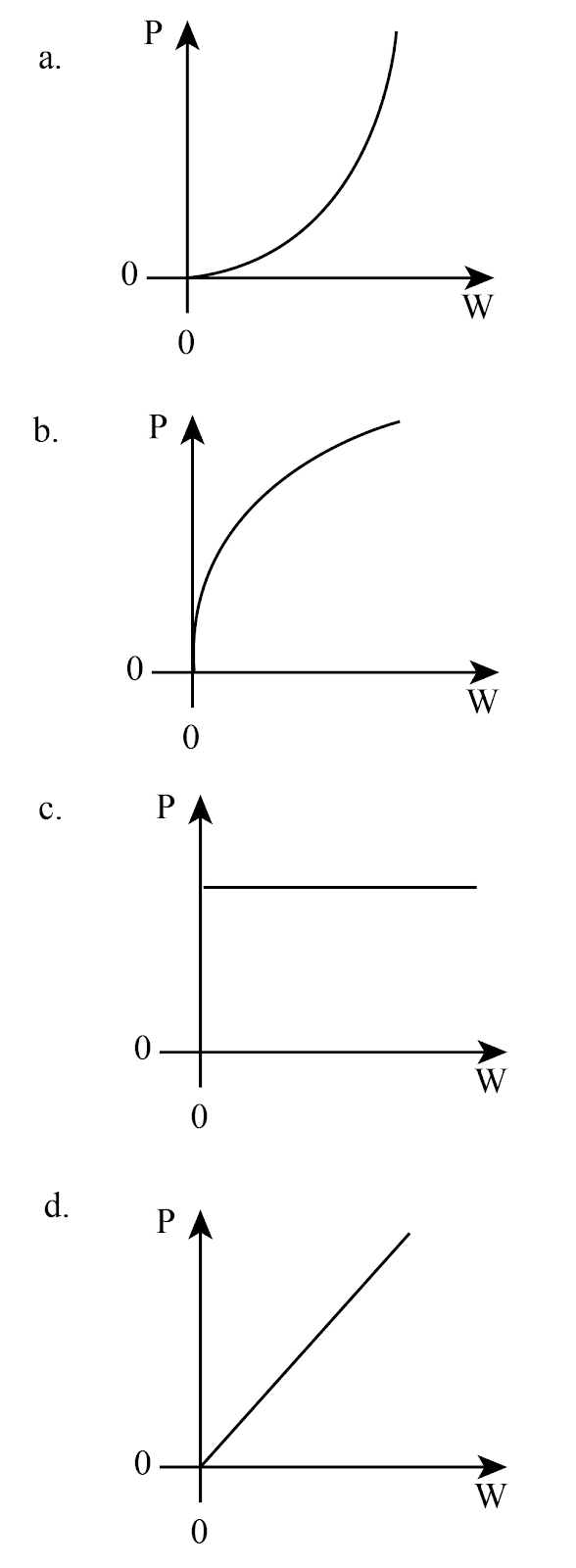
Identical toy bricks are placed one on top of another to make a tower on a table. Which graph shows the relationship between the pressure P that the tower exerts on the table and the weight W of the tower?
Answer
 Verified
243.6k+ views
Hint: As we all know that force is just an effort applied at a point to move some object or body. But if the value of the same force is increased on that particular area then we can say that the intensity of force is increased and we need to define a new quantity and that is pressure.
Complete step by step answer:
We should keep in mind that pressure is the force applied on the unit area of the surface. Pressure can be represented as:
$P = \dfrac{W}{A}$ …… (I)
Here $P$ is the pressure, $W$ is the force applied and $A$ is the surface area. Therefore, we can see that pressure depends on force and surface area.
Pressure has the characteristics of proportionality factor. Area is something which gives us the direction and pressure is defined everywhere in the volume of the bulk and not just only at the surface. A gas inside the container has a pressure everywhere overall the bulk volume.
Now we can see that the slope of P vs W graph is,
$ \Rightarrow m = \dfrac{P}{W}$ ….. (II)
Here m is the slope.
Now from equation (I), we can write equation (II) as,
$ \Rightarrow m = \dfrac{P}{W} = \dfrac{1}{A} = C$
Here, now C is the constant since the surface area A is constant. Therefore, we can say that the graph would be having a linear positive slope.
Therefore, the correct option is (D).
Note: In this problem the bottom most toy brick feels the pressure due to the reaction(normal) from the surface and also from the upper toy bricks, these pressures act on the lower and upper surface of the toy brick respectively. But while solving this problem we have only considered pressure on the surface due to the entire toy brick system.
Complete step by step answer:
We should keep in mind that pressure is the force applied on the unit area of the surface. Pressure can be represented as:
$P = \dfrac{W}{A}$ …… (I)
Here $P$ is the pressure, $W$ is the force applied and $A$ is the surface area. Therefore, we can see that pressure depends on force and surface area.
Pressure has the characteristics of proportionality factor. Area is something which gives us the direction and pressure is defined everywhere in the volume of the bulk and not just only at the surface. A gas inside the container has a pressure everywhere overall the bulk volume.
Now we can see that the slope of P vs W graph is,
$ \Rightarrow m = \dfrac{P}{W}$ ….. (II)
Here m is the slope.
Now from equation (I), we can write equation (II) as,
$ \Rightarrow m = \dfrac{P}{W} = \dfrac{1}{A} = C$
Here, now C is the constant since the surface area A is constant. Therefore, we can say that the graph would be having a linear positive slope.
Therefore, the correct option is (D).
Note: In this problem the bottom most toy brick feels the pressure due to the reaction(normal) from the surface and also from the upper toy bricks, these pressures act on the lower and upper surface of the toy brick respectively. But while solving this problem we have only considered pressure on the surface due to the entire toy brick system.
Recently Updated Pages
JEE Main 2026 Session 2 City Intimation Slip & Exam Date: Expected Date, Download Link

JEE Main 2026 Session 2 Application Form: Reopened Registration, Dates & Fees
JEE Main 2026 Session 2 Registration (Reopened): Last Date, Fees, Link & Process
WBJEE 2026 Registration Started: Important Dates Eligibility Syllabus Exam Pattern
Dimensions of Charge: Dimensional Formula, Derivation, SI Units & Examples
How to Calculate Moment of Inertia: Step-by-Step Guide & Formulas
Trending doubts
JEE Main 2026: Exam Dates, Session 2 Updates, City Slip, Admit Card & Latest News
Ideal and Non-Ideal Solutions Explained for Class 12 Chemistry
Understanding the Angle of Deviation in a Prism
Understanding Differential Equations: A Complete Guide
Hybridisation in Chemistry – Concept, Types & Applications
Understanding the Electric Field of a Uniformly Charged Ring
Other Pages
JEE Advanced Marks vs Ranks 2025: Understanding Category-wise Qualifying Marks and Previous Year Cut-offs
JEE Advanced 2026 - Exam Date (Released), Syllabus, Registration, Eligibility, Preparation, and More
CBSE Notes Class 11 Physics Chapter 1 - Units And Measurements - 2025-26
Important Questions For Class 11 Physics Chapter 1 Units and Measurement - 2025-26
CBSE Notes Class 11 Physics Chapter 4 - Laws of Motion - 2025-26
CBSE Notes Class 11 Physics Chapter 14 - Waves - 2025-26