




Hydrogen peroxide is prepared in the laboratory by:
A.Adding $Mn{O_2}$ to dilute ${H_2}S{O_4}$
B.Passing $C{O_2}$ into a paste in cold water
C.Adding $Pb{O_2}$ to an acidified $KMn{O_4}$
D.Adding $N{a_2}{O_2}$to cold water
Answer
 Verified
249.6k+ views
Hint: To answer this question, you should recall the concept of preparation of hydrogen peroxide. It contains oxygen in an intermediate oxidation state and can thus, act as both oxidising and reducing reagent.
Complete step by step answer:
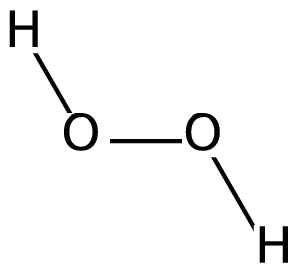
We know that peroxide is a compound which has two oxygen atoms bonded together. And Hydrogen Peroxide is the simplest peroxide. The chemical formula for hydrogen peroxide is ${H_2}{O_2}$. The structure of the molecule can be drawn as:
Now we know the methods of preparation of ${H_2}{O_2}$ so let us analyse each of the options systematically:
A.A balanced chemical reaction for this process can be written as \[2Mn{O_2}\; + {\text{ }}2{H_2}S{O_4} \to \;\;2MnS{O_4}\; + {\text{ }}{O_2}\; + {\text{ }}2{H_2}O\].
We can see that \[{H_2}{O_2}\]is not being formed in this reaction hence the given option is wrong and can be eliminated.
B.$C{O_2} + {H_2}O \to {H_2}C{O_3}$.
We can see that \[{H_2}{O_2}\]is not being formed in this reaction, thus the given option is wrong and can be eliminated.
C.\[5Pb{O_2} + 2M{n^{2 \oplus }} + 4{H^ \oplus } \to 5P{b^{2 \oplus }} + 2MnO{4^ - } + 2H2O\].
It is evident that \[{H_2}{O_2}\] is not being formed in this reaction, the given option is wrong and can be eliminated
D.\[N{a_2}{O_2}\left( s \right) + {H_2}S{O_4} \to N{a_2}S{O_4}\left( s \right) + {H_2}{O_2}\left( l \right)\].
We can see that here \[{H_2}{O_2}\]is being produced. This is indeed a preparation method of laboratory preparation of hydrogen peroxide by the action of ice-cold, dilute sulphuric acid on sodium peroxide or hydrated barium peroxide. A calculated quantity of sodium peroxide is added in small quantities to $20\% $ice-cold solution of sulphuric acid. Most of the sodium sulphate separates on cooling as crystals of \[N{a_2}S{O_4}.10{H_2}O\]. From this reaction, we obtain a \[30\% \] hydrogen peroxide yield containing a small amount of sodium sulphate.
Hence, we can conclude that the correct answer to this question is option D
Note: You must remember all the preparation methods of hydrogen peroxide which are most commonly used in the laboratories. Apart from the above reaction, the other important reaction for laboratory preparation of hydrogen peroxide is from barium peroxide: \[Ba{O_2}.8{H_2}O\; + {\text{ }}{H_2}S{O_{4\;}} \to {\text{ }}BaS{O_4}\; + {\text{ }}{H_2}{O_2}\; + {\text{ }}8{H_2}O\]
Complete step by step answer:
We know that peroxide is a compound which has two oxygen atoms bonded together. And Hydrogen Peroxide is the simplest peroxide. The chemical formula for hydrogen peroxide is ${H_2}{O_2}$. The structure of the molecule can be drawn as:
Now we know the methods of preparation of ${H_2}{O_2}$ so let us analyse each of the options systematically:
A.A balanced chemical reaction for this process can be written as \[2Mn{O_2}\; + {\text{ }}2{H_2}S{O_4} \to \;\;2MnS{O_4}\; + {\text{ }}{O_2}\; + {\text{ }}2{H_2}O\].
We can see that \[{H_2}{O_2}\]is not being formed in this reaction hence the given option is wrong and can be eliminated.
B.$C{O_2} + {H_2}O \to {H_2}C{O_3}$.
We can see that \[{H_2}{O_2}\]is not being formed in this reaction, thus the given option is wrong and can be eliminated.
C.\[5Pb{O_2} + 2M{n^{2 \oplus }} + 4{H^ \oplus } \to 5P{b^{2 \oplus }} + 2MnO{4^ - } + 2H2O\].
It is evident that \[{H_2}{O_2}\] is not being formed in this reaction, the given option is wrong and can be eliminated
D.\[N{a_2}{O_2}\left( s \right) + {H_2}S{O_4} \to N{a_2}S{O_4}\left( s \right) + {H_2}{O_2}\left( l \right)\].
We can see that here \[{H_2}{O_2}\]is being produced. This is indeed a preparation method of laboratory preparation of hydrogen peroxide by the action of ice-cold, dilute sulphuric acid on sodium peroxide or hydrated barium peroxide. A calculated quantity of sodium peroxide is added in small quantities to $20\% $ice-cold solution of sulphuric acid. Most of the sodium sulphate separates on cooling as crystals of \[N{a_2}S{O_4}.10{H_2}O\]. From this reaction, we obtain a \[30\% \] hydrogen peroxide yield containing a small amount of sodium sulphate.
Hence, we can conclude that the correct answer to this question is option D
Note: You must remember all the preparation methods of hydrogen peroxide which are most commonly used in the laboratories. Apart from the above reaction, the other important reaction for laboratory preparation of hydrogen peroxide is from barium peroxide: \[Ba{O_2}.8{H_2}O\; + {\text{ }}{H_2}S{O_{4\;}} \to {\text{ }}BaS{O_4}\; + {\text{ }}{H_2}{O_2}\; + {\text{ }}8{H_2}O\]
Recently Updated Pages
JEE Isolation, Preparation and Properties of Non-metals Important Concepts and Tips for Exam Preparation

Isoelectronic Definition in Chemistry: Meaning, Examples & Trends
Ionisation Energy and Ionisation Potential Explained
Iodoform Reactions - Important Concepts and Tips for JEE
Introduction to Dimensions: Understanding the Basics
Instantaneous Velocity Explained: Formula, Examples & Graphs
Trending doubts
JEE Main 2026: Exam Dates, Session 2 Updates, City Slip, Admit Card & Latest News
Hybridisation in Chemistry – Concept, Types & Applications
JEE Main 2026 Application Login: Direct Link, Registration, Form Fill, and Steps
Understanding the Electric Field of a Uniformly Charged Ring
Derivation of Equation of Trajectory Explained for Students
JEE Main Marking Scheme 2026- Paper-Wise Marks Distribution and Negative Marking Details
Other Pages
JEE Advanced Marks vs Ranks 2025: Understanding Category-wise Qualifying Marks and Previous Year Cut-offs
JEE Advanced 2026 - Exam Date (Released), Syllabus, Registration, Eligibility, Preparation, and More
CBSE Notes Class 11 Chemistry Chapter 9 - Hydrocarbons - 2025-26
CBSE Notes Class 11 Chemistry Chapter 5 - Thermodynamics - 2025-26
CBSE Notes Class 11 Chemistry Chapter 8 - Organic Chemistry Some Basic Principles And Techniques - 2025-26
JEE Advanced Weightage 2025 Chapter-Wise for Physics, Maths and Chemistry