




_________ grams of 3-Hydroxy propanal (MW=74) must be dehydrated to produce 7.8g of acrolein (MW=56) (\[{C_3}{H_4}O\]) if the percentage yield is 64. (Round off to the nearest integer).
[Given atomic masses; C=12.0 \[\mu \], H=1.0\[\mu \] , O=16.0\[\mu \]]
Answer
 Verified
300.6k+ views
Hint: In the above-mentioned chemical reaction dehydration reaction is taking place. A dehydration reaction is a type of reaction in which there will be a loss of water from the chemical reaction. It is the reverse process of hydration reaction.
Complete Step by Step Solution:
When 3-Hydroxy propanal is dehydrated to produce 7.8g of acrolein, the chemical reaction is given as:
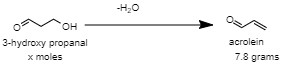
The moles of acrolein produced in the chemical reaction is:
\[\dfrac{{7.8}}{{56}} = 0.14\] moles
The percentage of yield would be equal to
\[\dfrac{{7.8/56}}{x} \times 100 = 64\]
\[x = \dfrac{{7.8 \times 100}}{{56 \times 64}} = \dfrac{{780}}{{56 \times 64}}\] moles
\[{W_{reac\tan t}} = \dfrac{{780}}{{56 \times 64}} \times 74 = 16.11\] grams
Therefore, 16.11 grams of 3-hydroxy propanal must be dehydrated to produce 7.8 grams of acrolein.
Note: Acrolein usually occurs as a colourless or yellow-colored liquid that dissolves in water very easily. It also has the tendency to quickly change into a vapour state when it is heated. Acrolein has a wide variety of uses such as in pesticides for controlling algae, weeds, bacteria, and mollusks. It also helps in the manufacturing of other industrial-based chemicals. It has a very choking odour and causes severe irritation to the eyes and mucous membrane. It is also toxic when it is inhaled and has a flash point which is below \[{0^o}F\]. It is less dense than water and its vapours are heavier than air. Very small amounts of acrolein can be produced and enter the atmosphere when oil. Plastics. Tobacco, gasoline, and oil are burned.
Complete Step by Step Solution:
When 3-Hydroxy propanal is dehydrated to produce 7.8g of acrolein, the chemical reaction is given as:
The moles of acrolein produced in the chemical reaction is:
\[\dfrac{{7.8}}{{56}} = 0.14\] moles
The percentage of yield would be equal to
\[\dfrac{{7.8/56}}{x} \times 100 = 64\]
\[x = \dfrac{{7.8 \times 100}}{{56 \times 64}} = \dfrac{{780}}{{56 \times 64}}\] moles
\[{W_{reac\tan t}} = \dfrac{{780}}{{56 \times 64}} \times 74 = 16.11\] grams
Therefore, 16.11 grams of 3-hydroxy propanal must be dehydrated to produce 7.8 grams of acrolein.
Note: Acrolein usually occurs as a colourless or yellow-colored liquid that dissolves in water very easily. It also has the tendency to quickly change into a vapour state when it is heated. Acrolein has a wide variety of uses such as in pesticides for controlling algae, weeds, bacteria, and mollusks. It also helps in the manufacturing of other industrial-based chemicals. It has a very choking odour and causes severe irritation to the eyes and mucous membrane. It is also toxic when it is inhaled and has a flash point which is below \[{0^o}F\]. It is less dense than water and its vapours are heavier than air. Very small amounts of acrolein can be produced and enter the atmosphere when oil. Plastics. Tobacco, gasoline, and oil are burned.
Recently Updated Pages
Normality of 03 M phosphorus acid H3PO3 is A 05 B 06 class 11 chemistry JEE_Main

A molecule with highest bond energy A Fluorine B Chlorine class 11 chemistry JEE_Main
A 30 solution of H2O2 is marketed as 100 volume hydrogen class 11 chemistry JEE_Main
Covalent compounds generally have low melting and boiling class 11 chemistry JEE_Main
When an acid reacts with a metal carbonate or metal class 11 chemistry JEE_Main
The degeneracy of hydrogen atom that has equal energy class 11 chemistry JEE_Main
Trending doubts
JEE Main 2026: Exam Dates, Session 2 Updates, City Slip, Admit Card & Latest News
Understanding the Electric Field of a Uniformly Charged Ring
Electron Gain Enthalpy and Electron Affinity Explained
Derivation of Equation of Trajectory Explained for Students
Understanding Atomic Structure for Beginners
How to Convert a Galvanometer into an Ammeter or Voltmeter
Other Pages
JEE Advanced Percentile vs Marks 2026: JEE Main Cutoff, AIR & IIT Admission Guide
NCERT Solutions For Class 11 Chemistry In Hindi Chapter 1 Some Basic Concepts Of Chemistry - 2026-27 Free PDF Download (Sign-in Required)
Hybridisation in Chemistry – Concept, Types & Applications
Understanding the Different Types of Solutions in Chemistry
Effective Nuclear Charge for JEE
CBSE Notes Class 11 Chemistry Chapter 5 - Thermodynamics - 2026-27 PDF Download (Login Required)