




Give the structures and IUPAC names of monohydric phenols of molecular formula, ${C_7}{H_8}O.$
Answer
 Verified
268.2k+ views
Hint: Phenols are aromatic alcohols. Monohydric phenol has one hydroxyl group attached to a benzene ring.
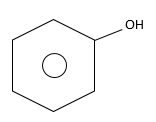
Complete step by step answer:
Molecular formula of the compound is ${C_7}{H_8}O.$ We have to find monohydric phenols. Phenols are aromatic alcohols in which one hydroxyl group is attached to a benzene ring.
Benzene ring has 6-carbon atoms in a ring, but total 7-carbon atoms are given in molecular formula.
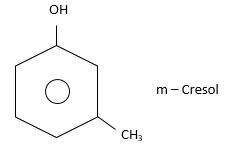
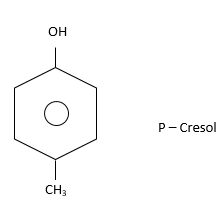
Therefore, each phenol is methyl substituted phenol. They are: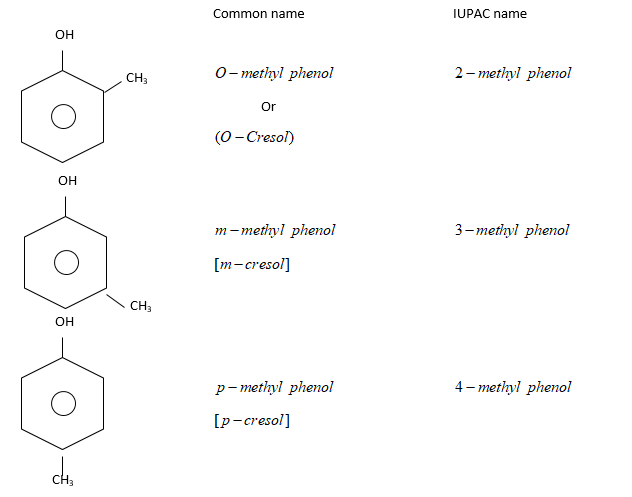 Common name of monohydric phenol is cresol.
When two hydrogen atoms of benzene are replaced by two monovalent atom or group of atoms, then resulting product have three different forms:
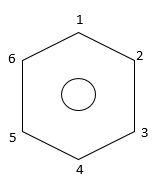
(i) Ortho (or 1,2): Substituents present on adjacent carbon atom. i.e., $ - C{H_3}$and $ - OH$group are present at adjacent C-atom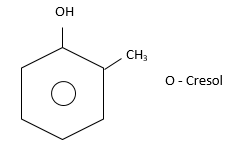
(ii) Meta (or 1,3): Substituents are present on alternate C-atoms. i.e., $ - C{H_3}$ and $ - OH$are present on alternate C-atoms.
(iii) Para (or 1,4): Two substituents i.e. $ - C{H_3}$ and $ - OH$are present on diagonally situated $C - atoms.$
Ortho, meta and para are generally represented as $O - ,m - $ and $p - $respectively.
Note: The formation of different structures by using one molecular formula is called isomerism. In the given compound three isomers are formed in which position of $ - C{H_3}$group is different with respect to $ - OH$ group on benzene ring.
Complete step by step answer:
Molecular formula of the compound is ${C_7}{H_8}O.$ We have to find monohydric phenols. Phenols are aromatic alcohols in which one hydroxyl group is attached to a benzene ring.
Benzene ring has 6-carbon atoms in a ring, but total 7-carbon atoms are given in molecular formula.
Therefore, each phenol is methyl substituted phenol. They are:
Common name of monohydric phenol is cresol.When two hydrogen atoms of benzene are replaced by two monovalent atom or group of atoms, then resulting product have three different forms:
(i) Ortho (or 1,2): Substituents present on adjacent carbon atom. i.e., $ - C{H_3}$and $ - OH$group are present at adjacent C-atom
(ii) Meta (or 1,3): Substituents are present on alternate C-atoms. i.e., $ - C{H_3}$ and $ - OH$are present on alternate C-atoms.
(iii) Para (or 1,4): Two substituents i.e. $ - C{H_3}$ and $ - OH$are present on diagonally situated $C - atoms.$
Ortho, meta and para are generally represented as $O - ,m - $ and $p - $respectively.
Note: The formation of different structures by using one molecular formula is called isomerism. In the given compound three isomers are formed in which position of $ - C{H_3}$group is different with respect to $ - OH$ group on benzene ring.
Recently Updated Pages
Algebra Made Easy: Step-by-Step Guide for Students

JEE Isolation, Preparation and Properties of Non-metals Important Concepts and Tips for Exam Preparation
JEE Energetics Important Concepts and Tips for Exam Preparation
Chemical Properties of Hydrogen - Important Concepts for JEE Exam Preparation
JEE General Topics in Chemistry Important Concepts and Tips
JEE Amino Acids and Peptides Important Concepts and Tips for Exam Preparation
Trending doubts
JEE Main 2026: Exam Dates, Session 2 Updates, City Slip, Admit Card & Latest News
JEE Main Participating Colleges 2026 - A Complete List of Top Colleges
Understanding the Electric Field of a Uniformly Charged Ring
Derivation of Equation of Trajectory Explained for Students
Understanding Atomic Structure for Beginners
JEE Main Marking Scheme 2026- Paper-Wise Marks Distribution and Negative Marking Details
Other Pages
JEE Advanced 2026 Notification Out with Exam Date, Registration (Extended), Syllabus and More
JEE Advanced Percentile vs Marks 2026: JEE Main Cutoff, AIR & IIT Admission Guide
CBSE Class 12 Chemistry Question Paper 2026 PDF Download (All Sets) with Answer Key
NCERT Solutions For Class 12 Chemistry Chapter 2 Electrochemistry - 2025-26
NCERT Solutions For Class 12 Chemistry Chapter 1 Solutions - 2025-26
NCERT Solutions For Class 12 Chemistry Chapter 3 Chemical Kinetics - 2025-26