




Four point charges $Q,\,q,\,Q\,$ and $q$ are placed at the corners of the square of a side $'a'$ as shown in the figure.
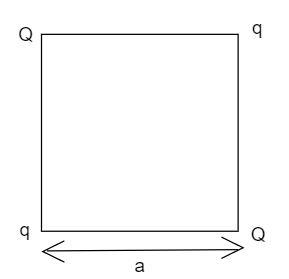
Find the:
(a) Resultant electric force on a charge $Q$ , and
(b) Potential energy of this system.
Answer
 Verified
257.4k+ views
Hint: Use the formula of the electrical force between two charges and substitute the known parameters to find the electric force on $Q$. To find the potential energy of the system, find the potential energy between the two charges and add all the potential energies.
Useful formula:
(1) The electric force on the charge is given by
$F = \dfrac{{k{q_1}{q_2}}}{{{r^2}}}$
Where $k$ is the coulomb constant, ${q_1}$ and ${q_2}$ are the charges under consideration and $r$ is the distance between the charges.
(2) The potential energy of two charges is given by
$P = \dfrac{{k{q_1}{q_2}}}{r}$
Where $P$ is the potential energy of two charges.
Complete step by step solution:
It is given that the
Distance between the charges, $r = a$
(a) To find the electric force on the charge $Q$ , the formula (1) is taken.
$F = \dfrac{{k{q_1}{q_2}}}{{{r^2}}}$
The force between the $Q$ and the $Q$ is calculated.
${F_{QQ}} = \dfrac{{k{Q^2}}}{{2{a^2}}}$
Similarly the force between the $Q$ and the other charges are calculated.
${F_{Qq}} = \sqrt 2 \dfrac{{kqQ}}{{{a^2}}}$
The resultant electric force on the charge $Q$ is the sum of the electric force provided by the other charges.
$F = {F_{QQ}} + {F_{Qq}}$
${F_{}} = \sqrt 2 \dfrac{{kqQ}}{{{a^2}}} + \dfrac{{k{Q^2}}}{{2{a^2}}}$
By simplifying the above equation,
$F = \dfrac{{2\sqrt 2 kqQ + k{Q^2}}}{{2{a^2}}}$
By taking the common terms out of the brackets,
$F = \dfrac{{kQ}}{{2{a^2}}}\left( {2\sqrt 2 q + Q} \right)$
Hence the resultant of the electric force that acts on the charge $Q$ is $\dfrac{{kQ}}{{2{a^2}}}\left( {2\sqrt 2 q + Q} \right)$ .
(b) Use the formula (2),
$P = \dfrac{{k{q_1}{q_2}}}{r}$
The total potential energy is the sum of the potential energies between all the charges.
$P = {P_{QQ}} + {P_{Oq}} + {P_{qq}}$
$P = \dfrac{{k{q_1}{q_2}}}{r} + \dfrac{{k{q_1}{q_2}}}{r} + \dfrac{{k{q_1}{q_2}}}{r}$
Substituting the known values,
$P = \dfrac{{k{Q^2}}}{{\sqrt 2 a}} + \dfrac{{4kQq}}{a} + \dfrac{{k{q^2}^{}}}{{\sqrt 2 a}}$
Hence the potential energy of the system is obtained as $\dfrac{{k{Q^2}}}{{\sqrt 2 a}} + \dfrac{{4kQq}}{a} + \dfrac{{k{q^2}^{}}}{{\sqrt 2 a}}$.
Note: The distance between two points are in the hypotenuse side of the square, then it is calculated by the formula $\sqrt {\left( {{a^2} + {b^2}} \right)} $. For example the distance between $Q$ and $Q$ or $q$ and $q$ is calculated as $\sqrt {\left( {{a^2} + {a^2}} \right)} = \sqrt {2{a^2}} = \sqrt 2 a$.
Useful formula:
(1) The electric force on the charge is given by
$F = \dfrac{{k{q_1}{q_2}}}{{{r^2}}}$
Where $k$ is the coulomb constant, ${q_1}$ and ${q_2}$ are the charges under consideration and $r$ is the distance between the charges.
(2) The potential energy of two charges is given by
$P = \dfrac{{k{q_1}{q_2}}}{r}$
Where $P$ is the potential energy of two charges.
Complete step by step solution:
It is given that the
Distance between the charges, $r = a$
(a) To find the electric force on the charge $Q$ , the formula (1) is taken.
$F = \dfrac{{k{q_1}{q_2}}}{{{r^2}}}$
The force between the $Q$ and the $Q$ is calculated.
${F_{QQ}} = \dfrac{{k{Q^2}}}{{2{a^2}}}$
Similarly the force between the $Q$ and the other charges are calculated.
${F_{Qq}} = \sqrt 2 \dfrac{{kqQ}}{{{a^2}}}$
The resultant electric force on the charge $Q$ is the sum of the electric force provided by the other charges.
$F = {F_{QQ}} + {F_{Qq}}$
${F_{}} = \sqrt 2 \dfrac{{kqQ}}{{{a^2}}} + \dfrac{{k{Q^2}}}{{2{a^2}}}$
By simplifying the above equation,
$F = \dfrac{{2\sqrt 2 kqQ + k{Q^2}}}{{2{a^2}}}$
By taking the common terms out of the brackets,
$F = \dfrac{{kQ}}{{2{a^2}}}\left( {2\sqrt 2 q + Q} \right)$
Hence the resultant of the electric force that acts on the charge $Q$ is $\dfrac{{kQ}}{{2{a^2}}}\left( {2\sqrt 2 q + Q} \right)$ .
(b) Use the formula (2),
$P = \dfrac{{k{q_1}{q_2}}}{r}$
The total potential energy is the sum of the potential energies between all the charges.
$P = {P_{QQ}} + {P_{Oq}} + {P_{qq}}$
$P = \dfrac{{k{q_1}{q_2}}}{r} + \dfrac{{k{q_1}{q_2}}}{r} + \dfrac{{k{q_1}{q_2}}}{r}$
Substituting the known values,
$P = \dfrac{{k{Q^2}}}{{\sqrt 2 a}} + \dfrac{{4kQq}}{a} + \dfrac{{k{q^2}^{}}}{{\sqrt 2 a}}$
Hence the potential energy of the system is obtained as $\dfrac{{k{Q^2}}}{{\sqrt 2 a}} + \dfrac{{4kQq}}{a} + \dfrac{{k{q^2}^{}}}{{\sqrt 2 a}}$.
Note: The distance between two points are in the hypotenuse side of the square, then it is calculated by the formula $\sqrt {\left( {{a^2} + {b^2}} \right)} $. For example the distance between $Q$ and $Q$ or $q$ and $q$ is calculated as $\sqrt {\left( {{a^2} + {a^2}} \right)} = \sqrt {2{a^2}} = \sqrt 2 a$.
Recently Updated Pages
JEE Main Mock Test 2025-26: Electromagnetic Induction & Alternating Currents

JEE Main Mock Test 2025-26: Optics Chapter Practice Online
JEE Main 2025-26 Mock Test: Properties of Solids and Liquids
JEE Main Mock Test 2025-26: Dual Nature of Matter & Radiation
JEE Main 2025-26 Electromagnetic Waves Mock Test with Solutions
JEE Main 2025-26 Mock Test: Electronic Devices Chapter Practice
Trending doubts
JEE Main 2026: Exam Dates, Session 2 Updates, City Slip, Admit Card & Latest News
JEE Main Participating Colleges 2026 - A Complete List of Top Colleges
JEE Main 2026 Application Login: Direct Link, Registration, Form Fill, and Steps
JEE Main Colleges 2026: Complete List of Participating Institutes
JEE Main Marking Scheme 2026- Paper-Wise Marks Distribution and Negative Marking Details
Hybridisation in Chemistry – Concept, Types & Applications
Other Pages
CBSE Class 12 Physics Question Paper 2026: Download SET-wise PDF with Answer Key & Analysis
JEE Advanced 2026 - Exam Date (Released), Syllabus, Registration, Eligibility, Preparation, and More
JEE Advanced Marks vs Ranks 2025: Understanding Category-wise Qualifying Marks and Previous Year Cut-offs
JEE Advanced Weightage 2025 Chapter-Wise for Physics, Maths and Chemistry
Understanding the Electric Field of a Uniformly Charged Ring
Derivation of Equation of Trajectory Explained for Students