




Fleming’s right hand rule gives:
(A) The magnitude of the induced emf
(B) The magnitude of the magnetic field
(C) The direction of the induced current
(D) Both magnitude and direction of the induced emf.
Answer
 Verified
263.7k+ views
Hint: In Fleming’s right hand rule we make use of our right hand to find the direction of the induced current. We can’t perform calculations or quantify things using just the fingers of the right hand, hence the chances of finding any magnitude using this rule is next to impossible .
Complete step by step solution:
Orsted, in his experiments, discovered that a current carrying conductor produces a magnetic field of its own and Faraday discovered that varying magnetic fields can induce emf and current .
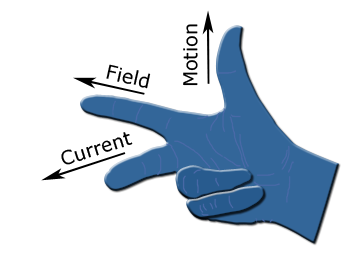
If the directions of both the quantities i.e. magnetic field and motion of the conductor is known then the direction of the third quantity which induced current can be discovered using Fleming’s right hand rule. It says that –“Hold the forefinger, thumb and second finger such that they are perpendicular to each other. If the forefinger indicates the direction of the magnetic field and the thumb shows the direction of the motion of the conductor , then the second finger will give us the direction of the induced current .
Hence, the correct option is C.
Note: We have to keep in mind this only holds true for the fingers of the right hand . If instead we used our left hand that would give us false results. This is not applicable to the left hand .
Complete step by step solution:
Orsted, in his experiments, discovered that a current carrying conductor produces a magnetic field of its own and Faraday discovered that varying magnetic fields can induce emf and current .
If the directions of both the quantities i.e. magnetic field and motion of the conductor is known then the direction of the third quantity which induced current can be discovered using Fleming’s right hand rule. It says that –“Hold the forefinger, thumb and second finger such that they are perpendicular to each other. If the forefinger indicates the direction of the magnetic field and the thumb shows the direction of the motion of the conductor , then the second finger will give us the direction of the induced current .
Hence, the correct option is C.
Note: We have to keep in mind this only holds true for the fingers of the right hand . If instead we used our left hand that would give us false results. This is not applicable to the left hand .
Recently Updated Pages
JEE Main 2025-26 Experimental Skills Mock Test – Free Practice

JEE Main 2025-26 Electronic Devices Mock Test: Free Practice Online
JEE Main 2025-26 Mock Tests: Free Practice Papers & Solutions
JEE Main 2025-26: Magnetic Effects of Current & Magnetism Mock Test
JEE Main 2025-26 Atoms and Nuclei Mock Test – Free Practice Online
JEE Main Mock Test 2025-26: Experimental Skills Chapter Online Practice
Trending doubts
JEE Main 2026: Exam Dates, Session 2 Updates, City Slip, Admit Card & Latest News
JEE Main Participating Colleges 2026 - A Complete List of Top Colleges
Kinematics Mock Test for JEE Main 2025-26: Comprehensive Practice
Kinematics Mock Test for JEE Main 2025-26: Practice & Ace the Exam
Hybridisation in Chemistry – Concept, Types & Applications
Understanding the Electric Field of a Uniformly Charged Ring
Other Pages
CBSE Class 12 Physics Question Paper 2026: Download SET-wise PDF with Answer Key & Analysis
JEE Advanced 2026 Notification Out with Exam Date, Registration (Extended), Syllabus and More
JEE Advanced Percentile vs Marks 2026: JEE Main Cutoff, AIR & IIT Admission Guide
JEE Advanced Weightage Chapter Wise 2026 for Physics, Chemistry, and Mathematics
JEE Advanced Marks vs Rank 2025 - Predict Your IIT Rank Based on Score
Derivation of Equation of Trajectory Explained for Students