




Find the electric field vector at ${{P}}\left( {{{a,a,a}}} \right)$ due to infinitely long lines of charges along ${{x,y}}$ and ${{z}}$ axes respectively. The charge density i.e. charge per unit length is ${{\lambda }}{{.}}$
Answer
 Verified
260.1k+ views
Hint:
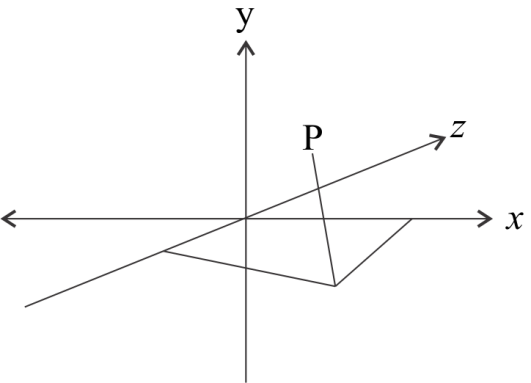
In This question, we have three line charges which will produce an electric field around them. To find the net magnitude of the electric field and its direction we will use superposition principle i.e. we first individually calculate the value of Electric field due to each line charge and then sum up to find the net Electric field.
Formula used:
The electric field due to line charge is given by (i) ${{E}}\;{{ = }}\,\dfrac{{{\lambda }}}{{{{2\pi }}{{{\varepsilon }}_{{0}}}}}{{.\hat r}}$
Where ‘E’ is electric field
$\lambda $ is linear charge density i.e. charge per unit length.
${\varepsilon _0}$ is permittivity of free space
$r$ is perpendicular distance from the line charge
$\hat r$ is unit vector in the direction of electric field.
(ii) ${{\hat r}}\;{{ = }}\;\dfrac{{{{\vec r}}}}{{\left| {{{\vec r}}} \right|}}$ where $\hat r$ is unit vector along $\vec r$, is position vector and $\left| {\vec r} \right|$ is magnitude of ${{\vec r}}{{.}}$
Complete step by step solution:
(i) Electric field due to line charge X-axis
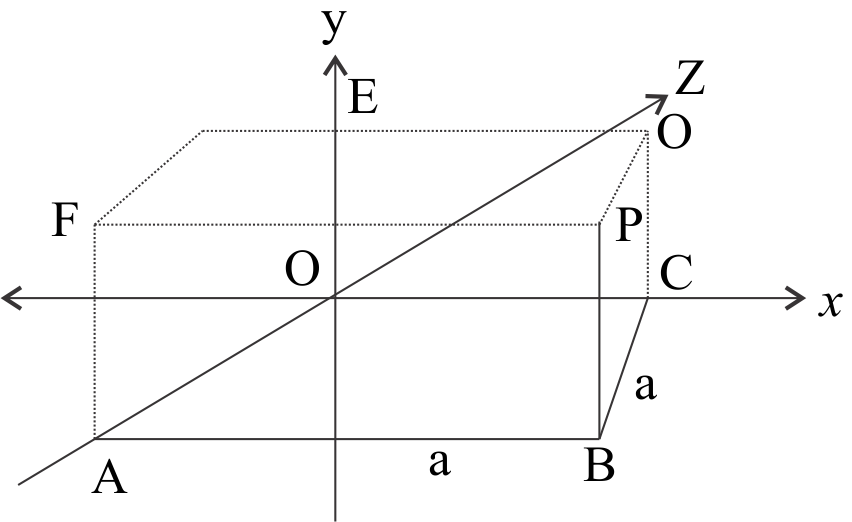
Here we have charge density of line charge is $\lambda ,$ and clear from the diagram that $CP$ is perpendicular distance of Point $P$ form line charge OX
Further from the triangle $BCP$ it is clear that, by Pythagoras theorem.
${{CP}}\;{{ = }}\;\sqrt {{{B}}{{{C}}^{{2}}}{{ + B}}{{{P}}^{{2}}}} \_\_\left( 1 \right)$
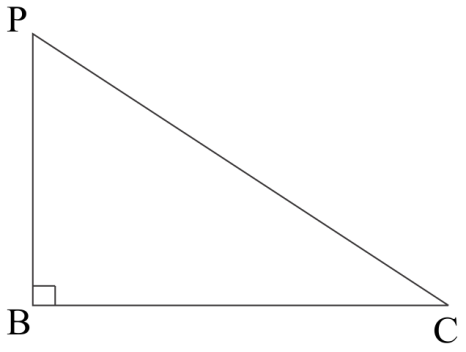
We have give BC$ = $ PB$ = $ a
So, substituting these values in $\left( 1 \right)$ we get
\[\left| {\overrightarrow {{{CP}}} } \right|\;{{ = }}\sqrt {{2}} {{a}}\;{{\_\_\_}}\left( {{2}} \right)\]
We know, the electric field at any distance which is radially outward from line can be found by relation ${{{F}}_{{x}}}{{ = }}\dfrac{{{\lambda }}}{{{{2\pi }}{{{\varepsilon }}_{{0}}}\left| {\overrightarrow {{{CP}}} } \right|}}{{.}}\widehat {{{CP}}}\;{{\_\_\_}}\left( {{3}} \right)$
Where $\widehat {{{CP}}}$ is unit vector along $\overrightarrow {{{CP}}} $
In vector form $\overrightarrow {{{CP}}} \;{{ = }}\;{{a\hat j + a\hat k}}$
So, $\widehat {{{CP}}}{{ = }}\dfrac{{\overrightarrow {{{CP}}} }}{{\left| {\overrightarrow {{{CP}}} } \right|}}{{ = }}\;\dfrac{{{{a\hat j + a\hat k}}}}{{\sqrt {{2}} {{a}}}}{{ = }}\dfrac{{{{\hat j + \hat k}}}}{{\sqrt {{2}} }}\;{{\_\_}}\left( {{4}} \right)$
Put the values from $\left( 2 \right)$ and $\left( 4 \right)$ in $\left( 3 \right)$ we get,
${{{E}}_{{x}}}{{ = }}\dfrac{{{\lambda }}}{{{{2\pi }}{{{\varepsilon }}_{{0}}}\sqrt {{2}} {{a}}}}{{.}}\dfrac{{\left( {{{\hat j + \hat k}}} \right)}}{{\sqrt {{2}} }}{{\_\_\_}}\left( {{5}} \right)$
(ii) Electric field due to line charge along Z axis in this case $\overrightarrow {{{AP}}} $ is perpendicular vector from line charge form Point ${{P}}{{.}}$ which can be obtained from triangle ${{BAP}}{{.}}$
In vector form $\overrightarrow {{{AP}}} {{ = a\hat i + a\hat j}}$ and magnitude of $\overrightarrow {{{AP}}} $ is given as,
$\left| \overrightarrow{{AP}} \right|\ {=}\ \sqrt{{A}{{{B}}^{{2}}}{+B}{{{P}}^{{2}}}}$
$\left| \overrightarrow{{AP}} \right|\ {=}\ \sqrt{{2}}{.a}\ { }\!\!\_\!\!{ }\!\!\_\!\!{ }\!\!\_\!\!{ }\left( {6} \right)$
If $\widehat {{{AP}}}$ is unit vector along $\overrightarrow {{{AP}}\;} $ then,
$\widehat {{{AP}}}\;{{ = }}\;\dfrac{{\overrightarrow {{{AP}}} }}{{\left| {\overrightarrow {{{AP}}} } \right|}}\;{{ = }}\;\dfrac{{{{a\hat i + a\hat j}}}}{{\sqrt {{2}} {{a}}}}\;{{ = }}\;\dfrac{{{{\hat i + \hat j}}}}{{\sqrt {{2}} }}\;{{\_\_\_}}\left( {{7}} \right)$
If ${{{E}}_{{z}}}$ represents electric field due to line charge along ${{y}}$ axis then,
\[{{{E}}_{{y}}}{{ = }}\;\dfrac{{{\lambda }}}{{{{2\pi }}{{{\varepsilon }}_{{0}}}\left| {\overrightarrow {{{AP}}} } \right|}}{{.}}\;\widehat {{{AP}}}\;{{\_\_\_}}\left( {{8}} \right)\]
From equation $\left( 6 \right),\left( 7 \right)$ and $\left( 8 \right)$, we get ,
${{{E}}_{{z}}}{{ = }}\,\dfrac{{{\lambda }}}{{{{2\pi }}{{{\varepsilon }}_{{0}}}\sqrt {{2}} {{.a}}}}\;\dfrac{{\left( {{{\hat i + \hat j}}} \right)}}{{\sqrt {{2}} }}\;{{\_\_\_}}\left( {{9}} \right)$
(iii) electric field due to line charge along y-axis in this case $\overrightarrow {{{EP}}} $ is perpendicular vector from line charge to point ${{P,}}$ which can be obtained from triangle ${{FEP}}$
In vector form, $\overrightarrow {{{EP}}} \;{{ = }}\;{{a\hat i + a\hat j}}$
In magnitude form,
\[\left| \overrightarrow{{EP}} \right|\ {=}\ \sqrt{{F}{{{P}}^{{2}}}{+E}{{{P}}^{{2}}}}\]
\[\left| \overrightarrow{{EP}} \right|\ {=}\ \sqrt{{2}}{.a}\ { }\!\!\_\!\!{ }\!\!\_\!\!{ }\!\!\_\!\!{ }\!\!\_\!\!{ }\left( {10} \right)\]
Also unit vector along $\overrightarrow {{{EP}}} $ can be calculated as,
$\widehat {{{EP}}}\;{{ = }}\;\dfrac{{\overrightarrow {{{EP}}} }}{{\left| {\overrightarrow {{{EP}}} } \right|}}\;{{ = }}\;\dfrac{{{{a\hat i + a\hat j}}}}{{\sqrt {{2}} {{.a}}}}\;{{ = }}\;\dfrac{{\left( {{{\hat i + \hat j}}} \right)}}{{\sqrt {{2}} }}\;{{\_\_}}\left( {{{11}}} \right)$
So, if $\overrightarrow {{{{E}}_{{y}}}} $ gives the electric field due to line charge along ${{y}}$ axis then it is evaluated as,
${\overrightarrow {{E}} _{{y}}}\;{{ = }}\;\dfrac{{{\lambda }}}{{{{2\pi }}{{{\varepsilon }}_{{0}}}\left| {\overrightarrow {{{EP}}} } \right|}}{{.}}\;\widehat {{{EP}}}\;{{\_\_}}\left( {{{12}}} \right)$
By equations $\left( {10} \right),\left( {11} \right)$ and $\left( {12} \right)$
${\overrightarrow {{E}} _{{y}}}\;{{ = }}\;\dfrac{{{\lambda }}}{{{{2\pi }}{{{\varepsilon }}_{{0}}}\sqrt {{2}} {{a}}}}\;\dfrac{{\left( {{{\hat i + \hat j}}} \right)}}{{\sqrt {{2}} }}\;{{\_\_\_\_}}\left( {{{13}}} \right)$
After adding equation $\left( 5 \right),\left( 9 \right)$ and $\left( {13} \right)$ to find net field at point ${{P}}$ we get,
$\overrightarrow {{E}} \;{{ = }}\;\dfrac{{{\lambda }}}{{{{2\pi }}{{{\varepsilon }}_{{0}}}\sqrt {{2}} {{.a}}}}\;\dfrac{{\left( {{{\hat i + \hat j + \hat i + \hat k + \hat j + \hat k}}} \right)}}{{\sqrt {{2}} }}$
${{E}}\;{{ = }}\;\dfrac{{{\lambda }}}{{{{2\pi }}{{{\varepsilon }}_{{0}}}{{.a}}}}\;\left( {{{\hat i + \hat j + \hat k}}} \right)$
Note: To calculate electric field at any point due to line charge, always use perpendicular distance line charge to the given point.
For any no. of line charges the net field can be calculated by using superposition principle.
In This question, we have three line charges which will produce an electric field around them. To find the net magnitude of the electric field and its direction we will use superposition principle i.e. we first individually calculate the value of Electric field due to each line charge and then sum up to find the net Electric field.
Formula used:
The electric field due to line charge is given by (i) ${{E}}\;{{ = }}\,\dfrac{{{\lambda }}}{{{{2\pi }}{{{\varepsilon }}_{{0}}}}}{{.\hat r}}$
Where ‘E’ is electric field
$\lambda $ is linear charge density i.e. charge per unit length.
${\varepsilon _0}$ is permittivity of free space
$r$ is perpendicular distance from the line charge
$\hat r$ is unit vector in the direction of electric field.
(ii) ${{\hat r}}\;{{ = }}\;\dfrac{{{{\vec r}}}}{{\left| {{{\vec r}}} \right|}}$ where $\hat r$ is unit vector along $\vec r$, is position vector and $\left| {\vec r} \right|$ is magnitude of ${{\vec r}}{{.}}$
Complete step by step solution:
(i) Electric field due to line charge X-axis
Here we have charge density of line charge is $\lambda ,$ and clear from the diagram that $CP$ is perpendicular distance of Point $P$ form line charge OX
Further from the triangle $BCP$ it is clear that, by Pythagoras theorem.
${{CP}}\;{{ = }}\;\sqrt {{{B}}{{{C}}^{{2}}}{{ + B}}{{{P}}^{{2}}}} \_\_\left( 1 \right)$
We have give BC$ = $ PB$ = $ a
So, substituting these values in $\left( 1 \right)$ we get
\[\left| {\overrightarrow {{{CP}}} } \right|\;{{ = }}\sqrt {{2}} {{a}}\;{{\_\_\_}}\left( {{2}} \right)\]
We know, the electric field at any distance which is radially outward from line can be found by relation ${{{F}}_{{x}}}{{ = }}\dfrac{{{\lambda }}}{{{{2\pi }}{{{\varepsilon }}_{{0}}}\left| {\overrightarrow {{{CP}}} } \right|}}{{.}}\widehat {{{CP}}}\;{{\_\_\_}}\left( {{3}} \right)$
Where $\widehat {{{CP}}}$ is unit vector along $\overrightarrow {{{CP}}} $
In vector form $\overrightarrow {{{CP}}} \;{{ = }}\;{{a\hat j + a\hat k}}$
So, $\widehat {{{CP}}}{{ = }}\dfrac{{\overrightarrow {{{CP}}} }}{{\left| {\overrightarrow {{{CP}}} } \right|}}{{ = }}\;\dfrac{{{{a\hat j + a\hat k}}}}{{\sqrt {{2}} {{a}}}}{{ = }}\dfrac{{{{\hat j + \hat k}}}}{{\sqrt {{2}} }}\;{{\_\_}}\left( {{4}} \right)$
Put the values from $\left( 2 \right)$ and $\left( 4 \right)$ in $\left( 3 \right)$ we get,
${{{E}}_{{x}}}{{ = }}\dfrac{{{\lambda }}}{{{{2\pi }}{{{\varepsilon }}_{{0}}}\sqrt {{2}} {{a}}}}{{.}}\dfrac{{\left( {{{\hat j + \hat k}}} \right)}}{{\sqrt {{2}} }}{{\_\_\_}}\left( {{5}} \right)$
(ii) Electric field due to line charge along Z axis in this case $\overrightarrow {{{AP}}} $ is perpendicular vector from line charge form Point ${{P}}{{.}}$ which can be obtained from triangle ${{BAP}}{{.}}$
In vector form $\overrightarrow {{{AP}}} {{ = a\hat i + a\hat j}}$ and magnitude of $\overrightarrow {{{AP}}} $ is given as,
$\left| \overrightarrow{{AP}} \right|\ {=}\ \sqrt{{A}{{{B}}^{{2}}}{+B}{{{P}}^{{2}}}}$
$\left| \overrightarrow{{AP}} \right|\ {=}\ \sqrt{{2}}{.a}\ { }\!\!\_\!\!{ }\!\!\_\!\!{ }\!\!\_\!\!{ }\left( {6} \right)$
If $\widehat {{{AP}}}$ is unit vector along $\overrightarrow {{{AP}}\;} $ then,
$\widehat {{{AP}}}\;{{ = }}\;\dfrac{{\overrightarrow {{{AP}}} }}{{\left| {\overrightarrow {{{AP}}} } \right|}}\;{{ = }}\;\dfrac{{{{a\hat i + a\hat j}}}}{{\sqrt {{2}} {{a}}}}\;{{ = }}\;\dfrac{{{{\hat i + \hat j}}}}{{\sqrt {{2}} }}\;{{\_\_\_}}\left( {{7}} \right)$
If ${{{E}}_{{z}}}$ represents electric field due to line charge along ${{y}}$ axis then,
\[{{{E}}_{{y}}}{{ = }}\;\dfrac{{{\lambda }}}{{{{2\pi }}{{{\varepsilon }}_{{0}}}\left| {\overrightarrow {{{AP}}} } \right|}}{{.}}\;\widehat {{{AP}}}\;{{\_\_\_}}\left( {{8}} \right)\]
From equation $\left( 6 \right),\left( 7 \right)$ and $\left( 8 \right)$, we get ,
${{{E}}_{{z}}}{{ = }}\,\dfrac{{{\lambda }}}{{{{2\pi }}{{{\varepsilon }}_{{0}}}\sqrt {{2}} {{.a}}}}\;\dfrac{{\left( {{{\hat i + \hat j}}} \right)}}{{\sqrt {{2}} }}\;{{\_\_\_}}\left( {{9}} \right)$
(iii) electric field due to line charge along y-axis in this case $\overrightarrow {{{EP}}} $ is perpendicular vector from line charge to point ${{P,}}$ which can be obtained from triangle ${{FEP}}$
In vector form, $\overrightarrow {{{EP}}} \;{{ = }}\;{{a\hat i + a\hat j}}$
In magnitude form,
\[\left| \overrightarrow{{EP}} \right|\ {=}\ \sqrt{{F}{{{P}}^{{2}}}{+E}{{{P}}^{{2}}}}\]
\[\left| \overrightarrow{{EP}} \right|\ {=}\ \sqrt{{2}}{.a}\ { }\!\!\_\!\!{ }\!\!\_\!\!{ }\!\!\_\!\!{ }\!\!\_\!\!{ }\left( {10} \right)\]
Also unit vector along $\overrightarrow {{{EP}}} $ can be calculated as,
$\widehat {{{EP}}}\;{{ = }}\;\dfrac{{\overrightarrow {{{EP}}} }}{{\left| {\overrightarrow {{{EP}}} } \right|}}\;{{ = }}\;\dfrac{{{{a\hat i + a\hat j}}}}{{\sqrt {{2}} {{.a}}}}\;{{ = }}\;\dfrac{{\left( {{{\hat i + \hat j}}} \right)}}{{\sqrt {{2}} }}\;{{\_\_}}\left( {{{11}}} \right)$
So, if $\overrightarrow {{{{E}}_{{y}}}} $ gives the electric field due to line charge along ${{y}}$ axis then it is evaluated as,
${\overrightarrow {{E}} _{{y}}}\;{{ = }}\;\dfrac{{{\lambda }}}{{{{2\pi }}{{{\varepsilon }}_{{0}}}\left| {\overrightarrow {{{EP}}} } \right|}}{{.}}\;\widehat {{{EP}}}\;{{\_\_}}\left( {{{12}}} \right)$
By equations $\left( {10} \right),\left( {11} \right)$ and $\left( {12} \right)$
${\overrightarrow {{E}} _{{y}}}\;{{ = }}\;\dfrac{{{\lambda }}}{{{{2\pi }}{{{\varepsilon }}_{{0}}}\sqrt {{2}} {{a}}}}\;\dfrac{{\left( {{{\hat i + \hat j}}} \right)}}{{\sqrt {{2}} }}\;{{\_\_\_\_}}\left( {{{13}}} \right)$
After adding equation $\left( 5 \right),\left( 9 \right)$ and $\left( {13} \right)$ to find net field at point ${{P}}$ we get,
$\overrightarrow {{E}} \;{{ = }}\;\dfrac{{{\lambda }}}{{{{2\pi }}{{{\varepsilon }}_{{0}}}\sqrt {{2}} {{.a}}}}\;\dfrac{{\left( {{{\hat i + \hat j + \hat i + \hat k + \hat j + \hat k}}} \right)}}{{\sqrt {{2}} }}$
${{E}}\;{{ = }}\;\dfrac{{{\lambda }}}{{{{2\pi }}{{{\varepsilon }}_{{0}}}{{.a}}}}\;\left( {{{\hat i + \hat j + \hat k}}} \right)$
Note: To calculate electric field at any point due to line charge, always use perpendicular distance line charge to the given point.
For any no. of line charges the net field can be calculated by using superposition principle.
Recently Updated Pages
JEE Main Mock Test 2025-26: Electromagnetic Induction & Alternating Currents

JEE Main Mock Test 2025-26: Optics Chapter Practice Online
JEE Main 2025-26 Mock Test: Properties of Solids and Liquids
JEE Main Mock Test 2025-26: Dual Nature of Matter & Radiation
JEE Main 2025-26 Electromagnetic Waves Mock Test with Solutions
JEE Main 2025-26 Mock Test: Electronic Devices Chapter Practice
Trending doubts
JEE Main 2026: Exam Dates, Session 2 Updates, City Slip, Admit Card & Latest News
JEE Main Participating Colleges 2026 - A Complete List of Top Colleges
Hybridisation in Chemistry – Concept, Types & Applications
Understanding the Electric Field of a Uniformly Charged Ring
Derivation of Equation of Trajectory Explained for Students
Understanding Atomic Structure for Beginners
Other Pages
CBSE Class 12 Physics Question Paper 2026: Download SET-wise PDF with Answer Key & Analysis
JEE Advanced 2026 Notification Out with Exam Date, Registration (Extended), Syllabus and More
JEE Advanced Marks vs Ranks 2025: Understanding Category-wise Qualifying Marks and Previous Year Cut-offs
JEE Advanced Weightage Chapter Wise 2026 for Physics, Chemistry, and Mathematics
How to Convert a Galvanometer into an Ammeter or Voltmeter
Electron Gain Enthalpy and Electron Affinity Explained