




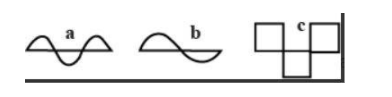
Figure shows wave patterns of three sounds $a$, $b$ and $c$. Name the characteristic of sound which is the same between $a$ and $b$.
Answer
 Verified
242.7k+ views
Hint: A permanent wave pattern is the oscillating pattern produced within a medium when the oscillating frequency of the origin causes contemplated waves from one end of the medium to obstruct with incident waves from the source. Such patterns are only created within the medium at specific frequencies of oscillation.
Complete step by step solution
The characteristic of sound that is common between the figures $a$ and $b$ are loudness and quality. The frequency of the wave between the wave patterns of sounds $a$ and $b$ is different.
Loudness:
The loudness of a sound wave is based on its relationship with the amplitude, all types of waves have a definite amplitude. That is for example, a height of a wave on a silent ocean will be less than $1$ foot meanwhile a good surfing wave might be $10$ feet or more in amplitude. During the time of the storm, the amplitude might increase from $40$ to $50$ feet.
Pitch:
The pitch of a sound relies on the frequency while loudness of a sound depends on the amplitude of sound waves. Overwhelmingly, many musicians, who have been educated, are experienced in detecting a difference in frequency between two separate sounds that are as small as $2\,\,Hz$.
The amplitude in both the waves are the same and hence, the loudness will remain the same as amplitude is directly proportional to the loudness of the note. The waveform or pattern of the two waves is the same and hence, they would be of the same quality.
Note: Loudness is liberated from the conversion in frequency, whereas in case of pitch, it is subjected on to the change in the frequency. As the frequency increases, the high pitch of the waves of the sound wave increases.
Complete step by step solution
The characteristic of sound that is common between the figures $a$ and $b$ are loudness and quality. The frequency of the wave between the wave patterns of sounds $a$ and $b$ is different.
Loudness:
The loudness of a sound wave is based on its relationship with the amplitude, all types of waves have a definite amplitude. That is for example, a height of a wave on a silent ocean will be less than $1$ foot meanwhile a good surfing wave might be $10$ feet or more in amplitude. During the time of the storm, the amplitude might increase from $40$ to $50$ feet.
Pitch:
The pitch of a sound relies on the frequency while loudness of a sound depends on the amplitude of sound waves. Overwhelmingly, many musicians, who have been educated, are experienced in detecting a difference in frequency between two separate sounds that are as small as $2\,\,Hz$.
The amplitude in both the waves are the same and hence, the loudness will remain the same as amplitude is directly proportional to the loudness of the note. The waveform or pattern of the two waves is the same and hence, they would be of the same quality.
Note: Loudness is liberated from the conversion in frequency, whereas in case of pitch, it is subjected on to the change in the frequency. As the frequency increases, the high pitch of the waves of the sound wave increases.
Recently Updated Pages
WBJEE 2026 Registration Started: Important Dates Eligibility Syllabus Exam Pattern

Dimensions of Charge: Dimensional Formula, Derivation, SI Units & Examples
How to Calculate Moment of Inertia: Step-by-Step Guide & Formulas
Circuit Switching vs Packet Switching: Key Differences Explained
Dimensions of Pressure in Physics: Formula, Derivation & SI Unit
JEE Extractive Metallurgy Important Concepts and Tips for Exam Preparation
Trending doubts
JEE Main 2026: Session 1 Results Out and Session 2 Registration Open, City Intimation Slip, Exam Dates, Syllabus & Eligibility
Ideal and Non-Ideal Solutions Explained for Class 12 Chemistry
JEE Main Participating Colleges 2026 - A Complete List of Top Colleges
Understanding the Angle of Deviation in a Prism
Understanding Differential Equations: A Complete Guide
Hybridisation in Chemistry – Concept, Types & Applications
Other Pages
JEE Advanced Marks vs Ranks 2025: Understanding Category-wise Qualifying Marks and Previous Year Cut-offs
JEE Advanced 2026 - Exam Date (Released), Syllabus, Registration, Eligibility, Preparation, and More
Important Questions For Class 11 Physics Chapter 1 Units and Measurement - 2025-26
CBSE Notes Class 11 Physics Chapter 1 - Units And Measurements - 2025-26
CBSE Notes Class 11 Physics Chapter 4 - Laws of Motion - 2025-26
CBSE Notes Class 11 Physics Chapter 14 - Waves - 2025-26