




Electromagnetic radiation with maximum wavelength is:
(A) Ultraviolet
(B) Radiowave
(C) X-ray
(D) Infrared
Answer
 Verified
310.8k+ views
Hint: It is the electromagnetic radiation which is used in communication technologies such as mobile phones, Wi-Fi, television, radio and so on. Heinrich Hertz discovered this type of waves. It is used to separate electrons from atoms and molecules, chemical changes in DNA and even in cooking food at home.
Complete step by step answer:
- Clark Maxwell first told that the radio waves existed. Heinrich Hertz demonstrated this wave in the lab.
- Like other electromagnetic radiations, they also travel at the speed of the light in the vacuum.
- They are formed by the electric charges under acceleration. These electric charges flow in a special metal conductor called antenna, then transmitted through a transmitter and finally received by the radio receiver. Radio waves occurring naturally are by lightning and astronomical objects.
- Electromagnetic radiation with maximum wavelength is the radio wave.
- The frequency ranges between 300 gigahertz (GHz) to 30 hertz (Hz).
- The representation of various types of electromagnetic radiation and its relation with energy and wavelength is shown in the following figure.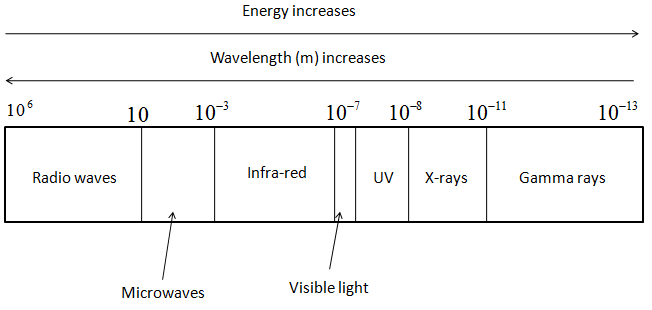
- Thus, from the figure, we can say that Radio waves will have least energy and will have the highest wavelength amongst them all.
-Nowadays, it is used as broadcasting radar, communication satellite, computer network, wireless devices such as earphones, computers and so on.
-Wi-Fi uses radio waves through wireless internet routers popularly known as LAN. It uses frequencies between 2.4 to 5.8 GHz.
So, the correct option is (B) Radiowave.
Note:
The wavelength of a wave is inversely proportional to the energy of the wave. Thus, we can say that as the wavelength of a wave increases, its energy decreases and as its wavelength decreases, its energy increases.
Complete step by step answer:
- Clark Maxwell first told that the radio waves existed. Heinrich Hertz demonstrated this wave in the lab.
- Like other electromagnetic radiations, they also travel at the speed of the light in the vacuum.
- They are formed by the electric charges under acceleration. These electric charges flow in a special metal conductor called antenna, then transmitted through a transmitter and finally received by the radio receiver. Radio waves occurring naturally are by lightning and astronomical objects.
- Electromagnetic radiation with maximum wavelength is the radio wave.
- The frequency ranges between 300 gigahertz (GHz) to 30 hertz (Hz).
- The representation of various types of electromagnetic radiation and its relation with energy and wavelength is shown in the following figure.
- Thus, from the figure, we can say that Radio waves will have least energy and will have the highest wavelength amongst them all.
-Nowadays, it is used as broadcasting radar, communication satellite, computer network, wireless devices such as earphones, computers and so on.
-Wi-Fi uses radio waves through wireless internet routers popularly known as LAN. It uses frequencies between 2.4 to 5.8 GHz.
So, the correct option is (B) Radiowave.
Note:
The wavelength of a wave is inversely proportional to the energy of the wave. Thus, we can say that as the wavelength of a wave increases, its energy decreases and as its wavelength decreases, its energy increases.
Recently Updated Pages
JEE Main 2023 (February 1st Shift 2) Physics Question Paper with Answer Key

JEE Main 2023 (February 1st Shift 1) Physics Question Paper with Answer Key
JEE Main 2023 (February 1st Shift 1) Maths Question Paper with Answer Key
Apparent Frequency Explained: Formula, Uses & Examples
JEE Main 2023 (February 1st Shift 2) Chemistry Question Paper with Answer Key
Hydrogen and Its Type Important Concepts and Tips for JEE Exam Preparation
Trending doubts
JEE Main 2026: Exam Dates, Session 2 Updates, City Slip, Admit Card & Latest News
Understanding the Electric Field of a Uniformly Charged Ring
Derivation of Equation of Trajectory Explained for Students
Hybridisation in Chemistry – Concept, Types & Applications
Understanding Electromagnetic Waves and Their Importance
How to Convert a Galvanometer into an Ammeter or Voltmeter
Other Pages
CBSE Notes Class 11 Chemistry Chapter 5 - Thermodynamics - 2026-27 PDF Download (Login Required)
NCERT Solutions For Class 11 Chemistry Chapter 5 Thermodynamics - 2026-27 Free PDF Download (Sign-in Required)
NCERT Solutions For Class 11 Chemistry Chapter 7 Redox Reaction - 2026-27 Free PDF Download (Login Required)
JEE Advanced Percentile vs Marks 2026: JEE Main Cutoff, AIR & IIT Admission Guide
JEE Advanced Weightage Chapter Wise 2026 for Physics, Chemistry, and Mathematics
NCERT Solutions For Class 11 Chemistry Chapter 8 Organic Chemistry - Some Basic Principles And Techniques - 2026-27 Free PDF Download (Sign-in Required)
CBSE Notes Class 11 Chemistry Chapter 5 - Thermodynamics - 2026-27 PDF Download (Login Required)
NCERT Solutions For Class 11 Chemistry Chapter 5 Thermodynamics - 2026-27 Free PDF Download (Sign-in Required)
NCERT Solutions For Class 11 Chemistry Chapter 7 Redox Reaction - 2026-27 Free PDF Download (Login Required)