




Draw the circuit diagram of the NPN transistor in a common emitter configuration. Hence describe the working method to obtain the output characteristic curve.
Answer
 Verified
258.3k+ views
Hint: A junction transistor is a semiconductor device that can amplify electrical signals and produce electrical oscillations. There are two types of transistors. One is called a PNP transistor and the other is called an NPN transistor. In an NPN transistor, a thin layer of p-type semiconductor is sandwiched between two n-type semiconductors.
Complete step by step solution:
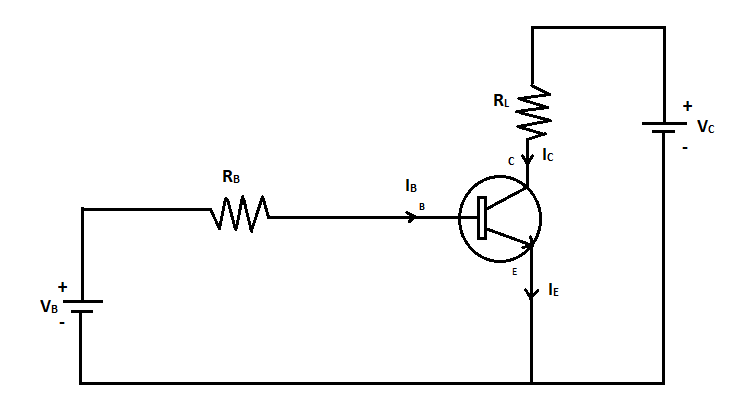
The circuit diagram of NPN transistor in common emitter configuration is given below
Working:
Here the base and the collector are connected to the positive terminals of the cell and the emitter is connected to the negative terminal of the cell. The electrons from the emitter flow towards the base resulting in an emitter current ${I_E}$. As the base is lightly doped and very thin, a few electrons combine with holes at the base. For every hole neutralized, an electron enters the positive terminal of the battery. This constitutes the base current ${I_B}$. The balanced electrons cross the base region and reach the collector region. These electrons move to the positive of the battery ${V_C}$. This constitutes the collector current ${I_C}$. Thus the emitter current is the sum of collector current and base current.
${I_E} = {I_B} + {I_C}$
As the collector current depends on the base current, the transistor action can be controlled by controlling the base current . The base current is of the order of microamperes whereas the collector current is of the order of milliamperes. The emitter current and the collector current are almost equal as the base current is very small.
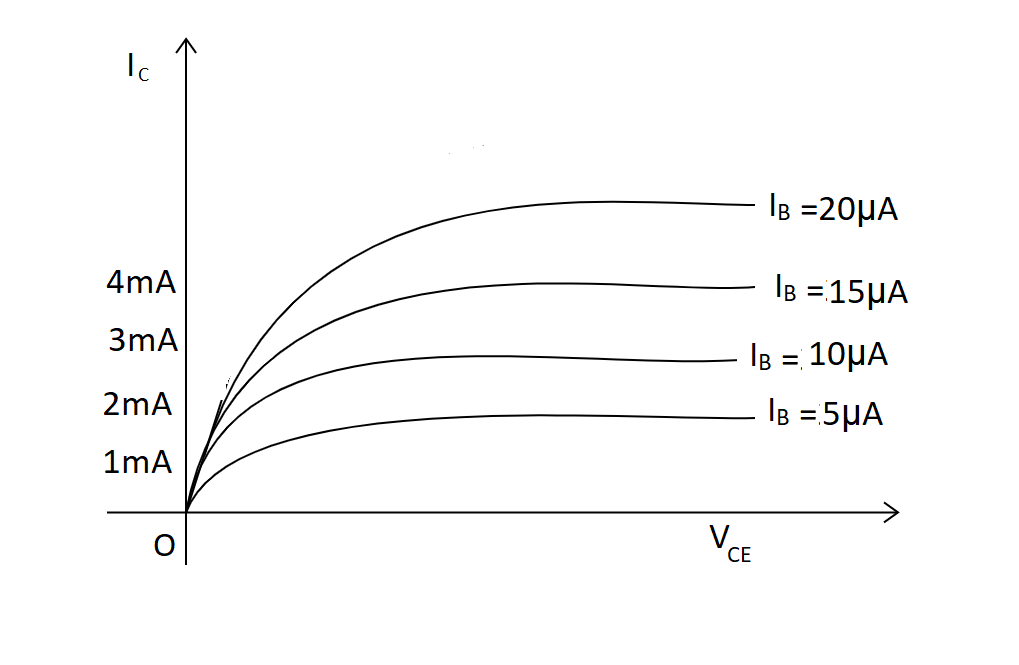
A graph is plotted with collector current ${I_C}$ along Y-axis and collector emitter voltage ${V_{CE}}$ along X-axis keeping ${I_B}$ constant. The procedure is repeated for different values of ${I_B}$. A family of output characteristic curves is obtained as shown.
Note:
As the collector-base region is reverse biased, its resistance is very high compared to the emitter-base region. Hence a greater amount of power is developed at the base collector region than that at the base emitter region. This produces an amplifying action for voltage or power.
Complete step by step solution:
The circuit diagram of NPN transistor in common emitter configuration is given below
Working:
Here the base and the collector are connected to the positive terminals of the cell and the emitter is connected to the negative terminal of the cell. The electrons from the emitter flow towards the base resulting in an emitter current ${I_E}$. As the base is lightly doped and very thin, a few electrons combine with holes at the base. For every hole neutralized, an electron enters the positive terminal of the battery. This constitutes the base current ${I_B}$. The balanced electrons cross the base region and reach the collector region. These electrons move to the positive of the battery ${V_C}$. This constitutes the collector current ${I_C}$. Thus the emitter current is the sum of collector current and base current.
${I_E} = {I_B} + {I_C}$
As the collector current depends on the base current, the transistor action can be controlled by controlling the base current . The base current is of the order of microamperes whereas the collector current is of the order of milliamperes. The emitter current and the collector current are almost equal as the base current is very small.
A graph is plotted with collector current ${I_C}$ along Y-axis and collector emitter voltage ${V_{CE}}$ along X-axis keeping ${I_B}$ constant. The procedure is repeated for different values of ${I_B}$. A family of output characteristic curves is obtained as shown.
Note:
As the collector-base region is reverse biased, its resistance is very high compared to the emitter-base region. Hence a greater amount of power is developed at the base collector region than that at the base emitter region. This produces an amplifying action for voltage or power.
Recently Updated Pages
JEE Main Mock Test 2025-26: Electromagnetic Induction & Alternating Currents

JEE Main Mock Test 2025-26: Optics Chapter Practice Online
JEE Main 2025-26 Mock Test: Properties of Solids and Liquids
JEE Main Mock Test 2025-26: Dual Nature of Matter & Radiation
JEE Main 2025-26 Electromagnetic Waves Mock Test with Solutions
JEE Main 2025-26 Mock Test: Electronic Devices Chapter Practice
Trending doubts
JEE Main 2026: Exam Dates, Session 2 Updates, City Slip, Admit Card & Latest News
JEE Main Participating Colleges 2026 - A Complete List of Top Colleges
JEE Main Marking Scheme 2026- Paper-Wise Marks Distribution and Negative Marking Details
Hybridisation in Chemistry – Concept, Types & Applications
Understanding the Electric Field of a Uniformly Charged Ring
Derivation of Equation of Trajectory Explained for Students
Other Pages
CBSE Class 12 Physics Question Paper 2026: Download SET-wise PDF with Answer Key & Analysis
JEE Advanced 2026 - Exam Date (Released), Syllabus, Registration, Eligibility, Preparation, and More
JEE Advanced Marks vs Ranks 2025: Understanding Category-wise Qualifying Marks and Previous Year Cut-offs
JEE Advanced Weightage 2025 Chapter-Wise for Physics, Maths and Chemistry
Understanding Atomic Structure for Beginners
Understanding Electromagnetic Waves and Their Importance