




How does phenol react with conc. Nitric acid? Give an equation.
Answer
 Verified
270.9k+ views
Hint: The reaction taking place between phenol and concentrated nitric acid is a nitration reaction. Nitration is a chemical reaction where the replacement of a Hydrogen atom present in a chemical compound is done with a nitro group.
Complete Step by Step Solution:
Phenol is an aromatic hydrocarbon where a hydroxyl group is present in a benzene ring. The molecular formula of phenol is \[{C_6}{H_5}OH\]. Phenol is a white crystalline solid which is volatile in nature.
Nitric acid is a strong acid having a molecular formula \[HN{O_3}\].
The nitration reaction is a type of electrophilic aromatic substitution where a hydrogen atom present in an aromatic hydrocarbon is displaced by an electrophile.
In the reaction between phenol and conc. Nitric acid, the nitro group is the electrophile.
In phenol, the hydroxyl group ease the delocalisation of the charge present in the aromatic compound.
When phenol reacts with concentrated nitric acid, 2, 4, 6-trinitrophenol is formed as the main product.
2, 4, 6-trinitrophenol is commonly known as Picric acid.
The reaction taking place between phenol and nitric acid is shown below.
Image: Nitration of phenol
Therefore, the product formed on the reaction of phenol and nitric acid is 2, 4, 6-trinitrophenol.
Note: When phenol is reacted with a dilute nitric acid solution at a temperature of 298K, it give a mixture of ortho and para derivative of nitrophenol as a main product. This mixture can be further separated by the distillation process due to their difference in boiling point. The ortho derivative is less volatile as compared to the para derivative due to hydrogen bonding.
The reaction is shown below.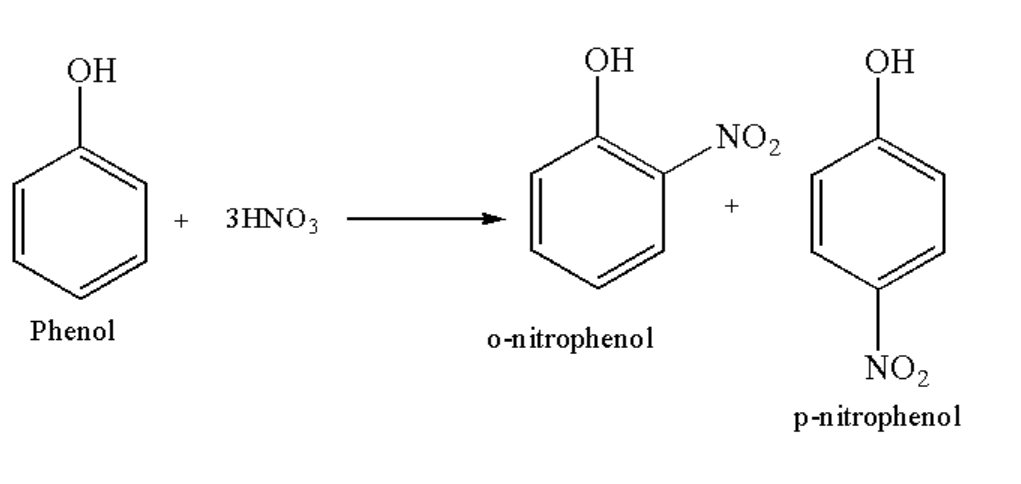
Image: Nitration of phenol
Complete Step by Step Solution:
Phenol is an aromatic hydrocarbon where a hydroxyl group is present in a benzene ring. The molecular formula of phenol is \[{C_6}{H_5}OH\]. Phenol is a white crystalline solid which is volatile in nature.
Nitric acid is a strong acid having a molecular formula \[HN{O_3}\].
The nitration reaction is a type of electrophilic aromatic substitution where a hydrogen atom present in an aromatic hydrocarbon is displaced by an electrophile.
In the reaction between phenol and conc. Nitric acid, the nitro group is the electrophile.
In phenol, the hydroxyl group ease the delocalisation of the charge present in the aromatic compound.
When phenol reacts with concentrated nitric acid, 2, 4, 6-trinitrophenol is formed as the main product.
2, 4, 6-trinitrophenol is commonly known as Picric acid.
The reaction taking place between phenol and nitric acid is shown below.
Image: Nitration of phenol
Therefore, the product formed on the reaction of phenol and nitric acid is 2, 4, 6-trinitrophenol.
Note: When phenol is reacted with a dilute nitric acid solution at a temperature of 298K, it give a mixture of ortho and para derivative of nitrophenol as a main product. This mixture can be further separated by the distillation process due to their difference in boiling point. The ortho derivative is less volatile as compared to the para derivative due to hydrogen bonding.
The reaction is shown below.
Image: Nitration of phenol
Recently Updated Pages
Disproportionation Reaction: Definition, Example & JEE Guide

Hess Law of Constant Heat Summation: Definition, Formula & Applications
JEE General Topics in Chemistry Important Concepts and Tips
JEE Extractive Metallurgy Important Concepts and Tips for Exam Preparation
JEE Atomic Structure and Chemical Bonding important Concepts and Tips
JEE Amino Acids and Peptides Important Concepts and Tips for Exam Preparation
Trending doubts
JEE Main 2026: Exam Dates, Session 2 Updates, City Slip, Admit Card & Latest News
JEE Main Participating Colleges 2026 - A Complete List of Top Colleges
Understanding the Electric Field of a Uniformly Charged Ring
Understanding Atomic Structure for Beginners
Derivation of Equation of Trajectory Explained for Students
Understanding the Different Types of Solutions in Chemistry
Other Pages
JEE Advanced 2026 Notification Out with Exam Date, Registration (Extended), Syllabus and More
JEE Advanced Percentile vs Marks 2026: JEE Main Cutoff, AIR & IIT Admission Guide
JEE Advanced Weightage Chapter Wise 2026 for Physics, Chemistry, and Mathematics
JEE Main Marking Scheme 2026- Paper-Wise Marks Distribution and Negative Marking Details
NCERT Solutions For Class 11 Chemistry In Hindi Chapter 1 Some Basic Concepts Of Chemistry - 2025-26
How to Convert a Galvanometer into an Ammeter or Voltmeter