




What is the direction of angular velocity for the second hand of a clock going from 0 to 30 seconds?
(A) Outward from the clock face
(B) Inward towards the clock face
(C) Upward
(D) Downward
(E) To the right
Answer
 Verified
263.7k+ views
Hint:Since angular velocity is in rotational motion and a vector quantity the right hand rule tells its direction. Curl the fingers in the direction of rotation along the axis and the thumb indicates the direction of angular velocity
Complete step by step answer:
Angular velocity is a vector quantity having both magnitude and direction.
To find out the direction of angular velocity we need to use the right-hand rule. The direction of angular velocity is always perpendicular to the plane of rotation. According to this right-hand rule, the fingers curl in the direction of rotation and the thumb pointing is the direction of the angular velocity.
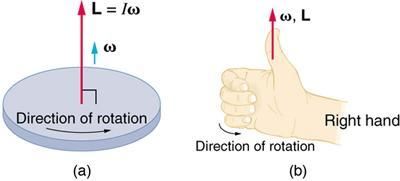
In this case the fingers are pointing at zero seconds and curl the fingers as it changes to 30 seconds along the axis of rotation now the thumb is pointing towards the clock which is the direction of angular velocity.
Hence, the direction of angular velocity is inwards towards the clock face and the correct option is B.
Note This right-hand rule is basically used to define the direction of the cross product of 2 vectors. It points in the direction which is perpendicular to both of these vectors. In this case angular velocity is defined as the cross product of the radius of the circle with the linear velocity of the particle. Its direction is also pointed mutually perpendicular to both of these vectors.
Complete step by step answer:
Angular velocity is a vector quantity having both magnitude and direction.
To find out the direction of angular velocity we need to use the right-hand rule. The direction of angular velocity is always perpendicular to the plane of rotation. According to this right-hand rule, the fingers curl in the direction of rotation and the thumb pointing is the direction of the angular velocity.
In this case the fingers are pointing at zero seconds and curl the fingers as it changes to 30 seconds along the axis of rotation now the thumb is pointing towards the clock which is the direction of angular velocity.
Hence, the direction of angular velocity is inwards towards the clock face and the correct option is B.
Note This right-hand rule is basically used to define the direction of the cross product of 2 vectors. It points in the direction which is perpendicular to both of these vectors. In this case angular velocity is defined as the cross product of the radius of the circle with the linear velocity of the particle. Its direction is also pointed mutually perpendicular to both of these vectors.
Recently Updated Pages
JEE Main Mock Test 2025-26: Principles Related To Practical

JEE Main 2025-26 Experimental Skills Mock Test – Free Practice
JEE Main 2025-26 Electronic Devices Mock Test: Free Practice Online
JEE Main 2025-26 Mock Tests: Free Practice Papers & Solutions
JEE Main 2025-26: Magnetic Effects of Current & Magnetism Mock Test
JEE Main Statistics and Probability Mock Test 2025-26
Trending doubts
JEE Main 2026: Exam Dates, Session 2 Updates, City Slip, Admit Card & Latest News
JEE Main Participating Colleges 2026 - A Complete List of Top Colleges
Hybridisation in Chemistry – Concept, Types & Applications
Understanding the Electric Field of a Uniformly Charged Ring
Derivation of Equation of Trajectory Explained for Students
Understanding Atomic Structure for Beginners
Other Pages
JEE Advanced 2026 Notification Out with Exam Date, Registration (Extended), Syllabus and More
JEE Advanced Marks vs Ranks 2025: Understanding Category-wise Qualifying Marks and Previous Year Cut-offs
CBSE Notes Class 11 Physics Chapter 1 - Units And Measurements - 2025-26
NCERT Solutions For Class 11 Physics Chapter 1 Units And Measurements - 2025-26
Important Questions For Class 11 Physics Chapter 1 Units and Measurement - 2025-26
JEE Advanced Weightage Chapter Wise 2026 for Physics, Chemistry, and Mathematics