




What is the cause of upthrust? At which point it can be considered to act?
Answer
 Verified
253.5k+ views
Hint: The force of the upthrust acts when any of the object falls in any type of the liquid or the gas. It is the buoyancy force that makes the objects to move upward on the liquid surface, if the weight of the object is greater than the upthrust force, then the object sinks inside the liquid.
Complete step by step solution:
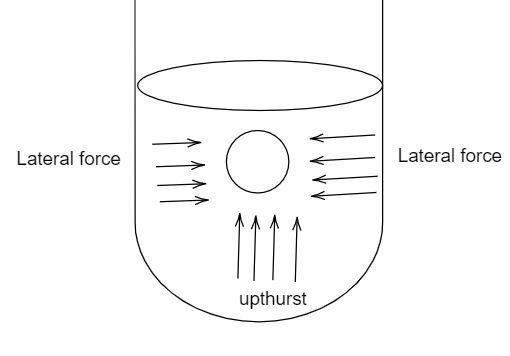
The liquid exerts the shape of the container it filled. Let us consider that the ball is dropped on a tank full of water. Pascal's law states that the force exerted by the liquid will be equal in all directions. Therefore this ball exerts some force on the liquid due to its weight. So the liquid exerts its force on all sides. Sideways, the force is exerted by the walls of the tank.
Since by Pascal’s law, these two forces are equal and opposite, these lateral forces cancel each other. But the force provided by the upward force is not cancelled because the force provided by the ball to the liquid downward is not equal to that of the upward. So the net force result is the upward force and it is called by the name upthrust. This force acts at the point of the centre of the buoyancy.
Note: In liquid, the pressure will be greater if the depth of the liquid storage will be higher. This can be proved when three holes in the tanks are made at different heights, the water will be forced out at a higher pressure and to the higher distance at the bottom holes when compared to the other.
Complete step by step solution:
The liquid exerts the shape of the container it filled. Let us consider that the ball is dropped on a tank full of water. Pascal's law states that the force exerted by the liquid will be equal in all directions. Therefore this ball exerts some force on the liquid due to its weight. So the liquid exerts its force on all sides. Sideways, the force is exerted by the walls of the tank.
Since by Pascal’s law, these two forces are equal and opposite, these lateral forces cancel each other. But the force provided by the upward force is not cancelled because the force provided by the ball to the liquid downward is not equal to that of the upward. So the net force result is the upward force and it is called by the name upthrust. This force acts at the point of the centre of the buoyancy.
Note: In liquid, the pressure will be greater if the depth of the liquid storage will be higher. This can be proved when three holes in the tanks are made at different heights, the water will be forced out at a higher pressure and to the higher distance at the bottom holes when compared to the other.
Recently Updated Pages
States of Matter Chapter For JEE Main Chemistry

JEE Main Participating Colleges 2026 - A Complete List of Top Colleges
Circuit Switching vs Packet Switching: Key Differences Explained
Mass vs Weight: Key Differences Explained for Students
[Awaiting the three content sources: Ask AI Response, Competitor 1 Content, and Competitor 2 Content. Please provide those to continue with the analysis and optimization.]
JEE Isolation, Preparation and Properties of Non-metals Important Concepts and Tips for Exam Preparation
Trending doubts
JEE Main 2026: Exam Dates, Session 2 Updates, City Slip, Admit Card & Latest News
JEE Main Marking Scheme 2026- Paper-Wise Marks Distribution and Negative Marking Details
JEE Main 2026 Application Login: Direct Link, Registration, Form Fill, and Steps
Hybridisation in Chemistry – Concept, Types & Applications
Understanding the Electric Field of a Uniformly Charged Ring
Derivation of Equation of Trajectory Explained for Students
Other Pages
JEE Advanced 2026 - Exam Date (Released), Syllabus, Registration, Eligibility, Preparation, and More
JEE Advanced Marks vs Ranks 2025: Understanding Category-wise Qualifying Marks and Previous Year Cut-offs
CBSE Notes Class 11 Physics Chapter 1 - Units And Measurements - 2025-26
NCERT Solutions For Class 11 Physics Chapter 1 Units And Measurements - 2025-26
Important Questions For Class 11 Physics Chapter 1 Units and Measurement - 2025-26
CBSE Notes Class 11 Physics Chapter 4 - Laws of Motion - 2025-26