




An oxidizing agent is a substance which can
A.Accept electrons
B.Donate electrons
C.Accept protons
D.Donate protons
Answer
 Verified
265.2k+ views
Hint: Basically, an oxidizing agent is a chemical species that tends to oxidize other substances. It causes an increase in the oxidation state of the substance by making it lose electrons. Generally, it takes the electrons towards itself and thus it gains electrons and gets reduced.
Complete step by step answer:
An oxidizing agent, also known as an oxidizer or oxidant is a chemical compound that readily transfers oxygen atoms in a redox reaction. Basically, it helps in the oxidation while getting reduced by gaining hydrogen and giving oxygen or gaining electrons form the other reactants. Some of the common examples of oxidizing agents are halogens such as chlorine and fluorine, oxygen and hydrogen peroxide.
Now, oxidizing agents can be defined in two different ways:
1.As an electron acceptor- These are the chemical substances whose atoms remove at least one electron from another atom in a chemical reaction. Basically, oxidizing agents are the reactants that undergo reduction in redox reactions. An illustration is as shown:
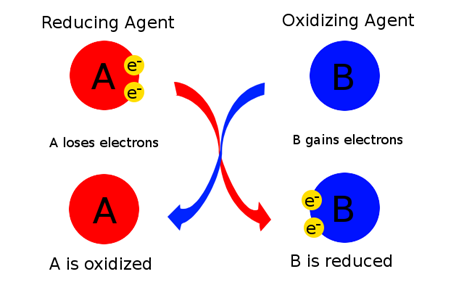
We can see that substance A undergoes oxidation, resulting in an increase in oxidation number whereas substance B becomes smaller as it gains electrons by undergoing reduction.
2.As an atom transferring substance- It is a substance that transfers at least one electronegative atom to a chemical species in a chemical reaction and the transferred atom is typically an oxygen atom. The example is as shown:
\[F{e_2}{O_3} + 3CO \to 2Fe + 3C{O_2}\]
In this case, the $F{e_2}{O_3}$ molecule acts as an oxidizer by transferring the electronegative oxygen atom to carbon monoxide molecule.
Therefore, an oxidizing agent is a substance which can accept electrons.
Hence, option A is correct.
Note:Oxidizing agents have various commercial and industrial applications. They are used in bleaching of fabrics, purification of water, storage of energy in batteries, vulcanization of rubber. Moreover, they are also vital to many biological processes such as metabolism and photosynthesis.
Complete step by step answer:
An oxidizing agent, also known as an oxidizer or oxidant is a chemical compound that readily transfers oxygen atoms in a redox reaction. Basically, it helps in the oxidation while getting reduced by gaining hydrogen and giving oxygen or gaining electrons form the other reactants. Some of the common examples of oxidizing agents are halogens such as chlorine and fluorine, oxygen and hydrogen peroxide.
Now, oxidizing agents can be defined in two different ways:
1.As an electron acceptor- These are the chemical substances whose atoms remove at least one electron from another atom in a chemical reaction. Basically, oxidizing agents are the reactants that undergo reduction in redox reactions. An illustration is as shown:
We can see that substance A undergoes oxidation, resulting in an increase in oxidation number whereas substance B becomes smaller as it gains electrons by undergoing reduction.
2.As an atom transferring substance- It is a substance that transfers at least one electronegative atom to a chemical species in a chemical reaction and the transferred atom is typically an oxygen atom. The example is as shown:
\[F{e_2}{O_3} + 3CO \to 2Fe + 3C{O_2}\]
In this case, the $F{e_2}{O_3}$ molecule acts as an oxidizer by transferring the electronegative oxygen atom to carbon monoxide molecule.
Therefore, an oxidizing agent is a substance which can accept electrons.
Hence, option A is correct.
Note:Oxidizing agents have various commercial and industrial applications. They are used in bleaching of fabrics, purification of water, storage of energy in batteries, vulcanization of rubber. Moreover, they are also vital to many biological processes such as metabolism and photosynthesis.
Recently Updated Pages
JEE Main Mock Test 2025-26: Principles Related To Practical

JEE Main 2025-26 Experimental Skills Mock Test – Free Practice
JEE Main 2025-26 Electronic Devices Mock Test: Free Practice Online
JEE Main 2025-26 Mock Tests: Free Practice Papers & Solutions
JEE Main 2025-26: Magnetic Effects of Current & Magnetism Mock Test
JEE Main Statistics and Probability Mock Test 2025-26
Trending doubts
JEE Main 2026: Exam Dates, Session 2 Updates, City Slip, Admit Card & Latest News
JEE Main Participating Colleges 2026 - A Complete List of Top Colleges
Hybridisation in Chemistry – Concept, Types & Applications
Understanding the Electric Field of a Uniformly Charged Ring
Derivation of Equation of Trajectory Explained for Students
How to Convert a Galvanometer into an Ammeter or Voltmeter
Other Pages
JEE Advanced 2026 Notification Out with Exam Date, Registration (Extended), Syllabus and More
JEE Advanced Percentile vs Marks 2026: JEE Main Cutoff, AIR & IIT Admission Guide
JEE Advanced Weightage Chapter Wise 2026 for Physics, Chemistry, and Mathematics
JEE Advanced Marks vs Rank 2025 - Predict Your IIT Rank Based on Score
NCERT Solutions For Class 11 Chemistry In Hindi Chapter 1 Some Basic Concepts Of Chemistry - 2025-26
Understanding Electromagnetic Waves and Their Importance