




An object kept on the principle axis is moving in the same direction as that of a mirror as shown in the figure. Speed of the object and mirror is $10m{s^{ - 1}}$ and $\dfrac{{40}}{{13}}m{s^{ - 1}}$ . Radius of the curvature of the mirror is $20cm$ . If the distance of the object from the mirror at this instant is $5xcm$ , the velocity of the image at this instant is found to be zero. Find x.
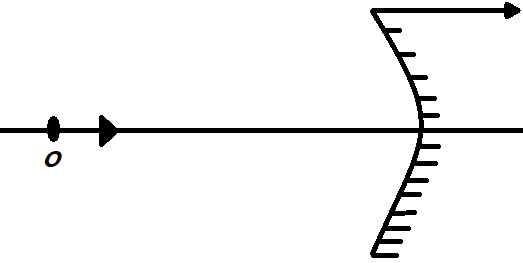
Answer
 Verified
239.4k+ views
Hint: In this question the values of the speed of the object, the mirror, and the radius of curvature are already given. We need to use the relation between the speed of the image and the object to find the required solution.
Formula used:
${\vec V_{im}} = - \dfrac{{{v^2}}}{{{u^2}}}{\vec v_{om}}$
Complete answer:
Before starting the solution of the question let us write all the given values which are present in the question,
The velocity of the object = $10m{s^{ - 1}}$
The velocity of the mirror = $\dfrac{{40}}{{13}}m{s^{ - 1}}$
The radius of curvature of the mirror = $20cm$
To find = the distance of the object from the mirror at an instant of $5xcm$ and also to find the value of x.
As we start the solution by using the below formula,
${\vec V_{im}} = - \dfrac{{{v^2}}}{{{u^2}}}{\vec v_{om}}$
By putting all the values in the above formula, we get the result as,
$0 - \dfrac{{40}}{{13}} = - {\left( {\dfrac{{ - 10}}{{ - 10 + x}}} \right)^2}\left( {10 - \dfrac{{40}}{{13}}} \right)$
By doing further solution of the above equation we get,
$\dfrac{{ - 10}}{{ - 10 + x}} = \pm \dfrac{2}{3}$
By using the cross multiplication method, we get the following values,
$5x = 25, - 5$
As we know that the object is in front of the mirror,
Hence, $x = 5$ .
Therefore, the correct answer of $x$ is $5$ .
Note: Choose the formula wisely for solving this problem. Some does the mistake of using the mirror formula. Also, it is mentioned that If the distance of the object from the mirror at that instant is 5xcm, the velocity of the image at this instant is found to be zero. Thus, we just can’t put the value of the speed of the object and the mirror directly in the formula.
Formula used:
${\vec V_{im}} = - \dfrac{{{v^2}}}{{{u^2}}}{\vec v_{om}}$
Complete answer:
Before starting the solution of the question let us write all the given values which are present in the question,
The velocity of the object = $10m{s^{ - 1}}$
The velocity of the mirror = $\dfrac{{40}}{{13}}m{s^{ - 1}}$
The radius of curvature of the mirror = $20cm$
To find = the distance of the object from the mirror at an instant of $5xcm$ and also to find the value of x.
As we start the solution by using the below formula,
${\vec V_{im}} = - \dfrac{{{v^2}}}{{{u^2}}}{\vec v_{om}}$
By putting all the values in the above formula, we get the result as,
$0 - \dfrac{{40}}{{13}} = - {\left( {\dfrac{{ - 10}}{{ - 10 + x}}} \right)^2}\left( {10 - \dfrac{{40}}{{13}}} \right)$
By doing further solution of the above equation we get,
$\dfrac{{ - 10}}{{ - 10 + x}} = \pm \dfrac{2}{3}$
By using the cross multiplication method, we get the following values,
$5x = 25, - 5$
As we know that the object is in front of the mirror,
Hence, $x = 5$ .
Therefore, the correct answer of $x$ is $5$ .
Note: Choose the formula wisely for solving this problem. Some does the mistake of using the mirror formula. Also, it is mentioned that If the distance of the object from the mirror at that instant is 5xcm, the velocity of the image at this instant is found to be zero. Thus, we just can’t put the value of the speed of the object and the mirror directly in the formula.
Recently Updated Pages
JEE Main 2025-26 Mock Tests: Free Practice Papers & Solutions

JEE Main 2025-26 Experimental Skills Mock Test – Free Practice
JEE Main 2025-26 Electronic Devices Mock Test: Free Practice Online
JEE Main 2025-26 Atoms and Nuclei Mock Test – Free Practice Online
JEE Main 2025-26: Magnetic Effects of Current & Magnetism Mock Test
JEE Main Mock Test 2025: Properties of Solids and Liquids
Trending doubts
JEE Main 2026: Session 1 Results Out and Session 2 Registration Open, City Intimation Slip, Exam Dates, Syllabus & Eligibility
Ideal and Non-Ideal Solutions Explained for Class 12 Chemistry
JEE Main Participating Colleges 2026 - A Complete List of Top Colleges
Step-by-Step Guide to Young’s Double Slit Experiment Derivation
Understanding the Angle of Deviation in a Prism
Understanding Electromagnetic Waves and Their Importance
Other Pages
CBSE Class 12 Physics Question Paper 2026: Download SET-wise PDF with Answer Key & Analysis
JEE Advanced Marks vs Ranks 2025: Understanding Category-wise Qualifying Marks and Previous Year Cut-offs
Essential Derivations for CBSE Class 12 Physics: Stepwise & PDF Solutions
JEE Advanced 2026 - Exam Date (Released), Syllabus, Registration, Eligibility, Preparation, and More
CBSE Class 12 Physics Question Paper Set 3 (55/2/3) 2025: PDF, Answer Key & Solutions
CBSE Class 12 Physics Question Paper Set 3 (55/1/3) 2025 – PDF, Solutions & Analysis