




An example of homopolysaccharides is/are: (This question contains multiple correct answers)
(A) Sucrose
(B) Cellulose
(C) Mannose
(D) Starch
Answer
 Verified
283.5k+ views
Hint: The monomers of Sucrose are glucose and fructose. The monomer of Cellulose is glucose. The mannose is an aldohexose. The monomer of starch is glucose.
Complete step by step solution:
Homopolysaccharides are those polymers that are made up of only one type of monomer. Polysaccharides are those compounds in which the number of monomers is greater than 100 or even thousand.
Let us study all the options one by one:
(a)- Sucrose: Sucrose is a disaccharide. It is also known as cane-sugar or table sugar. The formula of sucrose is ${{C}_{12}}{{H}_{22}}{{O}_{11}}$. It is the most common disaccharide and is widely distributed in the plants. It is manufactured from beetroot and sugarcane. When the sucrose is hydrolyzed it forms D-Glucose and D-Fructose.
$\underset{sucrose}{\mathop {{C}_{12}}{{H}_{22}}{{O}_{11}}}\,+{{H}_{2}}O\to \underset{D-Glu\cos e}{\mathop {{C}_{6}}{{H}_{12}}{{O}_{6}}}\,+\underset{D-Fructose}{\mathop {{C}_{6}}{{H}_{12}}{{O}_{6}}}\,$
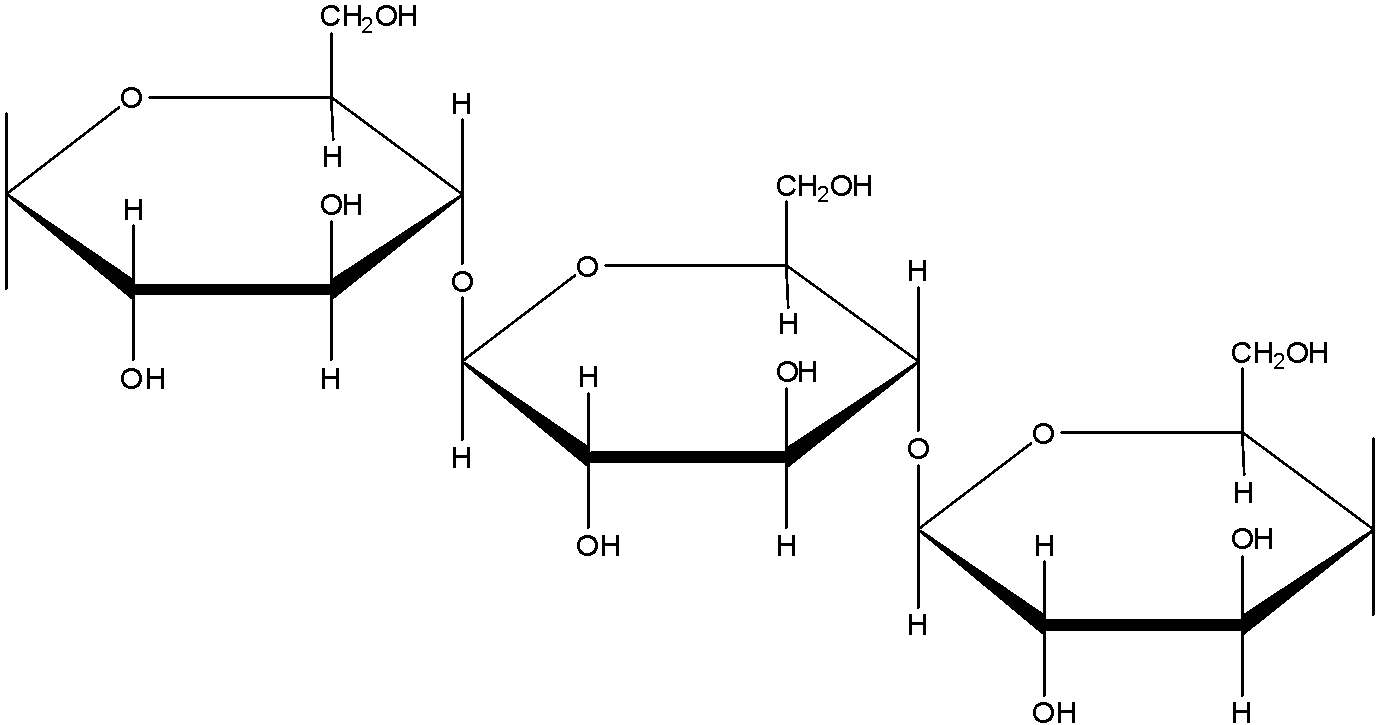
(b)- Cellulose: It is a polysaccharide that is made up of only one type of monomer. The monomer in the cellulose is glucose. The number of monomers varies from 300 to 3000 units per cellulose molecule. It is widely distributed in plants. The linkage in cellulose is $\beta -gly\cos idic\,linkage$.
(c)- Mannose: Mannose is an Aldohexose. The formula of mannose is ${{C}_{6}}{{H}_{12}}{{O}_{6}}$. It is a monomer unit.
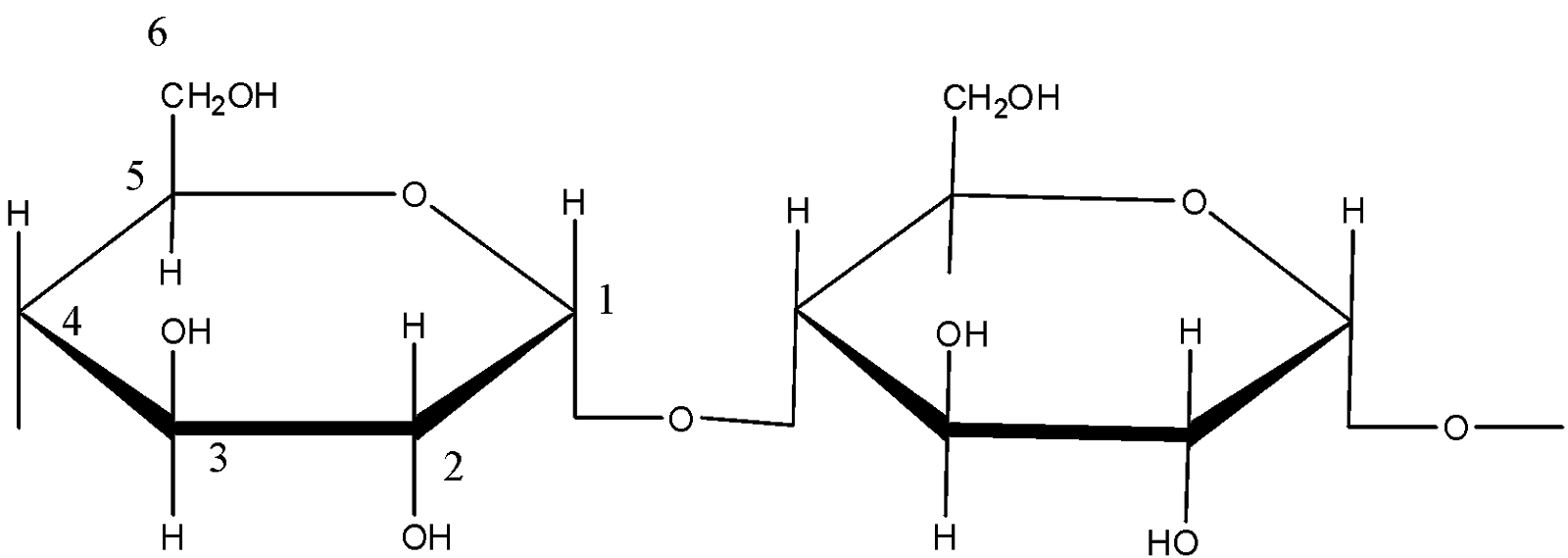
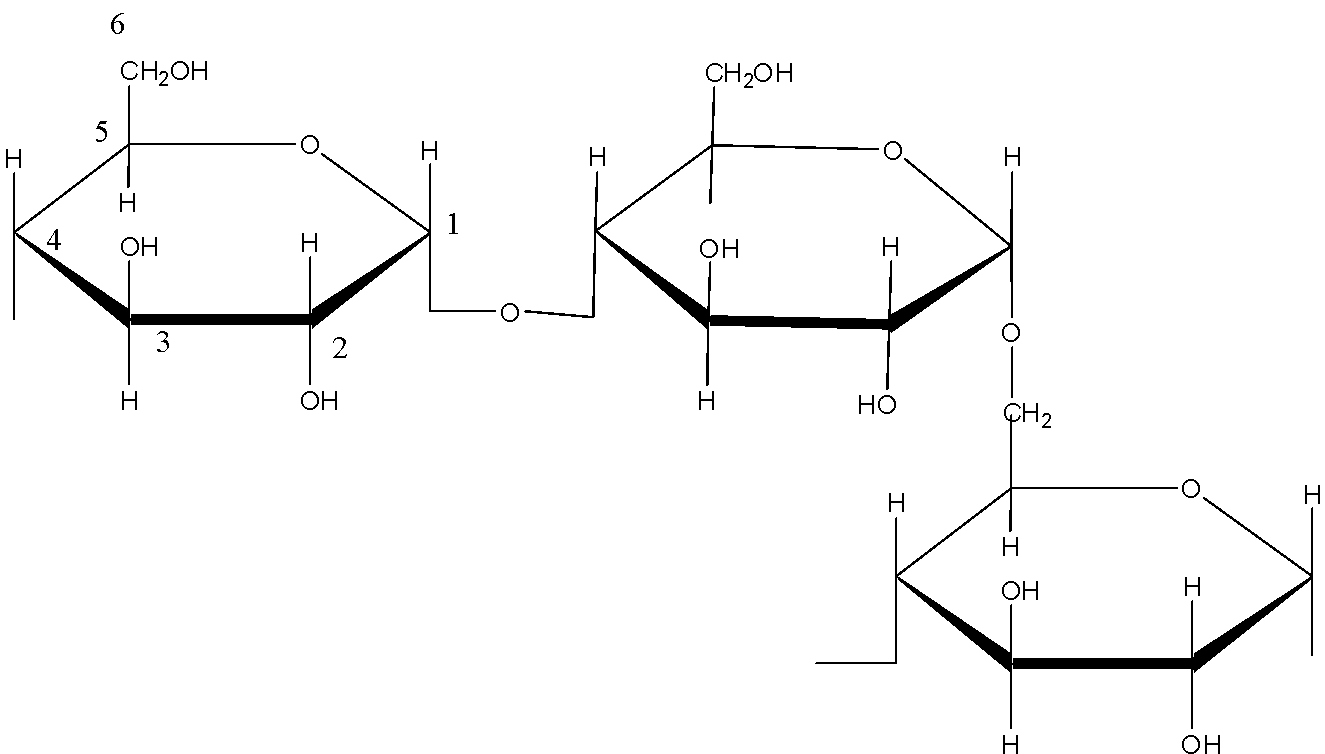
(d)- Starch: Starch is a polysaccharide which is made up of only one type of monomer. The monomer of Starch is glucose. It is a food reserve in plants Amylose, and amylopectin are two components of Starch. In amylose, the linkage is ${{C}_{1}}-{{C}_{4}}\text{ }\alpha -gly\cos idic\,linkage$. In amylopectin there are 2 linkages: ${{C}_{1}}-{{C}_{4}}\text{ }\alpha -gly\cos idic\,linkage$ and ${{C}_{1}}-{{C}_{6}}\text{ }\alpha -gly\cos idic\,linkage$.
The structure of amylose is:
The structure of amylopectin is:
So, the correct answer is options (B) and (D).
Note: Aldohexose refers to the carbohydrate which has 6 carbons in the ring structure and the main functional group is aldehydes. Cellulose and starch on hydrolysis will form only glucose.
Complete step by step solution:
Homopolysaccharides are those polymers that are made up of only one type of monomer. Polysaccharides are those compounds in which the number of monomers is greater than 100 or even thousand.
Let us study all the options one by one:
(a)- Sucrose: Sucrose is a disaccharide. It is also known as cane-sugar or table sugar. The formula of sucrose is ${{C}_{12}}{{H}_{22}}{{O}_{11}}$. It is the most common disaccharide and is widely distributed in the plants. It is manufactured from beetroot and sugarcane. When the sucrose is hydrolyzed it forms D-Glucose and D-Fructose.
$\underset{sucrose}{\mathop {{C}_{12}}{{H}_{22}}{{O}_{11}}}\,+{{H}_{2}}O\to \underset{D-Glu\cos e}{\mathop {{C}_{6}}{{H}_{12}}{{O}_{6}}}\,+\underset{D-Fructose}{\mathop {{C}_{6}}{{H}_{12}}{{O}_{6}}}\,$
(b)- Cellulose: It is a polysaccharide that is made up of only one type of monomer. The monomer in the cellulose is glucose. The number of monomers varies from 300 to 3000 units per cellulose molecule. It is widely distributed in plants. The linkage in cellulose is $\beta -gly\cos idic\,linkage$.
(c)- Mannose: Mannose is an Aldohexose. The formula of mannose is ${{C}_{6}}{{H}_{12}}{{O}_{6}}$. It is a monomer unit.
(d)- Starch: Starch is a polysaccharide which is made up of only one type of monomer. The monomer of Starch is glucose. It is a food reserve in plants Amylose, and amylopectin are two components of Starch. In amylose, the linkage is ${{C}_{1}}-{{C}_{4}}\text{ }\alpha -gly\cos idic\,linkage$. In amylopectin there are 2 linkages: ${{C}_{1}}-{{C}_{4}}\text{ }\alpha -gly\cos idic\,linkage$ and ${{C}_{1}}-{{C}_{6}}\text{ }\alpha -gly\cos idic\,linkage$.
The structure of amylose is:
The structure of amylopectin is:
So, the correct answer is options (B) and (D).
Note: Aldohexose refers to the carbohydrate which has 6 carbons in the ring structure and the main functional group is aldehydes. Cellulose and starch on hydrolysis will form only glucose.
Recently Updated Pages
JEE Main Mock Test 2025-26: Principles Related To Practical

JEE Main 2025 Organic Compounds Containing Oxygen Mock Test
JEE Main 2025-26 Organic Compounds Containing Oxygen Mock Test
JEE Main 2025-26 Mock Test: Purification & Characterisation of Organic Compounds
JEE Main 2025-26 Mock Test: Principles Related To Practical
JEE Main Mock Test 2025-26: Free Practice & Solutions
Trending doubts
JEE Main 2026: Exam Dates, Session 2 Updates, City Slip, Admit Card & Latest News
Understanding the Electric Field of a Uniformly Charged Ring
Understanding Atomic Structure for Beginners
Derivation of Equation of Trajectory Explained for Students
Electron Gain Enthalpy and Electron Affinity Explained
How to Convert a Galvanometer into an Ammeter or Voltmeter
Other Pages
JEE Advanced Percentile vs Marks 2026: JEE Main Cutoff, AIR & IIT Admission Guide
NCERT Solutions For Class 12 Chemistry Chapter 2 Electrochemistry - 2026-27
NCERT Solutions For Class 12 Chemistry Chapter 1 Solutions - 2026-27 Free PDF Download (Sign-in Required)
NCERT Solutions For Class 12 Chemistry Chapter 3 Chemical Kinetics - 2026-27
CBSE Notes Class 12 Chemistry Chapter 1 - Solutions - 2026-27
NCERT Solutions For Class 12 Chemistry Chapter 6 Haloalkanes And Haloarenes - 2026-27 PDF Download (Login Required)