




Among the following, which should have the highest r.m.s speed at the same temperature?
A.${\text{S}}{{\text{O}}_{\text{2}}}$
B.${\text{C}}{{\text{O}}_{\text{2}}}$
C.${{\text{O}}_{\text{2}}}$
D.${{\text{H}}_{\text{2}}}$
Answer
 Verified
283.8k+ views
Hint: To answer this question, you should recall the concept of root-mean-square speed of gas. Study the dependence of factors which affect this root mean square speed. Now use the factors to find the answer to this question.
The formula used:
${{\text{v}}_{{\text{rms}}}} = \sqrt {\dfrac{{{\text{3RT}}}}{{\text{M}}}} $ where ${{\text{v}}_{{\text{rms}}}}$=Root mean square speed, ${\text{R}}$= Universal gas constant, ${\text{T}}$= Temperature and ${\text{M}}$ is the Molar Mass of gas ---(i)
Complete Step by step solution:
We know that root mean square speed t is the square root of the average velocity-squared of the molecules in a gas. You can see that it takes into account both molecular weight and temperature, these factors directly affect the kinetic energy of a gas.
From equation (i) we can conclude that
${{\text{v}}_{{\text{rms}}}} \propto \dfrac{1}{{\text{M}}}$.
The molar mass will directly affect the root mean square speed.
The molar mass of each gas will be ${\text{S}}{{\text{O}}_{\text{2}}}$ = 64 g , ${\text{C}}{{\text{O}}_{\text{2}}}$ = 44 g, ${{\text{O}}_{\text{2}}}$ = 32 g, ${{\text{H}}_{\text{2}}}$ = 2 g
Out of the given options ${{\text{H}}_{\text{2}}}$ has the smallest molar mass thus, the highest r.m.s speed.
Therefore, we can conclude that the correct answer to this question is D.
Additional information: At 'higher temperature' and 'lower pressure', a gas behaves like an ideal gas, as the potential energy due to intermolecular forces becomes less significant compared with the particles' kinetic energy, and the size of the molecules becomes less significant compared to the space between them.
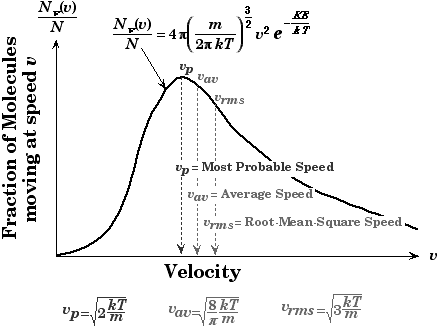
Note: Along with different speeds you should know the concept of Maxwell-Boltzmann equation. The Maxwell-Boltzmann equation helps define the distribution of speeds for gas at various temperatures. From this distribution graph function, the most probable speed, the average speed, and the root-mean-square speed can be derived. The most probable speed is the speed most likely to be possessed by any molecule in the system.
The formula used:
${{\text{v}}_{{\text{rms}}}} = \sqrt {\dfrac{{{\text{3RT}}}}{{\text{M}}}} $ where ${{\text{v}}_{{\text{rms}}}}$=Root mean square speed, ${\text{R}}$= Universal gas constant, ${\text{T}}$= Temperature and ${\text{M}}$ is the Molar Mass of gas ---(i)
Complete Step by step solution:
We know that root mean square speed t is the square root of the average velocity-squared of the molecules in a gas. You can see that it takes into account both molecular weight and temperature, these factors directly affect the kinetic energy of a gas.
From equation (i) we can conclude that
${{\text{v}}_{{\text{rms}}}} \propto \dfrac{1}{{\text{M}}}$.
The molar mass will directly affect the root mean square speed.
The molar mass of each gas will be ${\text{S}}{{\text{O}}_{\text{2}}}$ = 64 g , ${\text{C}}{{\text{O}}_{\text{2}}}$ = 44 g, ${{\text{O}}_{\text{2}}}$ = 32 g, ${{\text{H}}_{\text{2}}}$ = 2 g
Out of the given options ${{\text{H}}_{\text{2}}}$ has the smallest molar mass thus, the highest r.m.s speed.
Therefore, we can conclude that the correct answer to this question is D.
Additional information: At 'higher temperature' and 'lower pressure', a gas behaves like an ideal gas, as the potential energy due to intermolecular forces becomes less significant compared with the particles' kinetic energy, and the size of the molecules becomes less significant compared to the space between them.
Note: Along with different speeds you should know the concept of Maxwell-Boltzmann equation. The Maxwell-Boltzmann equation helps define the distribution of speeds for gas at various temperatures. From this distribution graph function, the most probable speed, the average speed, and the root-mean-square speed can be derived. The most probable speed is the speed most likely to be possessed by any molecule in the system.
Recently Updated Pages
Disproportionation Reaction: Definition, Example & JEE Guide

JEE Main 2025-26 Mock Test: Binomial Theorem & Quick Practice
Properties of Solids and Liquids Mock Test 2025
JEE Main Mock Test 2025-26: Principles Related To Practical
JEE Main Mock Test 2025-26: Dual Nature of Matter & Radiation
JEE Main 2025-26 Work, Energy and Power Mock Test – Free Practice Online
Trending doubts
JEE Main 2026: Exam Dates, Session 2 Updates, City Slip, Admit Card & Latest News
Understanding the Electric Field of a Uniformly Charged Ring
Understanding Atomic Structure for Beginners
Derivation of Equation of Trajectory Explained for Students
Electron Gain Enthalpy and Electron Affinity Explained
How to Convert a Galvanometer into an Ammeter or Voltmeter
Other Pages
JEE Advanced Percentile vs Marks 2026: JEE Main Cutoff, AIR & IIT Admission Guide
JEE Advanced 2026 Notification Out with Exam Date, Registration (Extended), Syllabus and More
NCERT Solutions For Class 11 Chemistry In Hindi Chapter 1 Some Basic Concepts Of Chemistry - 2026-27
Understanding Electromagnetic Waves and Their Importance
Understanding Instantaneous Velocity
NCERT Solutions For Class 11 Chemistry Chapter 8 Organic Chemistry - Some Basic Principles And Techniques - 2026-27