




According to Mendeleev's periodic law, the properties of elements are a periodic function of:
(A) Atomic number
(B) Atomic weight
(C) Number of electrons
(D) Density
Answer
 Verified
273.3k+ views
Hint: The Modern periodic table considers atomic number as the fundamental property that decides the properties of elements while Mendeleev’s version considers some other property. This property of the Modern periodic table corrected all the defects of Mendeleev’s periodic table.
Step-by-Step Solution:
Let us begin by studying Mendeleev’s periodic law and its resultant classification of elements in detail. Here, Symbols of elements and its atomic masses are shown
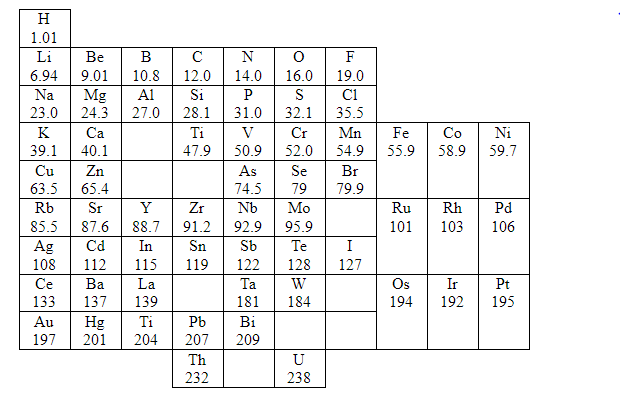
In 1869, a Russian chemist, Dmitri Mendeleev published a periodic table, which was after five years when John Newlands discovered his partly successful Law of Octaves. Mendeleev also arranged the elements that were known at the time in order of their relative atomic mass, but he did some other things that made his table much more successful.
Mendeleev considered atomic masses as fundamental property in order to classify elements. Based on atomic mass Mendeleev compared elements based on their atomic masses. He also studied their physical and chemical properties. While studying chemical properties he primarily considered the compounds formed by elements with oxygen and hydrogen as these elements form compounds with most of the elements.
After his study he started arranging the elements based on increasing atomic masses. With the physical and chemical properties, he found that every eighth element has properties similar to first. So, he placed every eighth element below the first. Likewise, he arranged all 63 elements in rows and columns.
Therefore, the answer to this question is (B) Atomic Weight.
Note: Be very careful between the basis of classification between the Modern and Mendeleev periodic laws, because the former uses atomic number as its basis for classification while the later uses atomic weight.
Step-by-Step Solution:
Let us begin by studying Mendeleev’s periodic law and its resultant classification of elements in detail. Here, Symbols of elements and its atomic masses are shown
In 1869, a Russian chemist, Dmitri Mendeleev published a periodic table, which was after five years when John Newlands discovered his partly successful Law of Octaves. Mendeleev also arranged the elements that were known at the time in order of their relative atomic mass, but he did some other things that made his table much more successful.
Mendeleev considered atomic masses as fundamental property in order to classify elements. Based on atomic mass Mendeleev compared elements based on their atomic masses. He also studied their physical and chemical properties. While studying chemical properties he primarily considered the compounds formed by elements with oxygen and hydrogen as these elements form compounds with most of the elements.
After his study he started arranging the elements based on increasing atomic masses. With the physical and chemical properties, he found that every eighth element has properties similar to first. So, he placed every eighth element below the first. Likewise, he arranged all 63 elements in rows and columns.
Therefore, the answer to this question is (B) Atomic Weight.
Note: Be very careful between the basis of classification between the Modern and Mendeleev periodic laws, because the former uses atomic number as its basis for classification while the later uses atomic weight.
Recently Updated Pages
WBJEE 2026 Result Live: Important Dates, Last Date Apply Online 2026

Disproportionation Reaction: Definition, Example & JEE Guide
Hess Law of Constant Heat Summation: Definition, Formula & Applications
JEE General Topics in Chemistry Important Concepts and Tips
JEE Extractive Metallurgy Important Concepts and Tips for Exam Preparation
JEE Atomic Structure and Chemical Bonding important Concepts and Tips
Trending doubts
JEE Main Participating Colleges 2026 - A Complete List of Top Colleges
Electron Gain Enthalpy and Electron Affinity Explained
Understanding Electromagnetic Waves and Their Importance
JoSAA 2026 Mock Seat Allotment Round 2 OUT JUNE 10: Check Choice Filling Deadline and Counselling Dates
80 Marks in JEE Mains Percentile 2026 Expected Percentile Rank NIT IIT Chances
IIIT JEE Main Cutoff 2024
Other Pages
CBSE Notes Class 11 Chemistry Chapter 6 - Equilibrium - 2026-27
CBSE Notes Class 11 Chemistry Chapter 5 - Thermodynamics - 2026-27
NCERT Solutions For Class 11 Chemistry Chapter 7 Redox Reaction - 2025-26
Electrochemistry JEE Advanced 2026 Notes
NCERT Solutions For Class 11 Chemistry Chapter 5 Thermodynamics - 2025-26
JEE Advanced 2026 Notes