




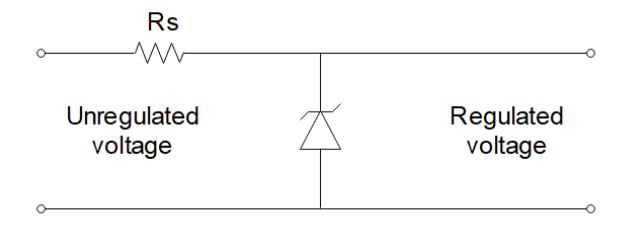
A Zener of power rating 1W is to be used as a voltage regulator. If Zener has a breakdown of 5V and it has to regulate voltage which fluctuated between 3V and 7V, what should be the value of ${R_s}$ for safe operation (Figure)?
Answer
 Verified
264.9k+ views
Hint: The value of the resistance for safe operation should be such that it can handle the fluctuation in the input voltage. The Zener diode will assist in regulating the voltage by limiting the current in the circuit.
Formula used: In this solution, we will use the following formula
$I = \dfrac{P}{V}$ where $I$ is the current in the Zener diode, $P$ is the power rating of the Zener, and $V$ is the voltage across the Zener diode.
- Ohm’s law: $V = IR$ where $V$ is the potential difference, $I$ is the current in the circuit, and $R$ is the resistance
Complete step by step answer:
We’ve been given the Zener diode in the image has a power rating of 1W and breakdown voltage of $5V$. Then the current in the Zener diode will be determined as
$I = \dfrac{1}{5} = 0.2A$
Now the value of the resistance should be such that it can handle the fluctuation in the voltage for the Zener current that we just calculated. So, using Ohm’s law, we can write
$V = IR$
The potential difference that the resistance has to be sustained is $V = 7 - 3 = 4V$ and the current will be equal to the Zener current. So, its resistance has to be
$R = \dfrac{V}{I} = \dfrac{4}{{0.2}}$
Which gives us
$R = 20\Omega $
Note: When being used as a voltage regulator, the Zener diode is connected in reverse bias mode. The current that we obtained in the Zener diode will remain constant over a range of fluctuating input voltages hereby maintaining a steady voltage difference to the load resistance despite fluctuating input voltages. For the Zener diode to regulate the power, there is a minimum Zener current that must be maintained for which the supply voltage must be greater than the breakdown voltage of the Zener diode.
Formula used: In this solution, we will use the following formula
$I = \dfrac{P}{V}$ where $I$ is the current in the Zener diode, $P$ is the power rating of the Zener, and $V$ is the voltage across the Zener diode.
- Ohm’s law: $V = IR$ where $V$ is the potential difference, $I$ is the current in the circuit, and $R$ is the resistance
Complete step by step answer:
We’ve been given the Zener diode in the image has a power rating of 1W and breakdown voltage of $5V$. Then the current in the Zener diode will be determined as
$I = \dfrac{1}{5} = 0.2A$
Now the value of the resistance should be such that it can handle the fluctuation in the voltage for the Zener current that we just calculated. So, using Ohm’s law, we can write
$V = IR$
The potential difference that the resistance has to be sustained is $V = 7 - 3 = 4V$ and the current will be equal to the Zener current. So, its resistance has to be
$R = \dfrac{V}{I} = \dfrac{4}{{0.2}}$
Which gives us
$R = 20\Omega $
Note: When being used as a voltage regulator, the Zener diode is connected in reverse bias mode. The current that we obtained in the Zener diode will remain constant over a range of fluctuating input voltages hereby maintaining a steady voltage difference to the load resistance despite fluctuating input voltages. For the Zener diode to regulate the power, there is a minimum Zener current that must be maintained for which the supply voltage must be greater than the breakdown voltage of the Zener diode.
Recently Updated Pages
JEE Main 2025-26 Experimental Skills Mock Test – Free Practice

JEE Main 2025-26 Electronic Devices Mock Test: Free Practice Online
JEE Main 2025-26 Mock Tests: Free Practice Papers & Solutions
JEE Main 2025-26: Magnetic Effects of Current & Magnetism Mock Test
JEE Main 2025-26 Atoms and Nuclei Mock Test – Free Practice Online
JEE Main Mock Test 2025-26: Experimental Skills Chapter Online Practice
Trending doubts
JEE Main 2026: Exam Dates, Session 2 Updates, City Slip, Admit Card & Latest News
JEE Main Participating Colleges 2026 - A Complete List of Top Colleges
Kinematics Mock Test for JEE Main 2025-26: Practice & Ace the Exam
Kinematics Mock Test for JEE Main 2025-26: Comprehensive Practice
Hybridisation in Chemistry – Concept, Types & Applications
Understanding the Electric Field of a Uniformly Charged Ring
Other Pages
CBSE Class 12 Physics Question Paper 2026: Download SET-wise PDF with Answer Key & Analysis
JEE Advanced 2026 Notification Out with Exam Date, Registration (Extended), Syllabus and More
JEE Advanced Percentile vs Marks 2026: JEE Main Cutoff, AIR & IIT Admission Guide
JEE Advanced Weightage Chapter Wise 2026 for Physics, Chemistry, and Mathematics
JEE Advanced Marks vs Rank 2025 - Predict Your IIT Rank Based on Score
Derivation of Equation of Trajectory Explained for Students