




A vicinal diol has two alcoholic groups present:
A.on the same carbon
B.on adjacent carbon
C.anywhere along with the carbon
D.none of the above
Answer
 Verified
273.9k+ views
Hint: We know that there are two types of groups one is vicinal and one is a geminal diol. One group has two hydroxyl groups on the same carbon and the other has two hydroxyl groups on different carbon.
Complete step by step answer:
We know that the vicinal meaning is adjacent or neighboring.
Let us see the example of vicinal diol:
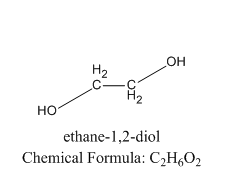
As we can see that the two alcoholic groups are present on the adjacent carbon in vicinal diol.
Therefore, we can conclude that the correct answer to this question is option B.
Additional Information:
Let us see the structure of geminal diol to understand the difference between vicinal alcohol and geminal alcohol.
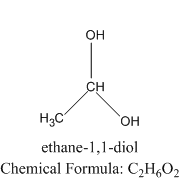
As we can see that the two alcoholic groups are present on the same carbon in geminal diol.
We know that in a vicinal diol, the two hydroxyl groups occupy neighboring positions, that is, they are attached to adjacent atoms and these compounds are called glycols. Examples include 1,2-ethanediol or ethylene glycol \[HO - {(C{H_2})_2} - OH\], a common ingredient of antifreeze products. Another example is propane-1,2-diol, or alpha propylene glycol, \[HO - C{H_2} - CH\left( {OH} \right) - C{H_3}\], used in the food and medicine industry, as well as a relatively non-poisonous antifreeze product.
We most know that on commercial scales, the main route to vicinal diols is the hydrolysis of epoxides and the epoxides are prepared by epoxidation of the alkene.
Note: We can get confused between the vicinal and geminal alcohol and we must know the placement of the alcoholic group on the adjacent carbon atom and same carbon atom respectively. So, option A and option C can be neglected.
Complete step by step answer:
We know that the vicinal meaning is adjacent or neighboring.
Let us see the example of vicinal diol:
As we can see that the two alcoholic groups are present on the adjacent carbon in vicinal diol.
Therefore, we can conclude that the correct answer to this question is option B.
Additional Information:
Let us see the structure of geminal diol to understand the difference between vicinal alcohol and geminal alcohol.
As we can see that the two alcoholic groups are present on the same carbon in geminal diol.
We know that in a vicinal diol, the two hydroxyl groups occupy neighboring positions, that is, they are attached to adjacent atoms and these compounds are called glycols. Examples include 1,2-ethanediol or ethylene glycol \[HO - {(C{H_2})_2} - OH\], a common ingredient of antifreeze products. Another example is propane-1,2-diol, or alpha propylene glycol, \[HO - C{H_2} - CH\left( {OH} \right) - C{H_3}\], used in the food and medicine industry, as well as a relatively non-poisonous antifreeze product.
We most know that on commercial scales, the main route to vicinal diols is the hydrolysis of epoxides and the epoxides are prepared by epoxidation of the alkene.
Note: We can get confused between the vicinal and geminal alcohol and we must know the placement of the alcoholic group on the adjacent carbon atom and same carbon atom respectively. So, option A and option C can be neglected.
Recently Updated Pages
Wheatstone Bridge – Principle, Formula, Diagram & Applications

Classification of Drugs in Chemistry: Types, Examples & Exam Guide
Mass vs Weight: Key Differences Explained for Students
Area vs Volume: Key Differences Explained for Students
Mutually Exclusive vs Independent Events: Key Differences Explained
Circuit Switching vs Packet Switching: Key Differences Explained
Trending doubts
JEE Main 2026: Exam Dates, Session 2 Updates, City Slip, Admit Card & Latest News
Understanding the Electric Field of a Uniformly Charged Ring
Understanding Atomic Structure for Beginners
Derivation of Equation of Trajectory Explained for Students
Understanding the Different Types of Solutions in Chemistry
Electron Gain Enthalpy and Electron Affinity Explained
Other Pages
JEE Advanced 2026 Notification Out with Exam Date, Registration (Extended), Syllabus and More
JEE Advanced Percentile vs Marks 2026: JEE Main Cutoff, AIR & IIT Admission Guide
JEE Advanced Weightage Chapter Wise 2026 for Physics, Chemistry, and Mathematics
NCERT Solutions For Class 11 Chemistry In Hindi Chapter 1 Some Basic Concepts Of Chemistry - 2025-26
How to Convert a Galvanometer into an Ammeter or Voltmeter
Understanding Electromagnetic Waves and Their Importance