




Where should be a uniform rod of length \[10m\] and weight \[100N\]and with a weight of \[100N\] at an extreme point be balanced?
A) \[5m\] from that extreme
B) \[2.5m\] from that extreme
C) \[2.5m\] from the other extreme
D) \[5m\] from the other extreme
Answer
 Verified
240k+ views
Hint: Draw an appropriate figure of this problem. Find where the center of mass will lie. The center of mass of the rod without the \[100N\] weight will be at the center of the rod. With the weight of \[100N\] at one extreme the center of mass will shift.
Complete step by step solution:
We have to find where the center of mass of the system will lie with the \[100N\] weight at one extreme. Center of mass will be the point where the equilibrium will lie.
Consider the following diagram:
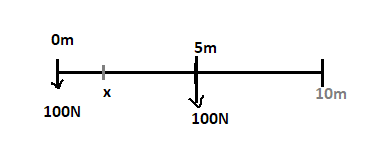
The center of mass is the point where the total weight of the system is assumed to be concentrated. All the forces are supposed to act at this point only which in turn brings about the motion.
The center of mass of the rod alone will lie at \[5m\] from any extreme i.e. at the center. Since the rod is of uniform length hence its mass is also uniformly distributed.
Now we need to find the distance from the left end where the new center of mass will lie when the weight of \[100N\] is present at that extreme.
Let us consider that the center of mass will lie at a distance x from the left extreme. As the two weights of \[100N\] each are placed at \[0m\] and \[5m\] respectively hence the center of mass will lie somewhere between \[0m\] and \[5m\].
Since the system is in equilibrium hence no torque is acting on the rod. Hence the angular momentum of the system at both points must be conserved. Angular momentum is a product of force and radius of center of rotation.
The force on point the points is of \[100N\] each, therefore for equilibrium:
The instantaneous center of rotation will be the point where equilibrium can be achieved, hence
\[(100N)(x)=(100N)(5-x)\]
$\Rightarrow x=5-x$
$\Rightarrow x=2.5$
The balance point will be at \[2.5m\] from the extreme where weight of \[100N\] is placed.
Note: Remember the center of mass of rod was at \[5m\] because the rod was uniform.
For two equal weights the equilibrium is always at the center of the line joining the two weights.
Complete step by step solution:
We have to find where the center of mass of the system will lie with the \[100N\] weight at one extreme. Center of mass will be the point where the equilibrium will lie.
Consider the following diagram:
The center of mass is the point where the total weight of the system is assumed to be concentrated. All the forces are supposed to act at this point only which in turn brings about the motion.
The center of mass of the rod alone will lie at \[5m\] from any extreme i.e. at the center. Since the rod is of uniform length hence its mass is also uniformly distributed.
Now we need to find the distance from the left end where the new center of mass will lie when the weight of \[100N\] is present at that extreme.
Let us consider that the center of mass will lie at a distance x from the left extreme. As the two weights of \[100N\] each are placed at \[0m\] and \[5m\] respectively hence the center of mass will lie somewhere between \[0m\] and \[5m\].
Since the system is in equilibrium hence no torque is acting on the rod. Hence the angular momentum of the system at both points must be conserved. Angular momentum is a product of force and radius of center of rotation.
The force on point the points is of \[100N\] each, therefore for equilibrium:
The instantaneous center of rotation will be the point where equilibrium can be achieved, hence
\[(100N)(x)=(100N)(5-x)\]
$\Rightarrow x=5-x$
$\Rightarrow x=2.5$
The balance point will be at \[2.5m\] from the extreme where weight of \[100N\] is placed.
Note: Remember the center of mass of rod was at \[5m\] because the rod was uniform.
For two equal weights the equilibrium is always at the center of the line joining the two weights.
Recently Updated Pages
Dimensions of Charge: Dimensional Formula, Derivation, SI Units & Examples

How to Calculate Moment of Inertia: Step-by-Step Guide & Formulas
Circuit Switching vs Packet Switching: Key Differences Explained
Dimensions of Pressure in Physics: Formula, Derivation & SI Unit
JEE Extractive Metallurgy Important Concepts and Tips for Exam Preparation
JEE General Topics in Chemistry Important Concepts and Tips
Trending doubts
JEE Main 2026: Session 1 Results Out and Session 2 Registration Open, City Intimation Slip, Exam Dates, Syllabus & Eligibility
Ideal and Non-Ideal Solutions Explained for Class 12 Chemistry
JEE Main Participating Colleges 2026 - A Complete List of Top Colleges
Clemmensen and Wolff Kishner Reductions Explained for JEE & NEET
Degree of Dissociation: Meaning, Formula, Calculation & Uses
Understanding the Angle of Deviation in a Prism
Other Pages
JEE Advanced Marks vs Ranks 2025: Understanding Category-wise Qualifying Marks and Previous Year Cut-offs
JEE Advanced 2026 - Exam Date (Released), Syllabus, Registration, Eligibility, Preparation, and More
CBSE Notes Class 11 Physics Chapter 4 - Laws of Motion - 2025-26
CBSE Notes Class 11 Physics Chapter 14 - Waves - 2025-26
CBSE Notes Class 11 Physics Chapter 9 - Mechanical Properties of Fluids - 2025-26
Inductive Effect and Its Role in Acidic Strength