




A smooth wedge A is fitted in a chamber hanging from a fixed ceiling near the earth’s surface. A block B placed at the top of the wedge takes time T to slide down the length of the wedge and the cable supporting the chamber is broken at the same instant, the block will
(A) Take a time longer than T to slide down the wedge
(B) Take a time shorter than T to slide down the wedge
(C) Remain at the top of the wedge
(D) Jump off the wedge
Answer
 Verified
246.9k+ views
Hint: In the given question, we have been given a smooth wedge that is fixed into a chamber hanging from a ceiling. We have been told that a block is placed on the top of the wedge. We have been asked what will happen to the block placed on the wedge when the string supporting the chamber is cut. When there is no cable supporting the chamber, it will suffer free fall and a pseudo force will act on it. Let’s see the detailed solution given below.
Complete step by step solution:
A diagrammatic representation of the arrangement of the block and the wedge in the chamber just after the instant when the cable is cut is shown below. The ceiling is labelled in the diagram and the dotted line represents the cable that has been cut.
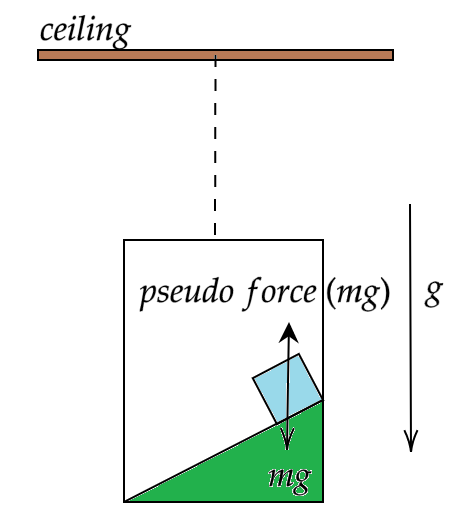
The weight of the block is acting vertically downwards. Since the entire arrangement will suffer free-fall after the snapping of the call, a pseudo force will act on the block in the upward direction. The pseudo force is equal to the product of the mass of the body and the acceleration it is undergoing. The acceleration in a free fall is the same as acceleration due to gravity. As can be seen in the figure, the magnitude of the pseudo force is equal to the magnitude of the weight of the block and both forces act in the mutually opposite direction. Hence the net force acting on the block would be zero and there would be no normal force acting on the block.
In the absence of any net external force acting on the block, the block would remain in its initial position at the top of the wedge.
Therefore, option (C) is the correct answer.
Note:
In the given question, we were told that the block takes time T to come down to the bottom of the wedge. We don’t need that data as we used a logical approach to arrive at the solution. A pseudo force is a virtual force, also known as inertial force. It is applied when we are observing a system from a non-inertial frame. Any frame of reference that moves with any acceleration is considered a non-inertial frame, as in the case of the given question, the chamber supporting the wedge is a non-inertial frame.
Complete step by step solution:
A diagrammatic representation of the arrangement of the block and the wedge in the chamber just after the instant when the cable is cut is shown below. The ceiling is labelled in the diagram and the dotted line represents the cable that has been cut.
The weight of the block is acting vertically downwards. Since the entire arrangement will suffer free-fall after the snapping of the call, a pseudo force will act on the block in the upward direction. The pseudo force is equal to the product of the mass of the body and the acceleration it is undergoing. The acceleration in a free fall is the same as acceleration due to gravity. As can be seen in the figure, the magnitude of the pseudo force is equal to the magnitude of the weight of the block and both forces act in the mutually opposite direction. Hence the net force acting on the block would be zero and there would be no normal force acting on the block.
In the absence of any net external force acting on the block, the block would remain in its initial position at the top of the wedge.
Therefore, option (C) is the correct answer.
Note:
In the given question, we were told that the block takes time T to come down to the bottom of the wedge. We don’t need that data as we used a logical approach to arrive at the solution. A pseudo force is a virtual force, also known as inertial force. It is applied when we are observing a system from a non-inertial frame. Any frame of reference that moves with any acceleration is considered a non-inertial frame, as in the case of the given question, the chamber supporting the wedge is a non-inertial frame.
Recently Updated Pages
List of NIT Colleges in India 2026: NIRF Ranking, Courses, Seats, Cutoff, Fees & Placement

NIT Cutoff 2026: Tier 1–4 NIT Opening & Closing Ranks
JEE Main 2026 Syllabus PDF: Latest NTA Maths, Physics & Chemistry Topics
JEE Main 2026 Expected Cutoff: General, OBC, EWS, SC, ST Qualifying Marks & Score
JEE Main 2026 Syllabus: Latest Updates & Exam Pattern
JEE Main Chapter Wise Weightage 2026 (Updated): Important Chapters, Subject-wise Analysis & PDF
Trending doubts
JEE Main 2026: Exam Dates, Session 2 Updates, City Slip, Admit Card & Latest News
Hybridisation in Chemistry – Concept, Types & Applications
Understanding the Electric Field of a Uniformly Charged Ring
JEE Main 2026 Application Login: Direct Link, Registration, Form Fill, and Steps
Derivation of Equation of Trajectory Explained for Students
Understanding Collisions: Types and Examples for Students
Other Pages
JEE Advanced Marks vs Ranks 2025: Understanding Category-wise Qualifying Marks and Previous Year Cut-offs
JEE Advanced 2026 - Exam Date (Released), Syllabus, Registration, Eligibility, Preparation, and More
CBSE Notes Class 11 Physics Chapter 1 - Units And Measurements - 2025-26
Important Questions For Class 11 Physics Chapter 1 Units and Measurement - 2025-26
NCERT Solutions For Class 11 Physics Chapter 1 Units And Measurements - 2025-26
CBSE Notes Class 11 Physics Chapter 4 - Laws of Motion - 2025-26