




A man holding a flag is running in the North-east direction with speed of $10\,m/s$ . Choose the correct options:
A) If wind is blowing in the east direction with the speed $5\sqrt 2 \,m/s$ ,then the flag will flutter in the south direction.
B) If wind is blowing in east direction with speed $5\sqrt 2 \,m/s$ , then flag will flutter in north direction
C) If wind is blowing in the north direction with the speed $5\sqrt 2 \,m/s$, then the flag will flutter in the east direction.
D) If wind is blowing in the north direction with the speed $5\sqrt 2 \,m/s$ ,then the flag will flutter in the west direction.
Answer
 Verified
256.8k+ views
Hint:In order to find the direction in which the flag flutters we need to know the direction of the resultant vector of the two velocities given. That is the velocity of wind with respect to man will give the direction in which the flag will flutter. Write the given velocities in vector form and subtract the velocity of man from the velocity of wind to find the velocity of wind with respect to man.
Complete step by step solution:
It is given that a man holding a flag is running in the north east direction. The speed with which he is running is $10\,m/s$ .
We need to find the direction in which the flag flutters when the wind is blowing in the east direction and when the wind is blowing in the north direction.
Let us first analyze the case where the wind is towards the east.
The magnitude of wind is given as ${v_w} = 5\sqrt 2 \,m/s$ .
Since it is blowing along the x direction, we can write it in vector form as
$\overrightarrow {{v_w}} = 5\sqrt 2 \,\,\widehat i$
Now let us write the vector form of the velocity of the man holding the flag ${v_m}$ .
It is given that he is moving in the north east direction. Which means this vector is making an angle ${45^ \circ }$ with the east direction.
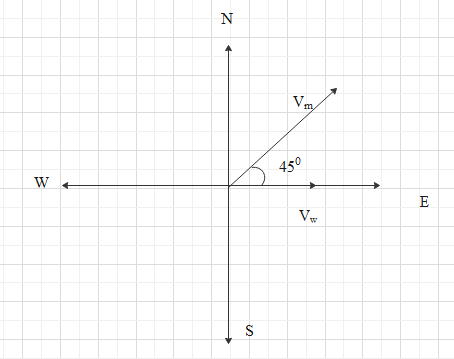
The component of this vector along x-axis will be ${v_m}\cos \theta $
That is ${v_m}\cos \,\,{45^ \circ } = 10 \times \dfrac{1}{{\sqrt 2 }} = 5\sqrt 2 $
And the component along y axis will be ${v_m}\sin \theta $ .
That is,
${v_m}\sin \,{45^ \circ } = 10 \times \dfrac{1}{{\sqrt 2 }} = 5\sqrt 2 $
Therefore, the velocity vector of the man can be written as
$\overrightarrow {{v_m}} = 5\sqrt 2 \,\widehat i + 5\sqrt 2 \,\widehat j$
Now we need to find the direction in which the flag will flutter. For that let us find the resultant velocity and its direction. If we find the velocity of wind with respect to man it will be the direction in which the flag flutters.
The resultant velocity of wind with respect to man is given as,
$\overrightarrow {{v_{wm}}} = \overrightarrow {{v_w}} - \overrightarrow {{v_m}} $
Let us substitute the value of these vectors. Then we get ,
$\overrightarrow {{v_{wm}}} = 5\sqrt 2 \,\widehat i - \left( {5\sqrt 2 \,\widehat i + 5\sqrt 2 \,\widehat j} \right)$
$ \Rightarrow \overrightarrow {{v_{wm}}} = - 5\sqrt 2 \,\widehat j$
Since we got negative $ - \widehat j$ we can say that this resultant is along the south direction.
Therefore, option A is correct.
Now let us consider the second case in which the wind is blowing towards the north direction.
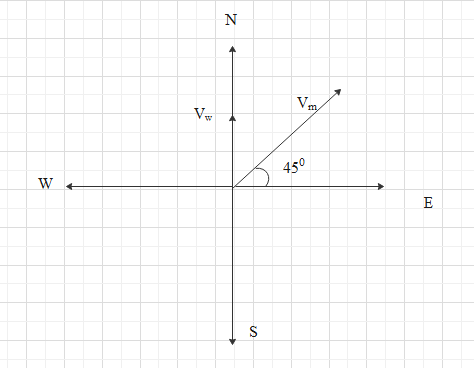
Since it is blowing along the positive y direction, we can write it in vector form as
$\overrightarrow {{v_w}} = 5\sqrt 2 \,\,\widehat j$ .
The velocity of the man is the same as in the first case.
$\overrightarrow {{v_m}} = 5\sqrt 2 \,\widehat i + 5\sqrt 2 \,\widehat j$
The velocity of wind with respect to man in this case is,
$\overrightarrow {{v_{wm}}} = \overrightarrow {{v_w}} - \overrightarrow {{v_m}} $
On substituting the values, we get,
$\overrightarrow {{v_{wm}}} = 5\sqrt 2 \,\widehat j - \left( {5\sqrt 2 \,\widehat i + 5\sqrt 2 \,\widehat j} \right)$
$\overrightarrow {{v_{wm}}} = - 5\sqrt 2 \,\widehat i$
Since we got negative $ - \widehat i$ we can say that this resultant is along the west direction.
Therefore, option D is correct.
Note:While doing the problems with vectors involved always take care of the directions. In order to write a vector which is along the x-axis we need to use the unit vector $\widehat i$ . If the vector is along the negative x direction it should be denoted using $ - \widehat i$ . Similarly, the direction of positive y-axis will be denoted using unit vector $\widehat j$ and the direction of the negative y axis will be denoted using $ - \widehat j$ .
Complete step by step solution:
It is given that a man holding a flag is running in the north east direction. The speed with which he is running is $10\,m/s$ .
We need to find the direction in which the flag flutters when the wind is blowing in the east direction and when the wind is blowing in the north direction.
Let us first analyze the case where the wind is towards the east.
The magnitude of wind is given as ${v_w} = 5\sqrt 2 \,m/s$ .
Since it is blowing along the x direction, we can write it in vector form as
$\overrightarrow {{v_w}} = 5\sqrt 2 \,\,\widehat i$
Now let us write the vector form of the velocity of the man holding the flag ${v_m}$ .
It is given that he is moving in the north east direction. Which means this vector is making an angle ${45^ \circ }$ with the east direction.
The component of this vector along x-axis will be ${v_m}\cos \theta $
That is ${v_m}\cos \,\,{45^ \circ } = 10 \times \dfrac{1}{{\sqrt 2 }} = 5\sqrt 2 $
And the component along y axis will be ${v_m}\sin \theta $ .
That is,
${v_m}\sin \,{45^ \circ } = 10 \times \dfrac{1}{{\sqrt 2 }} = 5\sqrt 2 $
Therefore, the velocity vector of the man can be written as
$\overrightarrow {{v_m}} = 5\sqrt 2 \,\widehat i + 5\sqrt 2 \,\widehat j$
Now we need to find the direction in which the flag will flutter. For that let us find the resultant velocity and its direction. If we find the velocity of wind with respect to man it will be the direction in which the flag flutters.
The resultant velocity of wind with respect to man is given as,
$\overrightarrow {{v_{wm}}} = \overrightarrow {{v_w}} - \overrightarrow {{v_m}} $
Let us substitute the value of these vectors. Then we get ,
$\overrightarrow {{v_{wm}}} = 5\sqrt 2 \,\widehat i - \left( {5\sqrt 2 \,\widehat i + 5\sqrt 2 \,\widehat j} \right)$
$ \Rightarrow \overrightarrow {{v_{wm}}} = - 5\sqrt 2 \,\widehat j$
Since we got negative $ - \widehat j$ we can say that this resultant is along the south direction.
Therefore, option A is correct.
Now let us consider the second case in which the wind is blowing towards the north direction.
Since it is blowing along the positive y direction, we can write it in vector form as
$\overrightarrow {{v_w}} = 5\sqrt 2 \,\,\widehat j$ .
The velocity of the man is the same as in the first case.
$\overrightarrow {{v_m}} = 5\sqrt 2 \,\widehat i + 5\sqrt 2 \,\widehat j$
The velocity of wind with respect to man in this case is,
$\overrightarrow {{v_{wm}}} = \overrightarrow {{v_w}} - \overrightarrow {{v_m}} $
On substituting the values, we get,
$\overrightarrow {{v_{wm}}} = 5\sqrt 2 \,\widehat j - \left( {5\sqrt 2 \,\widehat i + 5\sqrt 2 \,\widehat j} \right)$
$\overrightarrow {{v_{wm}}} = - 5\sqrt 2 \,\widehat i$
Since we got negative $ - \widehat i$ we can say that this resultant is along the west direction.
Therefore, option D is correct.
Note:While doing the problems with vectors involved always take care of the directions. In order to write a vector which is along the x-axis we need to use the unit vector $\widehat i$ . If the vector is along the negative x direction it should be denoted using $ - \widehat i$ . Similarly, the direction of positive y-axis will be denoted using unit vector $\widehat j$ and the direction of the negative y axis will be denoted using $ - \widehat j$ .
Recently Updated Pages
Electricity and Magnetism Explained: Key Concepts & Applications

JEE Energetics Important Concepts and Tips for Exam Preparation
JEE Isolation, Preparation and Properties of Non-metals Important Concepts and Tips for Exam Preparation
JEE Main 2023 (February 1st Shift 1) Maths Question Paper with Answer Key
JEE Main 2023 (February 1st Shift 2) Maths Question Paper with Answer Key
JEE Main 2023 (February 1st Shift 2) Chemistry Question Paper with Answer Key
Trending doubts
JEE Main 2026: Exam Dates, Session 2 Updates, City Slip, Admit Card & Latest News
JEE Main Participating Colleges 2026 - A Complete List of Top Colleges
JEE Main 2026 Application Login: Direct Link, Registration, Form Fill, and Steps
JEE Main Colleges 2026: Complete List of Participating Institutes
JEE Main Marking Scheme 2026- Paper-Wise Marks Distribution and Negative Marking Details
Hybridisation in Chemistry – Concept, Types & Applications
Other Pages
JEE Advanced 2026 - Exam Date (Released), Syllabus, Registration, Eligibility, Preparation, and More
JEE Advanced Marks vs Ranks 2025: Understanding Category-wise Qualifying Marks and Previous Year Cut-offs
CBSE Notes Class 11 Physics Chapter 1 - Units And Measurements - 2025-26
NCERT Solutions For Class 11 Physics Chapter 1 Units And Measurements - 2025-26
Important Questions For Class 11 Physics Chapter 1 Units and Measurement - 2025-26
JEE Advanced Weightage 2025 Chapter-Wise for Physics, Maths and Chemistry