




A man can swim at a speed of $5{\text{km/h}}$ w.r.t water. He wants to cross $1.5{\text{km}}$ wide river flowing at $3{\text{km/h}}$. He keeps himself at an angle of $60^\circ $ with flow direction while swimming. Find the time taken by him to cross the river.
A) $0.25{\text{h}}$
B) $0.35{\text{h}}$
C) $0.45{\text{h}}$
D) $0.55{\text{h}}$
Answer
 Verified
259.2k+ views
Hint: Here it is mentioned that he makes some angle with the direction of flow of the river as he swims across the river. This suggests that the velocity of the man will have a horizontal component and a vertical component. The velocity to cross the river will be provided by the vertical component of the velocity of the man.
Formula used:
The time taken by a body to cover a distance is given by, $t = \dfrac{d}{v}$ where $d$ is the distance and $v$ is the speed of the body.
Complete step by step answer:
Step 1: Sketch a rough figure depicting the direction of the velocity of the man.
Here a man tries to swim across a river of width $d = 1. 5{\text{km}}$. The velocity of the river is given to be $3{\text{km/h}}$ and the velocity of the man w.r.t the river is given to be $v = 5{\text{km/h}}$ .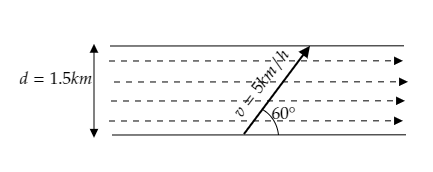
In the above figure, the velocity $v$ of the man w.r.t water makes an angle $\theta = 60^\circ $ with the direction of flow of the river. So the velocity of the man can be resolved into its vertical component and horizontal component as shown below.
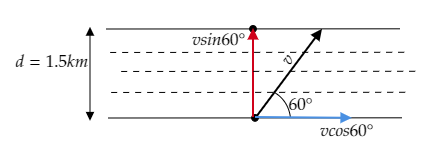
The vertical component of the man is given to be ${v_y} = v\sin 60^\circ = \dfrac{{5\sqrt 3 }}{2}{\text{km/h}}$ and the horizontal component is given to be ${v_x} = v\cos 60^\circ = \dfrac{5}{2}{\text{km/h}}$ .
Now the speed of the man to cross the river will be the vertical component ${v_y}$ of the velocity of the man.
Step 2: Express the time taken by the man to cover the width of the river.
The time taken by the man to cross the river can be expressed as $t = \dfrac{d}{{{v_y}}}$ --------- (1) where $d$ is the width of the river and ${v_y}$ is the speed of the man while crossing the river.
Substituting for ${v_y} = \dfrac{{5\sqrt 3 }}{2}{\text{km/h}}$ and $d = 1.5{\text{km}}$ in equation (1) we get, $t = \dfrac{{1. 5}}{{\left( {\dfrac{{5\sqrt 3 }}{2}} \right)}}$
$ \Rightarrow t = \dfrac{{1.5 \times 2}}{{5\sqrt 3 }} = 0.346{\text{h}}$
Thus the time taken to cross the river is $t = 0.35{\text{h}}$ .
Hence the correct option is (B).
Note: The direction of flow of the river is assumed to be horizontal. The width of the river is the distance to be covered by the man to cross the river. Here both the river and the man are moving with some speed so we use the relative velocity of the man w.r.t the river. This velocity is already given in the question as $v = 5{\text{km/h}}$.
Formula used:
The time taken by a body to cover a distance is given by, $t = \dfrac{d}{v}$ where $d$ is the distance and $v$ is the speed of the body.
Complete step by step answer:
Step 1: Sketch a rough figure depicting the direction of the velocity of the man.
Here a man tries to swim across a river of width $d = 1. 5{\text{km}}$. The velocity of the river is given to be $3{\text{km/h}}$ and the velocity of the man w.r.t the river is given to be $v = 5{\text{km/h}}$ .
In the above figure, the velocity $v$ of the man w.r.t water makes an angle $\theta = 60^\circ $ with the direction of flow of the river. So the velocity of the man can be resolved into its vertical component and horizontal component as shown below.
The vertical component of the man is given to be ${v_y} = v\sin 60^\circ = \dfrac{{5\sqrt 3 }}{2}{\text{km/h}}$ and the horizontal component is given to be ${v_x} = v\cos 60^\circ = \dfrac{5}{2}{\text{km/h}}$ .
Now the speed of the man to cross the river will be the vertical component ${v_y}$ of the velocity of the man.
Step 2: Express the time taken by the man to cover the width of the river.
The time taken by the man to cross the river can be expressed as $t = \dfrac{d}{{{v_y}}}$ --------- (1) where $d$ is the width of the river and ${v_y}$ is the speed of the man while crossing the river.
Substituting for ${v_y} = \dfrac{{5\sqrt 3 }}{2}{\text{km/h}}$ and $d = 1.5{\text{km}}$ in equation (1) we get, $t = \dfrac{{1. 5}}{{\left( {\dfrac{{5\sqrt 3 }}{2}} \right)}}$
$ \Rightarrow t = \dfrac{{1.5 \times 2}}{{5\sqrt 3 }} = 0.346{\text{h}}$
Thus the time taken to cross the river is $t = 0.35{\text{h}}$ .
Hence the correct option is (B).
Note: The direction of flow of the river is assumed to be horizontal. The width of the river is the distance to be covered by the man to cross the river. Here both the river and the man are moving with some speed so we use the relative velocity of the man w.r.t the river. This velocity is already given in the question as $v = 5{\text{km/h}}$.
Recently Updated Pages
JEE Main Mock Test 2025-26: Electromagnetic Induction & Alternating Currents

JEE Main Mock Test 2025-26: Optics Chapter Practice Online
JEE Main 2025-26 Mock Test: Properties of Solids and Liquids
JEE Main Mock Test 2025-26: Dual Nature of Matter & Radiation
JEE Main 2025-26 Electromagnetic Waves Mock Test with Solutions
JEE Main 2025-26 Mock Test: Electronic Devices Chapter Practice
Trending doubts
JEE Main 2026: Exam Dates, Session 2 Updates, City Slip, Admit Card & Latest News
JEE Main Participating Colleges 2026 - A Complete List of Top Colleges
JEE Main Marking Scheme 2026- Paper-Wise Marks Distribution and Negative Marking Details
Hybridisation in Chemistry – Concept, Types & Applications
Understanding the Electric Field of a Uniformly Charged Ring
Derivation of Equation of Trajectory Explained for Students
Other Pages
CBSE Class 12 Physics Question Paper 2026: Download SET-wise PDF with Answer Key & Analysis
JEE Advanced 2026 - Exam Date (Released), Syllabus, Registration, Eligibility, Preparation, and More
JEE Advanced Marks vs Ranks 2025: Understanding Category-wise Qualifying Marks and Previous Year Cut-offs
JEE Advanced Weightage 2025 Chapter-Wise for Physics, Maths and Chemistry
Understanding Atomic Structure for Beginners
How to Convert a Galvanometer into an Ammeter or Voltmeter