




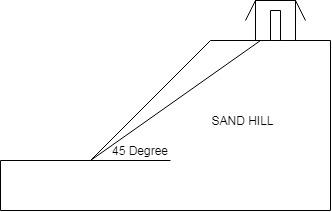
A house is built on the top of a hill with \[45^\circ \]slope. Due to the sliding of material and sand from top to the bottom of the hill, the slope angle has been reduced. If the coefficient of static friction between sand particles is 0.75, what is the final angle obtained by hill? (${\tan ^{ - 1}}0.75 = 37^\circ $ ).
A) $8^\circ $
B) $45^\circ $
C) $37^\circ $
D) $30^\circ $
Answer
 Verified
242.7k+ views
Hint: Here we have to use the concept of resolution of forces. Here, we need to find the equilibrium of the sand. So to do that we need to find equations for all the forces so that the net forces are equal to zero.
Complete step by step solution:
Resolve forces and find the angle:
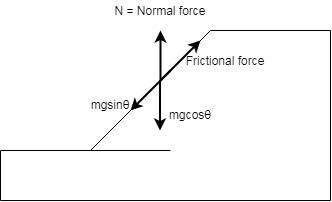
Resolve the vertical and the horizontal forces,
$N = mg\cos \theta $; …(m = mass, g = acceleration due to gravity)
Now, resolve the horizontal forces equate them together.
$\mu N = mg\sin \theta $; …(Frictional force = $\mu N$)
Put the value of N in the above equation:
$\mu \times mg\cos \theta = mg\sin \theta $;
Solve for the coefficient of friction and cancel out the terms with same values.
$\mu = \dfrac{{mg\sin \theta }}{{mg\cos \theta }}$;
$\mu = \tan \theta $;
Solve for the angle;
${\tan ^{ - 1}}\mu = \theta $;
Put the value of coefficient of friction which is 0.75.
${\tan ^{ - 1}}0.75 = \theta $;
The angle is:
$\theta = 37^\circ $;
Hence, Option (C) is correct. The final angle attained by the hill is $37^\circ $.
Note: Here the sand is sliding that means the forces on the sand are not in equilibrium. When the sand stops sliding that means the net force on the sand is equal to zero. Here, draw a diagram specifying each of the forces acting on the sand. Find the unknown angle.
Complete step by step solution:
Resolve forces and find the angle:
Resolve the vertical and the horizontal forces,
$N = mg\cos \theta $; …(m = mass, g = acceleration due to gravity)
Now, resolve the horizontal forces equate them together.
$\mu N = mg\sin \theta $; …(Frictional force = $\mu N$)
Put the value of N in the above equation:
$\mu \times mg\cos \theta = mg\sin \theta $;
Solve for the coefficient of friction and cancel out the terms with same values.
$\mu = \dfrac{{mg\sin \theta }}{{mg\cos \theta }}$;
$\mu = \tan \theta $;
Solve for the angle;
${\tan ^{ - 1}}\mu = \theta $;
Put the value of coefficient of friction which is 0.75.
${\tan ^{ - 1}}0.75 = \theta $;
The angle is:
$\theta = 37^\circ $;
Hence, Option (C) is correct. The final angle attained by the hill is $37^\circ $.
Note: Here the sand is sliding that means the forces on the sand are not in equilibrium. When the sand stops sliding that means the net force on the sand is equal to zero. Here, draw a diagram specifying each of the forces acting on the sand. Find the unknown angle.
Recently Updated Pages
WBJEE 2026 Registration Started: Important Dates Eligibility Syllabus Exam Pattern

Dimensions of Charge: Dimensional Formula, Derivation, SI Units & Examples
How to Calculate Moment of Inertia: Step-by-Step Guide & Formulas
Circuit Switching vs Packet Switching: Key Differences Explained
Dimensions of Pressure in Physics: Formula, Derivation & SI Unit
JEE Extractive Metallurgy Important Concepts and Tips for Exam Preparation
Trending doubts
JEE Main 2026: Session 1 Results Out and Session 2 Registration Open, City Intimation Slip, Exam Dates, Syllabus & Eligibility
Ideal and Non-Ideal Solutions Explained for Class 12 Chemistry
JEE Main Participating Colleges 2026 - A Complete List of Top Colleges
Understanding the Angle of Deviation in a Prism
Understanding Differential Equations: A Complete Guide
Hybridisation in Chemistry – Concept, Types & Applications
Other Pages
JEE Advanced Marks vs Ranks 2025: Understanding Category-wise Qualifying Marks and Previous Year Cut-offs
JEE Advanced 2026 - Exam Date (Released), Syllabus, Registration, Eligibility, Preparation, and More
Important Questions For Class 11 Physics Chapter 1 Units and Measurement - 2025-26
CBSE Notes Class 11 Physics Chapter 1 - Units And Measurements - 2025-26
CBSE Notes Class 11 Physics Chapter 4 - Laws of Motion - 2025-26
CBSE Notes Class 11 Physics Chapter 14 - Waves - 2025-26