




A convex mirror forms virtual image:
A) When the object is at focus
B) When the object is between focus and the centre
C) When the object is beyond C (centre)
D) For all positions of object
Answer
 Verified
271.8k+ views
Hint: There are around 6 cases of image formation for different positions of object in a converging lens. Four of them give real and inverted images and two of them give virtual and erect images. Generally to get an enlarged image the object is placed near the converging lens. Converging lenses are also called convex lenses.
Complete step by step answer:
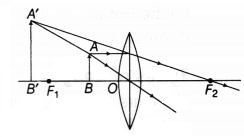
In a convex lens when the object is placed at focus and between pole and focus, the image is formed virtual and erect and the size of image is enlarged than the object. This is because the image is formed in front of the lens. The rays after refraction could not intersect on the other side, so they are extended backwards to get an image.
This makes the image real and erect. When the object is placed on the focus, then the image formed is virtual and at infinity of diminished size. And if the object is placed at any position between beyond center of curvature and between center of curvature and focus the image formed is real and inverted and the size is either small or equal to the size of object. All these formations are defined in cases of formation of image in a converging lens.
Note: To get a virtual image in a convex lens then the object should be placed at focus or near to the lens between focus and pole of lens and the image will be virtual and erect. Similarly to get real and inverted objects should be placed behind focus. Since it is a converging lens, most of the images formed are real and inverted.
Complete step by step answer:
In a convex lens when the object is placed at focus and between pole and focus, the image is formed virtual and erect and the size of image is enlarged than the object. This is because the image is formed in front of the lens. The rays after refraction could not intersect on the other side, so they are extended backwards to get an image.
This makes the image real and erect. When the object is placed on the focus, then the image formed is virtual and at infinity of diminished size. And if the object is placed at any position between beyond center of curvature and between center of curvature and focus the image formed is real and inverted and the size is either small or equal to the size of object. All these formations are defined in cases of formation of image in a converging lens.
Note: To get a virtual image in a convex lens then the object should be placed at focus or near to the lens between focus and pole of lens and the image will be virtual and erect. Similarly to get real and inverted objects should be placed behind focus. Since it is a converging lens, most of the images formed are real and inverted.
Recently Updated Pages
JoSAA Counselling 2026: JoSAA 2026 Mock Seat Allotment LIVE: Round 2 Result Released, Registration, Choice Filling and Ranks

Circuit Switching vs Packet Switching: Key Differences Explained
JEE General Topics in Chemistry Important Concepts and Tips
JEE Extractive Metallurgy Important Concepts and Tips for Exam Preparation
JEE Atomic Structure and Chemical Bonding important Concepts and Tips
JEE Amino Acids and Peptides Important Concepts and Tips for Exam Preparation
Trending doubts
JEE Main 2026: Exam Dates, Session 2 Updates, City Slip, Admit Card & Latest News
JEE Main Participating Colleges 2026 - A Complete List of Top Colleges
Kinematics Mock Test for JEE Main 2025-26: Comprehensive Practice
Understanding the Electric Field of a Uniformly Charged Ring
Understanding Atomic Structure for Beginners
Derivation of Equation of Trajectory Explained for Students
Other Pages
CBSE Class 12 Physics Question Paper 2026: Download SET-wise PDF with Answer Key & Analysis
JEE Advanced 2026 Notification Out with Exam Date, Registration (Extended), Syllabus and More
JEE Advanced Percentile vs Marks 2026: JEE Main Cutoff, AIR & IIT Admission Guide
JEE Advanced Weightage Chapter Wise 2026 for Physics, Chemistry, and Mathematics
Kinematics Mock Test for JEE Main 2025-26: Practice & Ace the Exam
How to Convert a Galvanometer into an Ammeter or Voltmeter