




A compound whose molecule is superimposable on its mirror image despite containing chiral carbon atoms is:
(A) Threo isomer
(B) Meso compound
(C) Enantiomer
(D) None of the above
Answer
 Verified
274.8k+ views
Hint: A compound whose molecules are superimposable on its mirror image despite containing chiral carbon atom is called meso compound.
Complete step by step answer:
Chiral carbon is also known as asymmetric carbon. When four valencies of carbon atom are satisfied by different groups, then C atom is known as asymmetric carbon.
Example: 2-chlorobutane
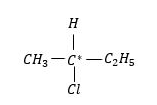
Here, four valencies satisfied by $ - H, - C{H_3}, - {C_2}{H_5}$and $ - Cl$group.
Threo: Compounds having two different chiral or asymmetric carbon atoms are named by using prefix threo.
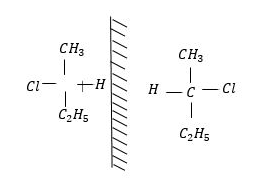
Enantiomers: Enantiomers are chiral molecules that are mirror images of one another.
The molecules are non-superimposable on one another. This means that molecules cannot be placed on top of one another and give the same molecules. Enantiomers have same chemical and physical properties, but differ in the effect on plane polarized light. They rotate plane polarized light in equal but opposite direction.
Example: 2-chlorobutane.
Meso: Meso compounds are superimposable on its mirror image. So they are non-optically active members of a set of stereoisomers at least two of which are optically active
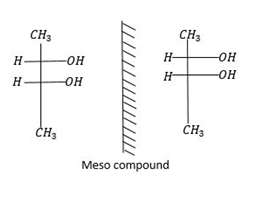
Thus, Option C is correct.
Note:
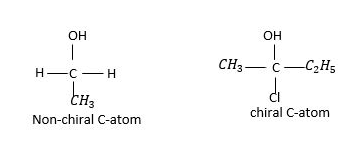
Four different groups should be bonded to chiral carbon. If two of them are the same then C-atom is not chiral.
Complete step by step answer:
Chiral carbon is also known as asymmetric carbon. When four valencies of carbon atom are satisfied by different groups, then C atom is known as asymmetric carbon.
Example: 2-chlorobutane
Here, four valencies satisfied by $ - H, - C{H_3}, - {C_2}{H_5}$and $ - Cl$group.
Threo: Compounds having two different chiral or asymmetric carbon atoms are named by using prefix threo.
Enantiomers: Enantiomers are chiral molecules that are mirror images of one another.
The molecules are non-superimposable on one another. This means that molecules cannot be placed on top of one another and give the same molecules. Enantiomers have same chemical and physical properties, but differ in the effect on plane polarized light. They rotate plane polarized light in equal but opposite direction.
Example: 2-chlorobutane.
Meso: Meso compounds are superimposable on its mirror image. So they are non-optically active members of a set of stereoisomers at least two of which are optically active
Thus, Option C is correct.
Note:
Four different groups should be bonded to chiral carbon. If two of them are the same then C-atom is not chiral.
Recently Updated Pages
Classification of Drugs in Chemistry: Types, Examples & Exam Guide

Difference Between Alcohol and Phenol: Structure, Tests & Uses
Wheatstone Bridge – Principle, Formula, Diagram & Applications
Mass vs Weight: Key Differences Explained for Students
Area vs Volume: Key Differences Explained for Students
Mutually Exclusive vs Independent Events: Key Differences Explained
Trending doubts
JEE Main 2026: Exam Dates, Session 2 Updates, City Slip, Admit Card & Latest News
Understanding the Electric Field of a Uniformly Charged Ring
Understanding Atomic Structure for Beginners
Derivation of Equation of Trajectory Explained for Students
Understanding the Different Types of Solutions in Chemistry
Electron Gain Enthalpy and Electron Affinity Explained
Other Pages
JEE Advanced 2026 Notification Out with Exam Date, Registration (Extended), Syllabus and More
JEE Advanced Percentile vs Marks 2026: JEE Main Cutoff, AIR & IIT Admission Guide
CBSE Class 12 Chemistry Question Paper 2026 PDF Download (All Sets) with Answer Key
NCERT Solutions For Class 12 Chemistry Chapter 2 Electrochemistry - 2025-26
NCERT Solutions For Class 12 Chemistry Chapter 1 Solutions - 2025-26
NCERT Solutions For Class 12 Chemistry Chapter 3 Chemical Kinetics - 2025-26