




2-Chloro-2-methylbutane on reaction with sodium methoxide in methanol yields
a.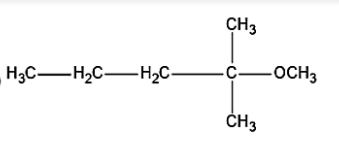
b. 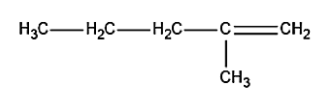
c. 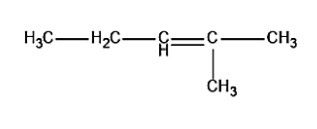
(A) All of these
(B) (a) and (c)
(C) (c)only
(D) (a) and (b)
Answer
 Verified
295.2k+ views
Hint: When 2-Chloro-2-methylbutane reacts with sodium methoxide in methanol, it undergoes \[{S_N}1\] and \[{E_1}\]. \[{S_N}1\]means unimolecular nucleophilic substitution reaction and \[{E_1}\]means unimolecular elimination reaction. On knowing what type of reaction can take place in this \[{S_N}1\]and \[{E_1}\]mechanism we can determine the product.
Complete step by step answer:
2-Chloro-2-methylbutane when reacted with sodium methoxide in methanol, it will form a carbocation by the removal of \[NaCl\]. The formed carbocation will undergo \[{S_N}1\] and \[{E_1}\].
In \[{S_N}1\]mechanism, nucleophile will come and attack the same position of the leaving group, that means that the nucleophile, methoxy group \[C{H_3}{O^ - }\] will be attached in the position of the leaving chlorine \[C{l^ - }\] group. Thus, leading to the formation of 2-Methoxy-2-methylbutane i.e. compound (a) in the figure.
In the\[{E_1}\] mechanism, the deprotonation will occur in the carbon atom which is nearer to the carbocation and hence leading to the formation of alkene. In 2-methylbutane carbocation, there are two carbon atoms which are nearer to the carbocation. One carbon atom is at the terminal position and the other carbon atom is at the third position.
In the terminal carbon atom, a proton is removed, thus leading to the formation of 2-methyl-1-butene i.e. compound (b) in the figure.
In the third carbon atom, a proton will be removed, thus leading to the formation of 2-methyl-2-butene i.e. compound (c) in the figure.
Therefore, all the three compounds(a), (b) and (c) during the reaction of 2-Chloro-2-methylbutane with sodium methoxide in methanol.
Hence, the correct answer is option (A) all the above.
Additional information:
Comparison of \[{S_N}1\] and \[{S_N}2\]
Note: In the reaction both elimination and substitution reaction take place. In the elimination reaction the deprotonation of the carbocation takes places to form alkene, while in the substitution reaction, substitution of leaving group by a nucleophile takes place. Here substitution takes place at only one position while elimination is taking place at two positions.
Complete step by step answer:
2-Chloro-2-methylbutane when reacted with sodium methoxide in methanol, it will form a carbocation by the removal of \[NaCl\]. The formed carbocation will undergo \[{S_N}1\] and \[{E_1}\].
In \[{S_N}1\]mechanism, nucleophile will come and attack the same position of the leaving group, that means that the nucleophile, methoxy group \[C{H_3}{O^ - }\] will be attached in the position of the leaving chlorine \[C{l^ - }\] group. Thus, leading to the formation of 2-Methoxy-2-methylbutane i.e. compound (a) in the figure.
In the\[{E_1}\] mechanism, the deprotonation will occur in the carbon atom which is nearer to the carbocation and hence leading to the formation of alkene. In 2-methylbutane carbocation, there are two carbon atoms which are nearer to the carbocation. One carbon atom is at the terminal position and the other carbon atom is at the third position.
In the terminal carbon atom, a proton is removed, thus leading to the formation of 2-methyl-1-butene i.e. compound (b) in the figure.
In the third carbon atom, a proton will be removed, thus leading to the formation of 2-methyl-2-butene i.e. compound (c) in the figure.
Therefore, all the three compounds(a), (b) and (c) during the reaction of 2-Chloro-2-methylbutane with sodium methoxide in methanol.
Hence, the correct answer is option (A) all the above.
Additional information:
Comparison of \[{S_N}1\] and \[{S_N}2\]
| \[{S_N}1\] | \[{S_N}2\] |
| Unimolecular | Bimolecular |
| Rate depends on two species | Rate depends only on one species |
| Second order | First order |
| Solvent used is polar protic | Solvent used is Polar aprotic |
| Alkyl halide reacts in the order\[3^\circ > 2^\circ > 1^\circ \] | Alkyl halide reacts in the order\[1^\circ > 2^\circ > 3^\circ \] |
Note: In the reaction both elimination and substitution reaction take place. In the elimination reaction the deprotonation of the carbocation takes places to form alkene, while in the substitution reaction, substitution of leaving group by a nucleophile takes place. Here substitution takes place at only one position while elimination is taking place at two positions.
Recently Updated Pages
How will you convert i Propene to propan1ol ii Ethanal class 12 chemistry JEE_Main

Atomic Structure JEE Main Mock Test 2026-27: Free Practice Online
JEE Main 2025-26 Mock Test: Classification of Elements & Periodicity
JEE Main Mock Test 2025-26: Free Practice, Analysis & Tips
JEE Main Mock Test 2026-27: Some Basic Concepts in Chemistry
Class 12 Chemistry Mock Test Series for JEE Main – Free Online Practice
Trending doubts
JEE Main 2026: Exam Dates, Session 2 Updates, City Slip, Admit Card & Latest News
Understanding the Electric Field of a Uniformly Charged Ring
Understanding Atomic Structure for Beginners
Derivation of Equation of Trajectory Explained for Students
How to Convert a Galvanometer into an Ammeter or Voltmeter
Electron Gain Enthalpy and Electron Affinity Explained
Other Pages
NCERT Solutions For Class 12 Chemistry Chapter 2 Electrochemistry - 2026-27 Free PDF Download (Sign-in Required)
NCERT Solutions For Class 12 Chemistry Chapter 1 Solutions - 2026-27 Free PDF Download (Sign-in Required)
NCERT Solutions For Class 12 Chemistry Chapter 3 Chemical Kinetics - 2026-27 Free PDF Download (Login Required)
CBSE Notes Class 12 Chemistry Chapter 1 - Solutions - 2026-27 PDF Download (Login Required)
NCERT Solutions for Class 12 Chemistry Chapter 6 Haloalkanes and Haloarenes - 2026-27 Free PDF Download (Sign-In Required)
NCERT Solutions For Class 12 Chemistry Chapter 7 Alcohol Phenol And Ether - 2026-27 Free PDF Download (Login Required)
NCERT Solutions For Class 12 Chemistry Chapter 2 Electrochemistry - 2026-27 Free PDF Download (Sign-in Required)
NCERT Solutions For Class 12 Chemistry Chapter 1 Solutions - 2026-27 Free PDF Download (Sign-in Required)
NCERT Solutions For Class 12 Chemistry Chapter 3 Chemical Kinetics - 2026-27 Free PDF Download (Login Required)