








Key Differences Between Static and Kinetic Friction
Friction affects how every object moves or stays at rest in our daily lives, often determining whether things slide, stop, or remain stationary.
Friction: The Essential Opposing Force
Friction is the force that resists motion when two surfaces contact, and it is vital in all mechanical processes explored in JEE Physics.
In real life, friction helps us walk without slipping and allows cars to brake efficiently, linking microscopic surface roughness to practical macroscopic effects.
The two main types, Static And Kinetic Friction, arise based on whether an object is stationary or moving relative to the surface beneath it.
Understanding Static Friction
Static friction acts when an object remains at rest against an applied force, preventing the start of motion until a certain threshold is overcome.
Its value adjusts itself to balance applied forces up to a maximum called limiting friction, described by $f_{s,\text{max}} = \mu_s N$.
Here, $\mu_s$ is the coefficient of static friction, and $N$ is the normal force acting perpendicular to the contact surface.
This force explains why pushing a heavy box gradually makes it budge only after significant effort overcomes the resistance.
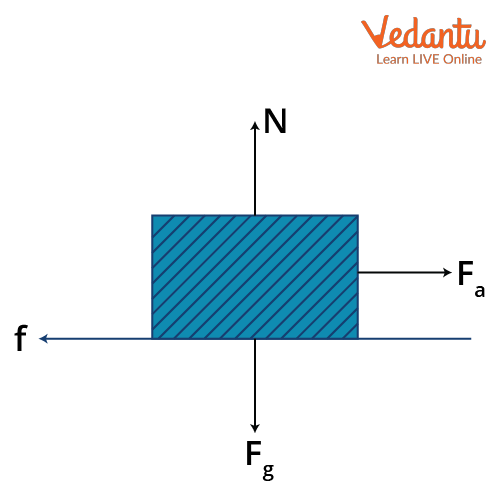
The size or area of contact does not change the maximum static friction as long as the normal force remains unchanged.
Transition to Kinetic Friction
Once the applied force exceeds the maximum static friction, the object begins to move, and kinetic friction replaces static friction at the interface.
The kinetic friction force, $f_k = \mu_k N$, acts opposite to motion, with $\mu_k$ the coefficient of kinetic friction, typically lower than $\mu_s$.
For example, sliding a book across a table feels easier once it starts moving, as kinetic friction is generally less than static friction.
While static friction is self-adjusting up to its limit, kinetic friction stays fairly constant as motion continues on a given surface.
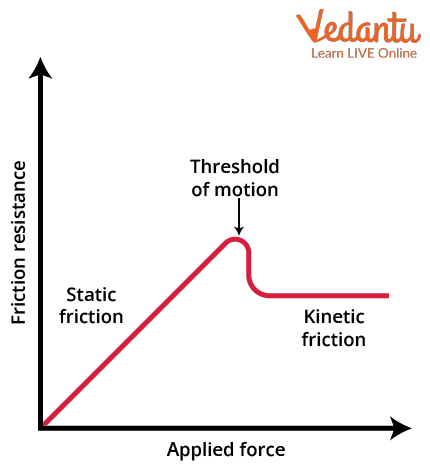
This behavior can be visualized in a graph of frictional force versus applied force, showing a sharp drop at the point where motion starts.
Understanding this transition is crucial for problems involving pulling or pushing objects, such as those encountered in Friction theory questions.
Static and Kinetic Friction: Key Differences
| Static Friction | Kinetic Friction |
|---|---|
| Acts when objects at rest | Acts when objects are moving |
| Self-adjusts up to a maximum | Remains constant for a surface |
| Maximum value: $f_{s,\text{max}} = \mu_s N$ | $f_k = \mu_k N$ |
| $\mu_s > \mu_k$ typically | $\mu_k$ is lower |
For more comparisons, the Difference Between Static And Dynamic Friction offers detailed distinctions crucial for mastering friction-based JEE problems.
Types of Friction Observed in Physics
- Static friction: prevents motion initiation
- Kinetic (sliding) friction: opposes ongoing sliding
- Rolling friction: relevant for wheels or balls
- Fluid friction: viscosity-driven resistance in liquids/gases
The dynamic study of these forms, including Static And Dynamic Friction, broadens our conceptual toolkit for analyzing motion in the physical world.
Friction: Core Formulas for JEE
| Friction Type | Formula |
|---|---|
| Static friction (max) | $f_{s,\text{max}} = \mu_s N$ |
| Kinetic friction | $f_k = \mu_k N$ |
These equations allow swift calculation of force values when working through Static Friction and Kinetic Friction problems in JEE exams and lab sessions.
Solved Example: Applying Friction Concepts
Suppose a crate of mass $10\,\text{kg}$ rests on the floor $(\mu_s=0.4,\ \mu_k=0.3)$. Find (a) the minimum horizontal force needed to just start moving it, (b) force needed to keep it moving at a constant velocity.
Solution: (a) Maximum static friction, $f_{s,\text{max}} = \mu_s N = 0.4 \times (10 \times 10) = 40\,\text{N}$.
So, at least $40\,\text{N}$ is required to initiate motion.
(b) Once in motion, $f_k = 0.3 \times 100 = 30\,\text{N}$ is needed to keep a constant speed.
Practice Problem: Try This
A $5\,\text{kg}$ box with $\mu_s = 0.5$ sits on a floor. What is the limiting static friction? Will a $20\,\text{N}$ push move it? Use $g=10\,\text{m/s}^2$.
Visualizing Forces and Free Body Diagrams
A free body diagram for friction shows normal force upwards, gravity downwards, applied force in the intended direction, and frictional force opposite to motion.
Practicing such visualizations helps master tricky static and kinetic friction free body diagram scenarios in mechanics.
Common Mistakes in Friction Problems
- Mixing up $\mu_s$ and $\mu_k$ in calculations
- Ignoring direction of friction—always opposite to motion
- Forgetting that static friction self-adjusts up to maximum
Solid understanding of these errors builds strong problem-solving skills, vital for JEE performance and effective static and kinetic friction practice problems sessions.
Applications and Relevance to JEE
- Braking systems and automobile control
- Walking, running, and athletic performance
- Design of machinery and use of lubricants
- Transport systems—rolling, sliding, and starting motion
JEE questions often test the ability to identify whether friction is static or kinetic and to use the correct formula accordingly.
Explore More Related Topics
- Angle of friction and angle of repose
- Laws of friction
- Rolling and fluid friction basics
- Friction in inclined plane problems
- Lubricants and methods of reducing friction


FAQs on Understanding Static and Kinetic Friction
1. What is the difference between static and kinetic friction?
Static friction prevents an object from moving when a force is applied, while kinetic friction acts on an object that is already sliding.
Key differences include:
- Static friction is usually higher than kinetic friction.
- Static friction acts on stationary objects; kinetic friction acts on moving objects.
- Static friction increases until it reaches a maximum value, called limiting friction.
- Kinetic friction remains almost constant regardless of the speed of motion.
2. What is static friction?
Static friction is the force that keeps an object at rest when a force tries to move it.
Important points:
- Acts between two surfaces that are not moving relative to each other.
- Prevents the start of motion.
- Varies in value up to a certain maximum, known as limiting friction.
3. What is kinetic friction?
Kinetic friction is the resistive force between two surfaces when one is sliding over the other.
Key facts:
- Also known as sliding friction.
- Acts when the object is already moving.
- Its magnitude is usually less than static friction for the same surfaces.
4. What are the factors affecting friction?
Friction depends on several key factors:
- Nature and roughness of the two surfaces in contact.
- The normal force pressing the surfaces together.
- Materials of the surfaces.
- Presence of lubricants or contaminants.
5. Why is static friction usually greater than kinetic friction?
Static friction is usually greater than kinetic friction because more force is needed to overcome the initial interlocking of surface irregularities than to keep objects sliding.
Key points:
- Once movement begins, microscopic junctions break and reform less effectively.
- After starting to move, less force is needed to keep moving.
6. What is limiting friction?
Limiting friction is the maximum static friction force that can be applied before an object starts to move.
Highlights:
- It is the upper limit of static friction.
- Occurs just before motion begins.
- After motion starts, kinetic friction takes over.
7. What are the types of friction?
The three main types of friction are:
- Static friction – prevents the start of motion.
- Kinetic friction (sliding friction) – acts during motion.
- Rolling friction – acts when an object rolls over a surface.
8. How can friction be reduced?
Friction can be reduced by:
- Applying lubricants like oil or grease between surfaces.
- Polishing surfaces to make them smoother.
- Using rolling elements like ball bearings.
- Replacing sliding with rolling motion where possible.
9. Why is friction necessary in daily life?
Friction is necessary because it enables us to walk, write, hold things, and stop vehicles.
Examples include:
- Walking – friction between the ground and our feet prevents slipping.
- Writing – allows the pen or pencil to mark paper.
- Braking – helps vehicles stop or slow down safely.
10. What is the importance of friction in our daily life?
Friction has both useful and harmful effects in daily life.
- Useful: Allows walking, driving, holding objects, and writing.
- Harmful: Causes wear and tear of machine parts and energy loss as heat.
11. State two advantages and disadvantages of friction.
Two advantages of friction:
- Enables us to walk or run without slipping.
- Keeps objects in place and prevents unwanted movement.
- Causes wear and tear of surfaces in contact.
- Leads to loss of energy as heat in machines.
12. Why does an object in motion eventually stop due to friction?
Friction opposes motion, so it gradually removes kinetic energy from moving objects, making them stop.
Points to note:
- Friction always acts in the opposite direction to motion.
- Without friction (e.g., on ice or in space), objects would keep moving with constant velocity.
13. What is rolling friction? How is it different from sliding friction?
Rolling friction is the resistance to motion when an object rolls over a surface, while sliding friction occurs when an object slides.
Key differences:
- Rolling friction is usually much less than sliding friction, making it easier to roll than to slide objects.
- Example: It is easier to move a suitcase with wheels (rolling) than drag it (sliding).
