






Who Invented the First Mobile Phone and How It Worked
The world’s first mobile phone marked a revolutionary turning point in the history of communication. Before its invention, people relied on landline telephones that were fixed to one location. The development of the first mobile phone allowed individuals to communicate wirelessly while moving from one place to another. This breakthrough laid the foundation for modern smartphones and wireless communication systems. Understanding the origin, development, and impact of the world’s first mobile phone is an important topic in General Knowledge, especially for students and competitive exam aspirants.
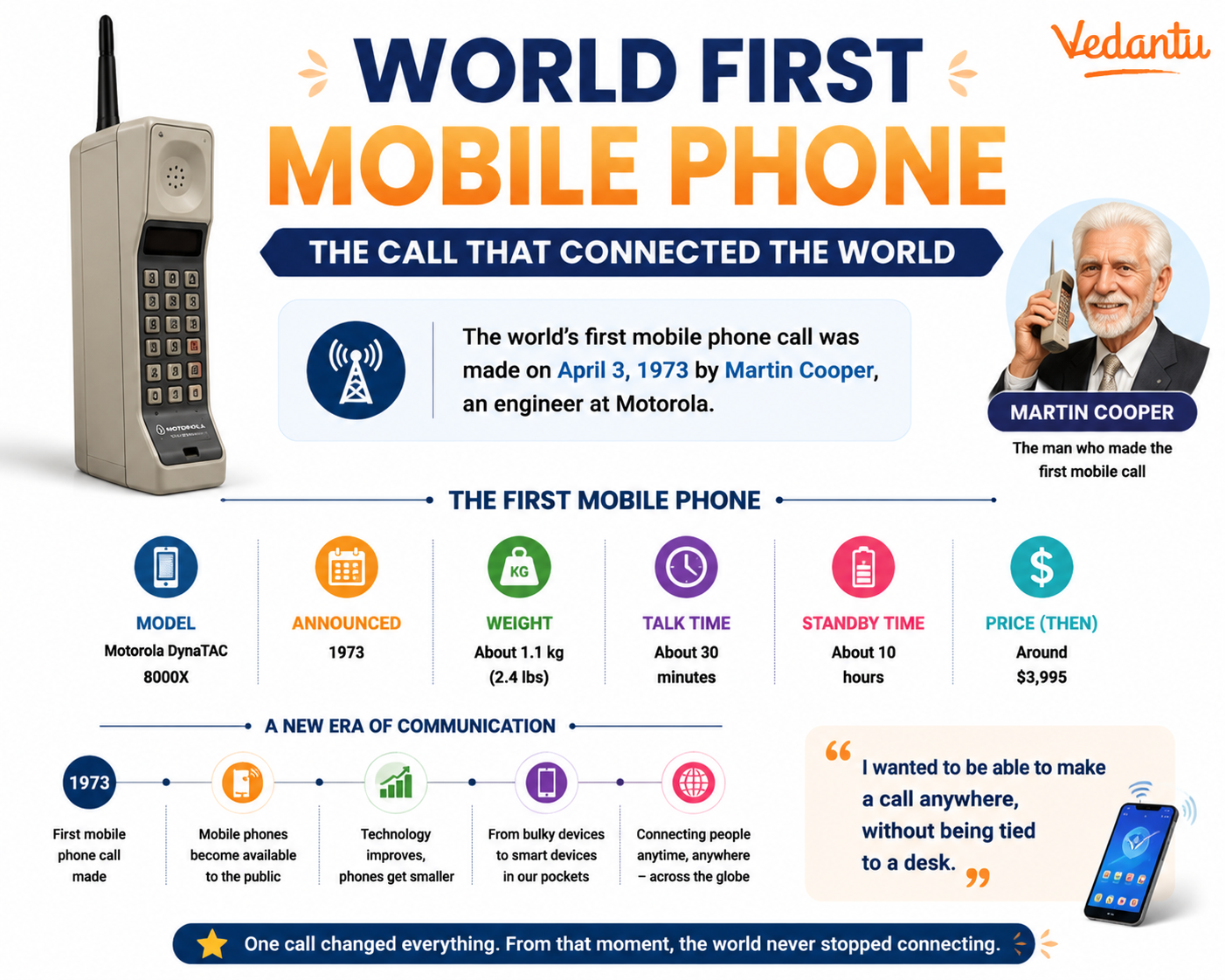
Who Invented the World’s First Mobile Phone?
The world’s first mobile phone was invented by Martin Cooper, an engineer working at Motorola. On April 3, 1973, he made the first public mobile phone call in New York City. This historic call was made to Joel Engel, a rival researcher at Bell Labs. Martin Cooper is widely regarded as the father of the mobile phone.
- Inventor - Martin Cooper
- Company - Motorola
- Date of first call - April 3, 1973
- Place - New York City, USA
Name and Model of the First Mobile Phone
The first commercially available mobile phone was called the Motorola DynaTAC 8000X. Although the first call was made in 1973, it took about 10 years of development before the device was released to the public in 1983. The phone was large, heavy, and expensive compared to today’s devices.
Key Features of Motorola DynaTAC 8000X
- Weight - Around 1.1 kg
- Length - About 25 cm
- Battery life - 20 to 30 minutes of talk time
- Charging time - Approximately 10 hours
- Price - Around 3995 US dollars in 1983
Important Facts About the World’s First Mobile Phone
| Parameter | Details | Year |
|---|---|---|
| First Mobile Call | Made by Martin Cooper | 1973 |
| Commercial Launch | Motorola DynaTAC 8000X | 1983 |
The table above highlights the key milestones in the development of the first mobile phone. The invention in 1973 demonstrated the concept, while the commercial launch in 1983 made mobile communication available to the public.
How the First Mobile Phone Worked
The first mobile phone operated using analog cellular networks. It connected to nearby cell towers that transmitted voice signals through radio frequencies. Unlike modern digital smartphones, the early system had limited coverage and fewer users per network area. However, it successfully proved that wireless personal communication was possible.
Basic Working Process
- The user dialed a number on the keypad.
- The phone converted voice into radio signals.
- Signals were transmitted to the nearest cell tower.
- The network connected the call to the receiver.
Impact of the First Mobile Phone
The invention of the first mobile phone changed global communication permanently. It removed the limitation of fixed-line telephones and introduced portability. Over time, mobile phones became smaller, cheaper, and more powerful. This innovation led to the development of digital networks, smartphones, mobile internet, and global connectivity.
- Enabled wireless communication
- Laid the foundation for smartphones
- Boosted global business and communication
- Transformed social interaction
Difference Between the First Mobile Phone and Modern Smartphones
The first mobile phone was mainly designed for voice communication. Modern smartphones are multifunctional devices that combine communication, computing, photography, entertainment, and internet access in one compact gadget.
Major Differences
- Size - Early phones were large and heavy, modern phones are slim and lightweight
- Technology - Analog network vs digital 4G and 5G networks
- Battery - Very limited talk time vs long lasting batteries
- Features - Only calling vs apps, internet, camera, and multimedia
Why the World’s First Mobile Phone is Important for GK
Questions about the world’s first mobile phone are frequently asked in school exams, quizzes, and competitive examinations. Important points such as the inventor, year of invention, company name, and model are commonly tested. Knowing these facts helps students build strong general awareness about technological advancements.
- Father of mobile phone - Martin Cooper
- First call made in - 1973
- First commercial model - Motorola DynaTAC 8000X
- Commercial release year - 1983
Conclusion
The world’s first mobile phone was a groundbreaking invention that transformed the way people communicate. Invented by Martin Cooper in 1973 and later commercialized as the Motorola DynaTAC 8000X in 1983, it marked the beginning of the mobile communication era. Although it was large and expensive, it paved the way for the advanced smartphones we use today. Understanding its history and significance is essential for students and anyone interested in technological progress.
FAQs on World’s First Mobile Phone: Complete Student Guide
1. What was the world’s first mobile phone?
The world’s first mobile phone was the Motorola DynaTAC 8000X, introduced in 1983 as the first commercially available handheld mobile device.
- Developed by Motorola
- Weighed about 1.1 kg (2.5 pounds)
- Offered about 30 minutes of talk time
- Took nearly 10 hours to charge
This historic device marked the beginning of the mobile communication revolution and paved the way for modern cell phones and smartphones.
2. Who invented the first mobile phone?
The first mobile phone was invented by Martin Cooper, an engineer at Motorola, in 1973.
- Made the first mobile call on April 3, 1973
- Called his rival at Bell Labs
- Known as the Father of the Mobile Phone
Martin Cooper’s invention laid the foundation for today’s wireless communication technology and global cellular networks.
3. When was the first mobile phone invented?
The first mobile phone was invented on April 3, 1973, when Martin Cooper made the first handheld mobile call.
- Developed by Motorola
- First commercial launch in 1983
- Began the era of cellular communication
This invention marked a major milestone in the history of telecommunication and wireless devices.
4. How much did the first mobile phone cost?
The first commercial mobile phone, the Motorola DynaTAC 8000X, cost about $3,995 in 1983.
- Equivalent to thousands of dollars today
- Considered a luxury device
- Mainly used by business professionals
Due to its high price, early cell phones were not affordable for the general public.
5. What were the features of the first mobile phone?
The first mobile phone had very basic features compared to modern smartphones.
- 30 minutes of talk time
- 10-hour charging time
- Could store up to 30 phone numbers
- No texting, internet, or camera
It was mainly designed for voice communication and marked the beginning of portable wireless technology.
6. Why is Martin Cooper called the Father of the Mobile Phone?
Martin Cooper is called the Father of the Mobile Phone because he made the first handheld cellular call in 1973.
- Led the team at Motorola
- Challenged the dominance of Bell Labs
- Promoted personal, portable communication
His contribution transformed the world of telecommunications, cellular networks, and mobile devices.
7. What was the weight of the first mobile phone?
The first mobile phone, the Motorola DynaTAC 8000X, weighed about 1.1 kilograms (2.5 pounds).
- Much heavier than modern smartphones
- Large and bulky design
- Nicknamed the “brick phone”
This highlights how far mobile technology evolution has progressed over the years.
8. How did the first mobile phone change communication?
The first mobile phone revolutionized communication by allowing people to make calls without being connected to a landline.
- Introduced portable communication
- Reduced dependence on fixed telephones
- Started the growth of cellular networks worldwide
It laid the groundwork for today’s smartphones, mobile internet, and global connectivity.
9. Which company developed the first commercial mobile phone?
The first commercial mobile phone was developed by Motorola.
- Model name: DynaTAC 8000X
- Launched in 1983
- Led by engineer Martin Cooper
Motorola became a pioneer in the early mobile phone industry and cellular communication market.
10. What is the importance of the first mobile phone in history?
The first mobile phone is important because it marked the beginning of the modern mobile communication era.
- Initiated the development of cellular technology
- Inspired innovation in wireless devices
- Led to the creation of smartphones and mobile apps
It remains a key milestone in the history of telecommunications, information technology, and global connectivity.
