






Reasons for Creating Union Territories in India’s Constitution
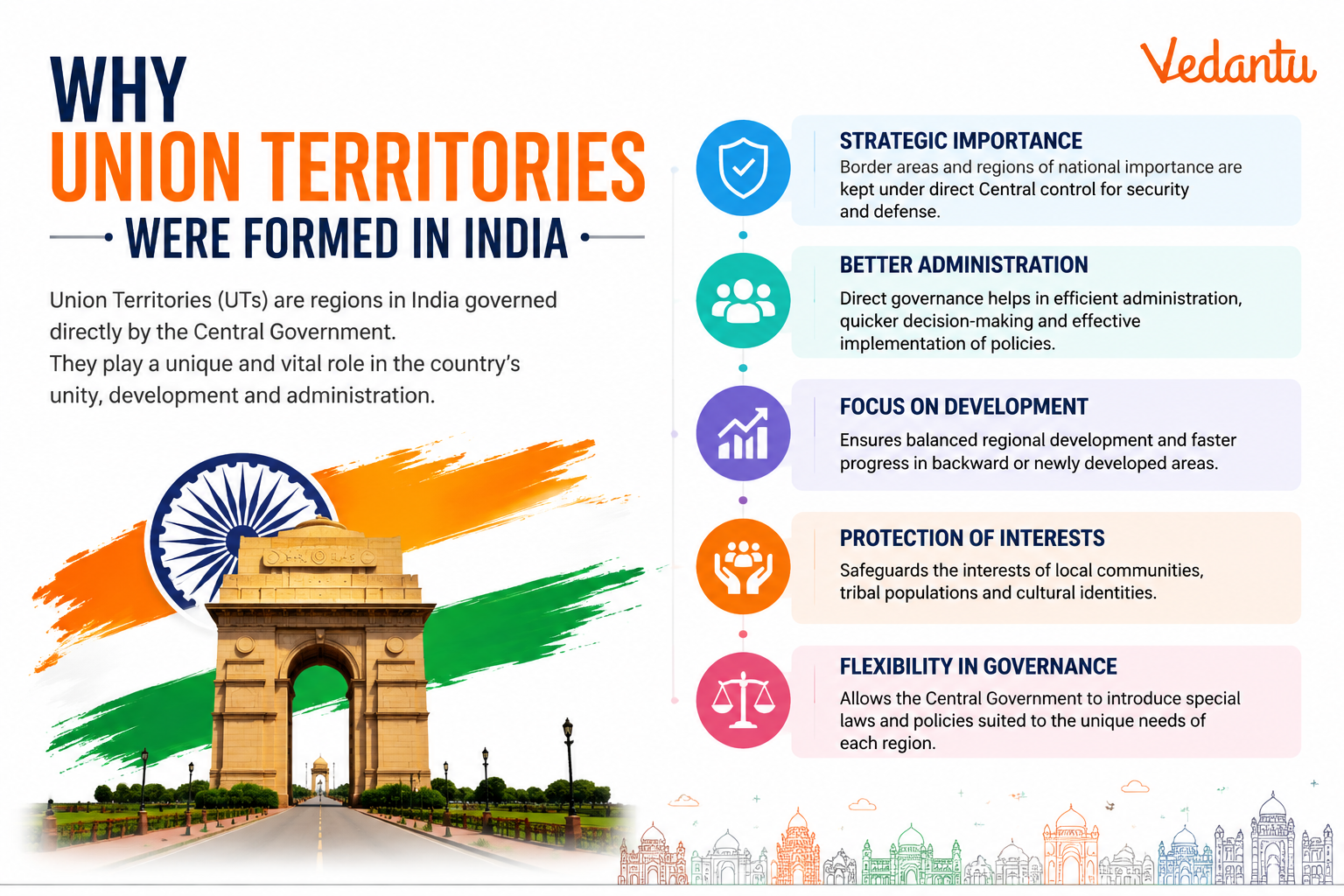
Union Territories in India were formed to ensure better administration, national security, cultural protection, and balanced regional development. Unlike states, Union Territories are directly governed by the Central Government, though some have their own legislative assemblies. The creation of Union Territories was based on historical, political, administrative, and strategic reasons. Understanding why Union Territories were formed is important for students, competitive exam aspirants, and general readers who want to learn about India’s administrative structure.
What Are Union Territories?
Union Territories are administrative divisions of India that are governed directly by the President of India through an Administrator or Lieutenant Governor. While states have their own governments with full powers under the Constitution, Union Territories have limited powers and depend more on the Central Government.
- They are governed under Articles 239 to 241 of the Indian Constitution.
- Some Union Territories like Delhi and Puducherry have legislative assemblies.
- Others are directly administered by the Central Government.
Why Were Union Territories Formed?
1. Administrative Convenience
Some regions were too small in size or population to be made full-fledged states. Managing them as separate states would have been inefficient. Therefore, they were made Union Territories for better governance and administrative control.
2. Strategic Importance
Certain areas have high strategic value due to their location near international borders or coastal regions. Direct control by the Central Government ensures stronger security and quicker decision-making.
- Andaman and Nicobar Islands - important for naval defense.
- Lakshadweep - strategically located in the Arabian Sea.
- Ladakh - sensitive border region.
3. Cultural and Historical Reasons
Some territories had unique cultural, linguistic, or historical backgrounds that made them different from neighboring states. To preserve their identity and ensure smooth integration into India, they were designated as Union Territories.
For example, Puducherry was formerly a French colony and has a distinct cultural influence. Direct central administration helped in its smooth transition after independence.
4. Political and Constitutional Reasons
Certain regions required special administrative arrangements due to political conditions. Making them Union Territories allowed the Central Government to maintain stability and implement policies effectively.
Delhi, being the national capital, was made a Union Territory to ensure that the Central Government retains control over national institutions and security.
5. Transitional Arrangements
Some regions were initially made Union Territories as a temporary arrangement before becoming full states. This allowed the Central Government to prepare the region for statehood.
- Himachal Pradesh was once a Union Territory before becoming a state.
- Goa was a Union Territory before attaining statehood in 1987.
Key Reasons for Formation of Union Territories
| Reason | Explanation | Example |
|---|---|---|
| Administrative Efficiency | Small size or population made statehood impractical | Lakshadweep |
| Strategic Importance | Direct central control for national security | Ladakh |
| Cultural Distinctiveness | Unique historical and cultural background | Puducherry |
The table above summarizes the major reasons behind the formation of Union Territories in India. Each Union Territory has its own background, but most were created to ensure effective governance and national interest.
Difference Between States and Union Territories
- States have elected governments with full legislative powers, while Union Territories have limited powers.
- States are governed by a Chief Minister, while Union Territories are administered by a Lieutenant Governor or Administrator.
- Union Territories are directly controlled by the Central Government.
Current Union Territories of India
As of now, India has the following Union Territories:
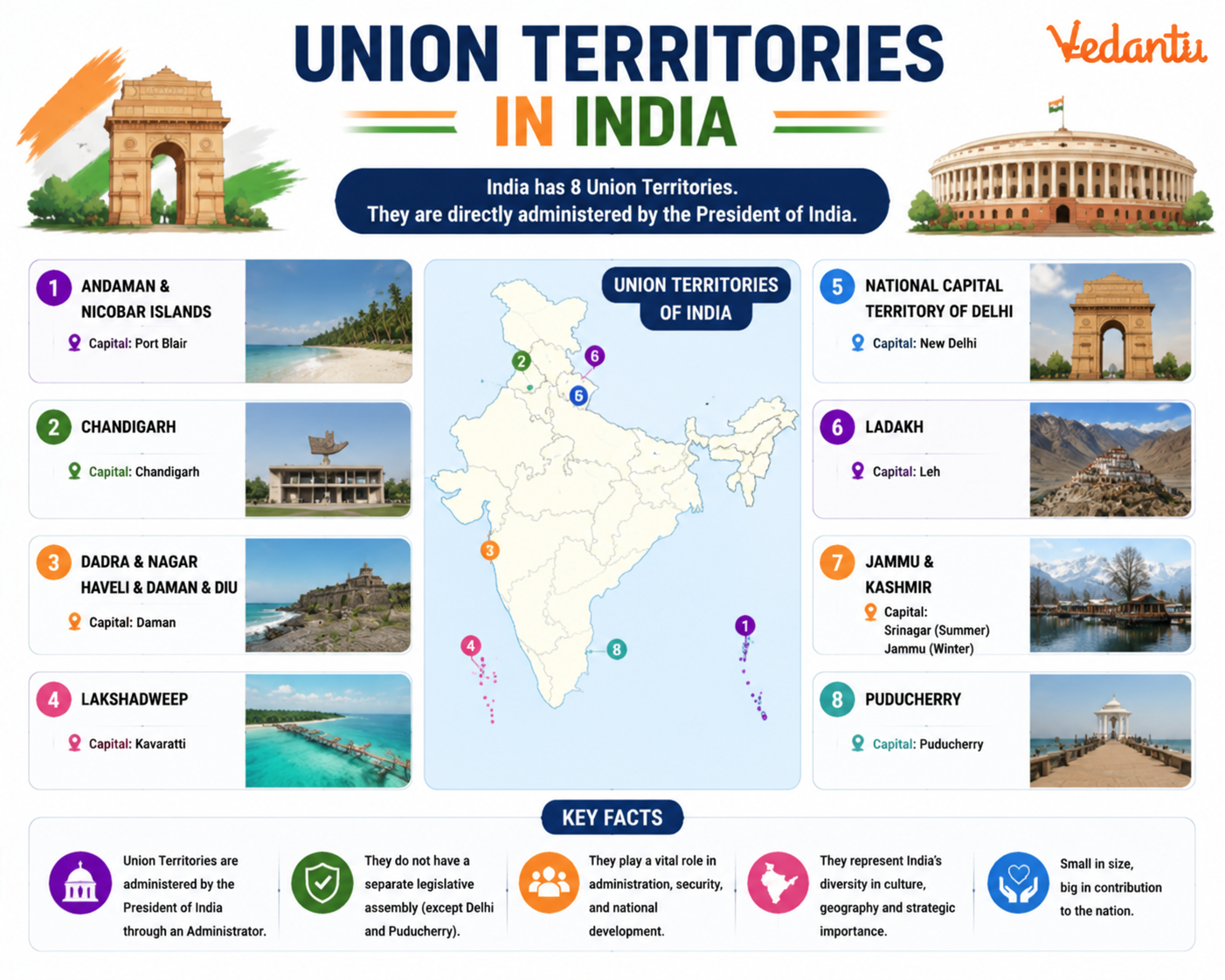
- Andaman and Nicobar Islands
- Chandigarh
- Dadra and Nagar Haveli and Daman and Diu
- Delhi
- Jammu and Kashmir
- Ladakh
- Lakshadweep
- Puducherry
Conclusion
Union Territories were formed to meet specific administrative, strategic, cultural, and political needs of the country. They allow the Central Government to exercise direct control over sensitive or small regions and ensure efficient governance. Understanding why Union Territories were formed helps in grasping the structure of Indian federalism and the balance between central and state powers. This topic is important for General Knowledge and competitive examinations as it explains how India manages its diverse and strategically important regions effectively.
FAQs on Why Union Territories Were Formed in India: Simple Explanation for Students
1. Why were Union Territories formed in India?
Union Territories were formed to ensure better administration of small, strategically important, or culturally distinct regions in India.
• Administrative efficiency in small areas with limited population
• Direct control by the Central Government for national security and unity
• Protection of tribal, cultural, and ethnic diversity
• Management of newly acquired territories after independence
• Balanced governance where full statehood was not practical
These reasons explain why Union Territories in India differ from states in governance structure.
2. What is a Union Territory in India?
A Union Territory (UT) is a region directly governed by the Central Government of India under the Constitution.
• Administered by a Lieutenant Governor or Administrator
• Some UTs like Delhi and Puducherry have partial statehood with a legislative assembly
• Mentioned under Article 239 of the Indian Constitution
• Created for better governance and national control
This system ensures centralized administration in specific regions.
3. How are Union Territories different from States?
Union Territories differ from states mainly in terms of administrative control and powers.
• States have an elected Chief Minister and Governor
• UTs are governed by an Administrator appointed by the President
• States enjoy greater legislative powers under the State List
• UTs depend more on the Central Government
This distinction highlights the difference between State Government and Union Territory administration.
4. How many Union Territories are there in India in 2026?
As of 2026, India has 8 Union Territories.
• Andaman and Nicobar Islands
• Chandigarh
• Dadra and Nagar Haveli and Daman and Diu
• Delhi (NCT)
• Jammu and Kashmir
• Ladakh
• Lakshadweep
• Puducherry
These UTs were created based on administrative, political, and strategic needs.
5. Why was Delhi made a Union Territory?
Delhi was made a Union Territory to keep the national capital under central control for security and governance.
• It is the capital of India
• Houses key institutions like Parliament and Supreme Court
• Requires special administrative status
• Given partial statehood as National Capital Territory (NCT) of Delhi
This ensures balanced power between the state government and the Centre.
6. Why was Jammu and Kashmir made a Union Territory?
Jammu and Kashmir became a Union Territory after the abrogation of Article 370 in 2019 to strengthen national integration and governance.
• Reorganization under the Jammu and Kashmir Reorganisation Act, 2019
• Division into Jammu & Kashmir and Ladakh UTs
• Direct central administration for better security and development
• Focus on political stability and uniform laws
This change aimed at stronger integration with the Union of India.
7. Do Union Territories have their own legislature?
Only some Union Territories have their own legislative assemblies.
• Delhi, Puducherry, and Jammu & Kashmir have legislatures
• Other UTs are directly governed by the Central Government
• Legislative powers are limited compared to full states
• Parliament can make laws for all UTs
This mixed model ensures flexibility in Union Territory governance.
8. Who administers a Union Territory?
A Union Territory is administered by an official appointed by the President of India.
• Known as Lieutenant Governor or Administrator
• Acts as a representative of the President of India
• Implements policies of the Central Government
• May work with an elected government in UTs with legislature
This system ensures centralized supervision and efficient administration.
9. Why were small territories like Lakshadweep made Union Territories?
Small territories like Lakshadweep were made Union Territories due to their limited size, population, and strategic importance.
• Small geographical area and population
• Strategic location in the Arabian Sea
• Need for direct central governance
• Protection of local tribal culture and environment
This arrangement supports better management and national security.
10. Can a Union Territory become a State?
Yes, a Union Territory can become a state if Parliament passes a law under the Constitution.
• Parliament has power under Article 3 of the Indian Constitution
• Example: Himachal Pradesh and Goa were once UTs
• Requires political and administrative readiness
• Decision depends on governance and development needs
This shows that the status of a Union Territory can change over time.
