






Key Factors That Explain Why India Is Unique in the World
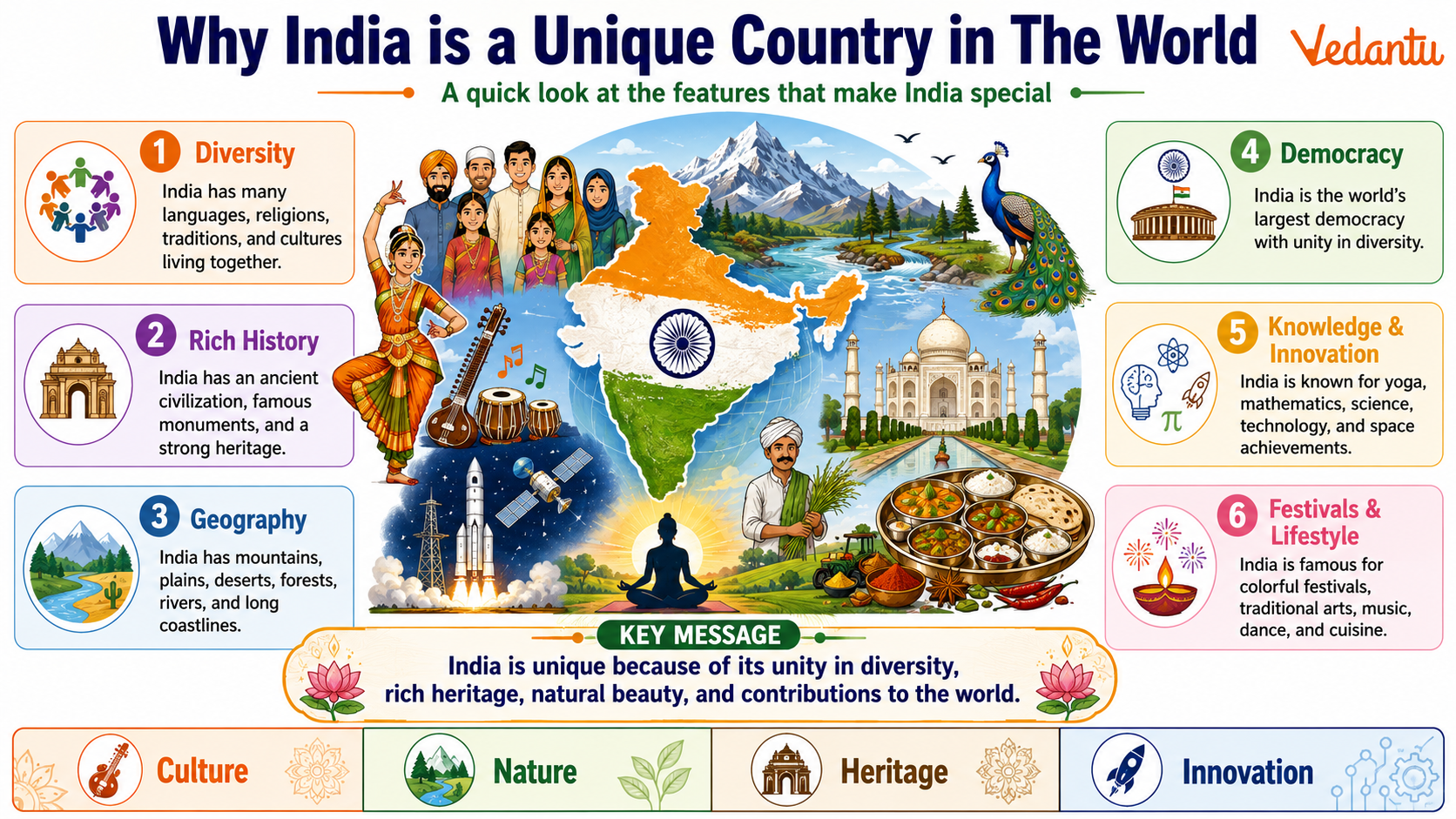
India is often described as one of the most unique countries in the world due to its extraordinary diversity, ancient civilization, cultural richness, and rapid modern development. From the snow-covered Himalayas to the tropical beaches of Kerala, from hundreds of languages to multiple religions living together, India presents a rare combination of unity in diversity. It is a country where tradition and technology coexist, making it distinct on the global stage.
Geographical Uniqueness of India
India is the seventh largest country in the world by area and has a wide range of geographical features. Its physical diversity is one of the main reasons why India is considered unique.
- The Himalayas in the north protect the country and influence its climate.
- The Indo-Gangetic plains are among the most fertile lands in the world.
- The Thar Desert in the west adds to its climatic diversity.
- The Western and Eastern Ghats are rich in biodiversity.
- A coastline of over 7,500 km supports trade, fishing, and tourism.
This geographical variety supports different lifestyles, occupations, and cultures across the country.
Cultural and Religious Diversity
India is known as the land of unity in diversity. It is home to people of different religions, languages, and traditions living together peacefully.
Religious Diversity
- Hinduism, Buddhism, Jainism, and Sikhism originated in India.
- Islam, Christianity, Judaism, and Zoroastrianism are also widely practiced.
- India celebrates numerous festivals such as Diwali, Eid, Christmas, Gurpurab, and Pongal.
Linguistic Diversity
India has 22 officially recognized languages under the Constitution and hundreds of regional languages and dialects. Hindi and English are widely used for communication, administration, and education.
This cultural and linguistic variety makes India one of the most diverse societies in the world.
Historical Significance
India has one of the oldest civilizations in the world, dating back to the Indus Valley Civilization around 2500 BCE. Over centuries, it has seen the rise and fall of powerful empires such as the Maurya, Gupta, Mughal, and the British Empire.
- Ancient universities like Nalanda attracted scholars from across Asia.
- India gave the world the concept of zero and the decimal system.
- The freedom struggle led by Mahatma Gandhi promoted non-violence and civil disobedience.
India’s historical legacy continues to influence its identity and global image.
Political and Democratic Strength
India is the world’s largest democracy. Since gaining independence in 1947, it has maintained a stable democratic system with regular elections.
- A written Constitution that ensures fundamental rights.
- A federal structure with powers divided between central and state governments.
- An independent judiciary and free press.
Managing such diversity under one democratic framework makes India politically unique.
Economic and Technological Growth
India is one of the fastest-growing major economies in the world. It has shown remarkable progress in various sectors.
- A global leader in information technology and software services.
- Significant achievements in space research through ISRO missions.
- A strong agricultural base supporting a large population.
- A growing startup ecosystem and digital economy.
India balances traditional industries with modern innovation, adding to its uniqueness.
Key Facts That Make India Unique
| Feature | Details | Global Significance |
|---|---|---|
| Democracy | World’s largest democracy | Model of diverse democratic governance |
| Culture | Multiple religions and languages | Symbol of unity in diversity |
| History | Ancient civilization and heritage sites | Rich contribution to world knowledge |
These features collectively highlight why India stands out among nations and continues to influence global culture, politics, and economics.
Natural and Biodiversity Wealth
India is one of the 17 mega-diverse countries in the world. It has a wide variety of flora and fauna due to its different climatic zones.
- Home to the Bengal tiger, Asiatic lion, and Indian elephant.
- Numerous national parks and wildlife sanctuaries.
- Diverse ecosystems including mountains, forests, wetlands, and coral reefs.
This ecological richness further enhances India’s uniqueness on the world map.
Conclusion
India is unique because of its remarkable blend of ancient traditions and modern progress, vast geographical diversity, rich cultural heritage, democratic strength, and economic growth. It successfully unites people of different backgrounds under one national identity. This rare combination of diversity and unity makes India truly one of a kind in the world.
FAQs on Why India Is a Unique Country in the World for Students
1. Why is India considered a unique country in the world?
India is considered unique because of its extraordinary diversity in culture, religion, language, and geography.
- Home to over 1.4 billion people with diverse ethnic groups
- Recognizes 22 official languages and hundreds of dialects
- Birthplace of major religions like Hinduism, Buddhism, Jainism, and Sikhism
- Features varied landscapes including the Himalayas, Thar Desert, Western Ghats, and Indian Ocean coastline
- Known as the world’s largest democracy, making India politically unique as well.
2. What makes India culturally diverse?
India’s cultural diversity comes from its long history, regional traditions, and multi-religious society.
- Different festivals like Diwali, Eid, Christmas, and Baisakhi are celebrated nationwide
- Varied traditional dances such as Bharatanatyam, Kathak, and Kathakali
- Diverse food cuisines from North Indian curries to South Indian dosas
- Unique clothing styles like saree, turban, and dhoti
This unity in diversity makes Indian culture globally distinctive.
3. Why is India called the land of religions?
India is called the land of religions because several major world religions originated here.
- Birthplace of Hinduism, the oldest living religion
- Origin of Buddhism founded by Gautama Buddha
- Emergence of Jainism and Sikhism
- Peaceful coexistence of Islam, Christianity, Judaism, and Zoroastrianism
This spiritual heritage makes India a global center of faith and philosophy.
4. How does India’s geography make it unique?
India’s geography is unique due to its wide range of natural features within one country.
- The Himalayan mountain range in the north
- The vast Thar Desert in Rajasthan
- Fertile Indo-Gangetic Plains
- Long coastline along the Arabian Sea and Bay of Bengal
- Rich biodiversity in the Western and Eastern Ghats
This geographical diversity supports varied climates, wildlife, and agriculture.
5. Why is India known as the world’s largest democracy?
India is called the world’s largest democracy because it has the highest number of eligible voters.
- Democratic system established in 1950 with the Indian Constitution
- Regular free and fair general elections
- Multi-party political system
- Fundamental Rights guaranteed to citizens
This democratic framework highlights India’s political uniqueness.
6. What role does history play in making India unique?
India’s ancient and continuous history makes it one of the world’s oldest civilizations.
- Home to the Indus Valley Civilization (2500 BCE)
- Influence of powerful empires like the Maurya and Gupta Empires
- Cultural contributions during the Mughal period
- Freedom struggle led by Mahatma Gandhi against British rule
This rich historical legacy shapes modern India’s identity.
7. How is India unique in terms of languages?
India is linguistically unique with hundreds of spoken languages and scripts.
- 22 scheduled languages recognized by the Constitution
- Major languages include Hindi, Bengali, Tamil, Telugu, and Marathi
- Different scripts such as Devanagari, Tamil, and Gujarati
- Multilingual population comfortable with two or more languages
This linguistic diversity reflects India’s multicultural identity.
8. Why is India famous for its unity in diversity?
India is famous for unity in diversity because people of different backgrounds live together peacefully.
- Multiple religions and communities coexist
- National symbols like the Indian Constitution promote equality
- Shared celebrations of national festivals like Independence Day and Republic Day
- Respect for cultural differences strengthens national integration
This principle defines India’s social harmony.
9. What makes India’s heritage and monuments unique?
India’s heritage monuments reflect its artistic, architectural, and historical richness.
- The Taj Mahal, a UNESCO World Heritage Site
- Ancient temples like Konark Sun Temple and Meenakshi Temple
- Historic forts such as Red Fort and Jaipur Forts
- Rock-cut caves of Ajanta and Ellora
These monuments showcase India’s architectural excellence and cultural legacy.
10. How does India contribute uniquely to the world?
India contributes uniquely to the world through knowledge, spirituality, science, and culture.
- Development of Yoga and Ayurveda
- Contributions to mathematics like the concept of Zero
- Growing leadership in Information Technology (IT) and space research like ISRO missions
- Global influence through Bollywood and Indian cuisine
These achievements make India an influential and unique nation globally.
