






Who Is Eligible for Z, Z+, Y and X Category Security Cover in India?
In India, high-risk individuals such as top political leaders, judges, bureaucrats, celebrities, and other important personalities are provided special security cover based on threat perception. The security categories are popularly known as X, Y, Z, and Z Plus security. These security levels are decided after a detailed assessment by intelligence agencies and are provided mainly by central forces like the National Security Guard (NSG), Central Reserve Police Force (CRPF), and state police. Understanding who gets Z, Z Plus, Y, and X security in India and why is important for competitive exams and general awareness.
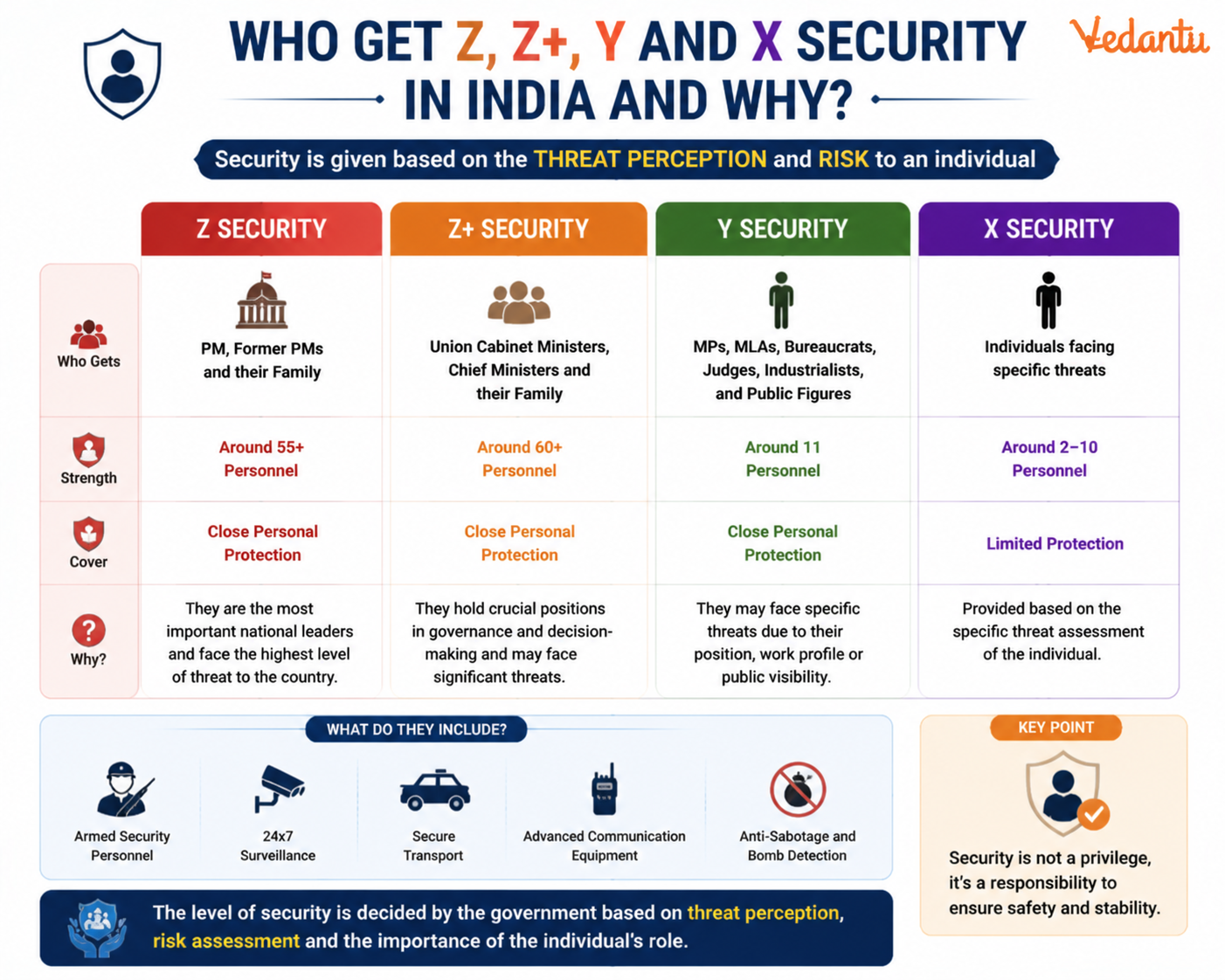
What Are Security Categories in India?
Security categories in India are classifications of protection given to individuals facing threats to their life. The level of security depends on the seriousness of the threat assessed by agencies like the Intelligence Bureau (IB). The central or state government approves the security cover based on recommendations.
- Security is provided after a threat perception report.
- The Ministry of Home Affairs takes the final decision at the central level.
- Security can be upgraded or downgraded based on updated assessments.
Types of Security in India
| Security Category | Number of Security Personnel | Provided To |
|---|---|---|
| Z Plus | Around 55 or more personnel | Top political leaders, high-risk individuals |
| Z | Around 22 personnel | Senior politicians, judges, VIPs |
| Y | Around 11 personnel | Politicians, celebrities, officials |
| X | 2 personnel | Individuals with lower threat perception |
The number of personnel may vary depending on the situation and threat level. The highest category is Z Plus, while X is the lowest among these four.
Z Plus Security
Z Plus security is the highest level of security cover in India provided to individuals facing extreme threat. It is usually given to top political leaders and persons who are at high risk of terrorist attacks or serious threats.
Features of Z Plus Security
- Around 55 or more security personnel.
- Includes NSG commandos and armed police officers.
- Bulletproof vehicles and advanced security equipment.
- 24 hour protection at residence and during travel.
The Prime Minister of India receives Special Protection Group security, which is even higher and separate from Z Plus.
Z Security
Z security is provided to individuals who face significant threats but are not at the highest level of risk. Many senior political leaders, judges, and high-profile personalities are covered under this category.
Features of Z Security
- Around 22 security personnel.
- Includes armed guards and escort vehicles.
- Protection at home and during public appearances.
Y Security
Y category security is given to individuals who have moderate threat perception. This category is common for politicians, public figures, and witnesses in sensitive cases.
Features of Y Security
- Around 11 security personnel.
- Includes personal security officers.
- Protection during travel and public events.
X Security
X category is the lowest level of VIP security provided in India. It is granted when there is a minor but noticeable threat to an individual.
Features of X Security
- Two armed security personnel.
- Basic protection at residence or during travel.
Why Are These Security Levels Provided?
Security categories are provided to protect individuals who may be targeted due to their position, decisions, political involvement, or public influence. The main reasons include:
- Threat from terrorist organizations.
- Political rivalry or extremist groups.
- Judicial decisions in sensitive cases.
- Public prominence and controversial statements.
The primary aim is to ensure the safety of important individuals and maintain national stability.
Important Points for Competitive Exams
- Z Plus is the highest security category among X, Y, Z, and Z Plus.
- Security is based on threat perception assessment.
- The Ministry of Home Affairs approves central security cover.
- Security can be withdrawn or downgraded.
Questions related to security categories in India are frequently asked in UPSC, SSC, State PSC, and other competitive examinations under General Knowledge and Polity sections.
Conclusion
The X, Y, Z, and Z Plus security categories in India are structured systems designed to protect individuals facing different levels of threat. These categories are determined after careful evaluation by intelligence agencies and approved by the government. Understanding who gets which security cover and why helps in building strong general awareness and is highly useful for competitive exam preparation.
FAQs on Who Gets Z, Z+, Y and X Security in India and Why It Is Given
1. What are Z, Z+, Y, and X security categories in India?
The Z, Z+, Y, and X security categories are levels of VIP security in India provided based on threat perception.
• Z+ Security – Highest civilian security cover with around 50–55 personnel including NSG commandos.
• Z Security – Around 20–25 security personnel including armed guards.
• Y Security – 8–11 security staff for moderate threat levels.
• X Security – 2–4 armed security personnel for basic protection.
These categories are part of India's VIP security system and are granted after threat assessment by intelligence agencies.
2. Who decides the security category for a person in India?
The Ministry of Home Affairs (MHA) decides the security category based on intelligence reports.
• Inputs are taken from Intelligence Bureau (IB), state police, and other agencies.
• Decisions are based on threat perception analysis.
• Security cover can be upgraded or downgraded depending on risk.
This system ensures that VIP protection in India is provided according to actual security threats.
3. Who usually gets Z+ security in India?
The Z+ security category is given to individuals facing the highest level of threat.
• Prime Minister of India (with SPG cover).
• Former Prime Ministers and their immediate families (based on threat review).
• Senior political leaders and high-risk individuals.
• Key witnesses or individuals under serious terror threats.
This level includes NSG Black Cat commandos and is considered the highest civilian security cover in India.
4. What is the difference between Z+ and Z security?
The main difference between Z+ and Z security is the number of personnel and level of protection.
• Z+ – 50+ security personnel including NSG commandos and advanced security arrangements.
• Z – 20–25 personnel with armed escorts and police protection.
• Z+ includes stronger convoy systems and closer surveillance.
This distinction is important in understanding VIP security classifications in India.
5. Why is Y category security provided?
The Y category security is provided to individuals facing moderate security threats.
• Includes 8–11 armed security personnel.
• Given to politicians, judges, or public figures with potential risks.
• May include personal security officers (PSOs).
This level ensures adequate personal protection security without the extensive arrangements of Z or Z+ categories.
6. What does X category security include?
The X category security is the lowest level of VIP protection in India.
• Provides 2–4 armed security personnel.
• Offered when there is a minimal but noticeable threat.
• Usually includes one or two Personal Security Officers (PSOs).
It is designed for basic VIP security cover based on limited threat perception.
7. Is security cover permanent once granted?
No, security cover in India is not permanent and depends on regular threat reviews.
• The Intelligence Bureau conducts periodic assessments.
• Security levels can be upgraded or downgraded.
• Cover can be withdrawn if no threat exists.
This ensures proper allocation of VIP protection forces and prevents misuse of security resources.
8. What is SPG security and how is it different from Z+?
The Special Protection Group (SPG) provides exclusive security to the Prime Minister of India and immediate family.
• SPG is governed by the SPG Act, 1988.
• It is more specialized than Z+ security.
• Z+ may include NSG commandos, but SPG is exclusively for the PM.
SPG is considered the most elite form of prime ministerial security in India.
9. Which forces provide VIP security in India?
Several forces provide VIP security in India depending on the category assigned.
• NSG (National Security Guard) – For Z+ category.
• CRPF (Central Reserve Police Force) – Often for Z and Y categories.
• ITBP and CISF – For selected VIP duties.
• State Police – Local protection and escorts.
This multi-agency system ensures comprehensive high-profile security protection.
10. Why is VIP security important in India?
VIP security is important to protect leaders and public figures from potential threats and maintain national stability.
• Prevents assassination attempts and terror attacks.
• Ensures smooth functioning of government and administration.
• Protects individuals facing political or extremist threats.
The system of Z, Z+, Y, and X security categories plays a vital role in safeguarding India's democracy and leadership.
