






What Are the Main Types of Unemployment with Examples?
Unemployment is one of the most important economic problems faced by countries around the world. It refers to a situation where individuals who are willing and able to work at the prevailing wage rate are unable to find employment. Understanding the Types of Unemployment is essential for students, competitive exam aspirants, and general readers because it helps in analyzing economic conditions, government policies, and labor market trends. Different types of unemployment arise due to different reasons, and each has unique effects on the economy and society.
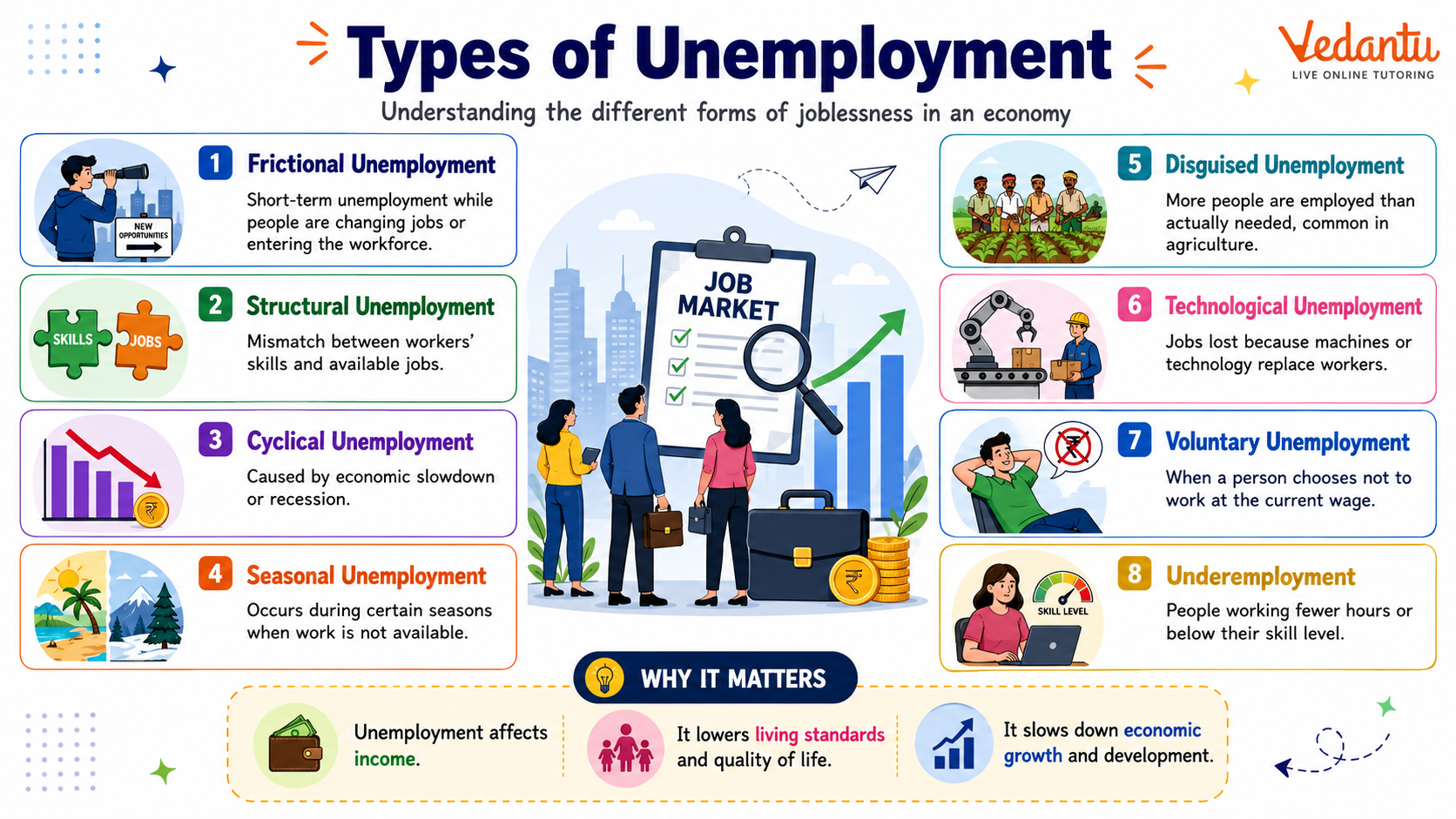
What is Unemployment?
Unemployment occurs when people who are capable of working and actively seeking jobs cannot find suitable employment. It is measured using the unemployment rate, which represents the percentage of unemployed people in the total labor force. The nature and causes of unemployment vary, which leads to different classifications.
Major Types of Unemployment
1. Frictional Unemployment
Frictional unemployment occurs when people are temporarily unemployed while changing jobs or entering the workforce for the first time. It is a short-term and natural form of unemployment.
- Fresh graduates searching for their first job
- Workers switching from one job to another
- People relocating to a new city
2. Structural Unemployment
Structural unemployment arises when there is a mismatch between workers skills and the requirements of available jobs. It is often caused by technological changes or shifts in the economy.
- Automation replacing manual labor
- Decline of traditional industries
- Lack of required technical skills
3. Cyclical Unemployment
Cyclical unemployment is caused by fluctuations in the business cycle. During economic recessions, demand for goods and services decreases, leading to job losses.
- Occurs during economic slowdown
- Reduces when the economy recovers
- Affected by overall demand in the market
4. Seasonal Unemployment
Seasonal unemployment happens when workers are employed only during certain seasons of the year. It is common in agriculture, tourism, and construction sectors.
- Farm workers during off-harvest seasons
- Tourism workers during off-season periods
- Workers in holiday-based industries
5. Disguised Unemployment
Disguised unemployment occurs when more people are employed in a job than actually required. The extra workers do not contribute to increased productivity.
- Common in agricultural sectors of developing countries
- Marginal productivity of extra workers is zero
- Hidden form of unemployment
6. Technological Unemployment
Technological unemployment results from the introduction of new machines and technology that replace human labor.
- Automation in factories
- Use of artificial intelligence in services
- Reduced demand for low-skilled workers
Comparison of Types of Unemployment
| Type | Main Cause | Nature |
|---|---|---|
| Frictional | Job transition | Short-term |
| Structural | Skill mismatch | Long-term |
| Cyclical | Economic recession | Depends on business cycle |
The table highlights the major differences among common types of unemployment. Each type requires different policy measures such as skill development programs, economic stimulus, or labor market reforms.
Causes of Unemployment
- Rapid population growth
- Slow economic growth
- Technological advancement
- Lack of skill development
- Regional imbalance in industrial development
Effects of Unemployment
Unemployment has serious economic and social consequences. It reduces income levels, lowers purchasing power, and slows economic growth. Long-term unemployment may also lead to poverty, inequality, and social unrest.
- Increase in poverty rate
- Rise in government welfare expenditure
- Loss of human resources
- Social and psychological stress
Measures to Reduce Unemployment
- Promoting skill development and vocational training
- Encouraging entrepreneurship and small businesses
- Investing in infrastructure projects
- Implementing supportive labor market policies
Conclusion
Understanding the different types of unemployment is crucial for analyzing economic health and planning effective solutions. Each type such as frictional, structural, cyclical, seasonal, disguised, and technological unemployment has distinct causes and impacts. By identifying the specific nature of unemployment in an economy, governments and policymakers can design appropriate strategies to create jobs, improve skills, and ensure sustainable economic growth.
FAQs on Types of Unemployment in Economics: Meaning and Overview
1. What are the main types of unemployment?
The main types of unemployment refer to different situations in which people are willing to work but cannot find jobs. The major types include:
• Frictional Unemployment – Temporary unemployment while changing jobs
• Structural Unemployment – Mismatch between skills and job requirements
• Cyclical Unemployment – Caused by economic recession or slowdown
• Seasonal Unemployment – Occurs during certain seasons only
• Disguised Unemployment – More workers employed than required
These types of unemployment are commonly discussed in economics, competitive exams, and general knowledge topics.
2. What is frictional unemployment?
Frictional unemployment is short-term unemployment that occurs when people are between jobs or entering the workforce.
• Happens during job transitions
• Includes fresh graduates searching for jobs
• Considered a natural part of a healthy economy
It is also known as search unemployment and usually does not last long.
3. What is structural unemployment?
Structural unemployment occurs when workers’ skills do not match the available jobs in the market.
• Caused by technological changes
• Results from industrial shifts
• Requires skill development or retraining
This type of unemployment is common during industrial transformation and economic modernization.
4. What is cyclical unemployment?
Cyclical unemployment happens due to economic downturns or recessions.
• Occurs during low economic growth
• Businesses reduce hiring and production
• Decreases when the economy recovers
It is closely linked to the business cycle and overall economic performance.
5. What is seasonal unemployment?
Seasonal unemployment arises when people are employed only during specific seasons of the year.
• Common in agriculture, tourism, and construction
• Workers remain jobless in off-seasons
• Depends on weather and demand cycles
This type of unemployment is temporary and predictable.
6. What is disguised unemployment?
Disguised unemployment occurs when more people are working than actually required, but productivity remains unchanged.
• Common in agriculture and rural areas
• Removing extra workers does not affect output
• Indicates hidden unemployment
It is also called hidden unemployment in economic studies.
7. What is the difference between structural and cyclical unemployment?
The key difference lies in the cause of unemployment in the economy.
• Structural Unemployment – Caused by skill mismatch and technological change
• Cyclical Unemployment – Caused by economic recession or decline in demand
Structural is long-term, while cyclical unemployment depends on the economic cycle.
8. What causes unemployment in an economy?
Unemployment is caused by several economic and social factors.
• Economic slowdown or recession
• Rapid population growth
• Technological advancement
• Lack of education and skills
• Seasonal demand fluctuations
These factors affect the labour market and job opportunities.
9. How does unemployment affect the economy?
Unemployment negatively impacts economic growth and social stability.
• Reduces national income
• Lowers standard of living
• Increases poverty and inequality
• Decreases consumer spending
High unemployment rates can slow down overall economic development.
10. How can unemployment be reduced?
Unemployment can be reduced through effective economic and policy measures.
• Promoting skill development programs
• Encouraging industrial growth
• Supporting small-scale industries
• Implementing government employment schemes
• Boosting economic growth and investment
Such steps strengthen the job market and improve employment opportunities.
