






Major Island Clusters of the World: Location and Features
The Island Groups are an important topic in General Knowledge and Geography. An island is a piece of land completely surrounded by water, and when several islands are located close to each other, they form an island group or archipelago. Island groups are found in oceans, seas, rivers, and lakes. They are significant for their geographical location, biodiversity, cultural diversity, economic importance, and strategic value. Understanding island groups helps students in school exams, competitive exams, and general awareness studies.
What Are Island Groups
Island groups, also known as archipelagos, are clusters of islands situated near one another. These islands may have been formed due to volcanic activity, tectonic movements, coral growth, or rising sea levels. Some island groups are part of a country, while others are independent nations. They often have unique ecosystems and distinct cultures.
Main Features of Island Groups
- Surrounded completely by water
- Located close to each other in a sea or ocean
- Often formed by volcanic or coral activity
- Rich in marine biodiversity
- Strategically important for trade and defense
Major Island Groups of the World
There are many famous island groups across the world. Some are large and densely populated, while others are small and sparsely inhabited. Below is a table highlighting some well known island groups.
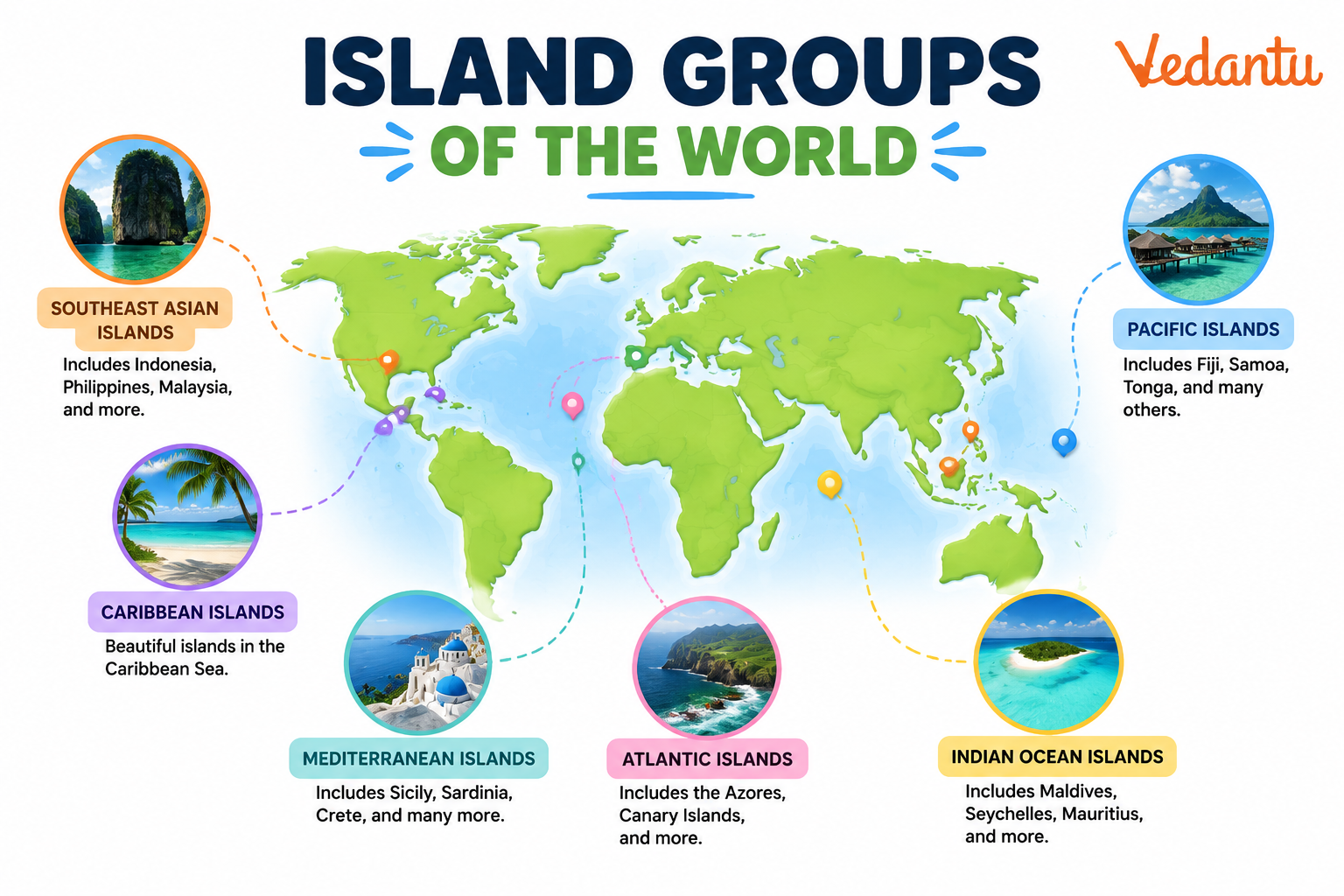
Important Island Groups of the World
| Island Group | Location | Country or Region |
|---|---|---|
| Andaman and Nicobar Islands | Bay of Bengal | India |
| Lakshadweep | Arabian Sea | India |
| Maldives | Indian Ocean | South Asia |
| Philippines | Pacific Ocean | Southeast Asia |
| Indonesia | Indian and Pacific Oceans | Southeast Asia |
These island groups vary in size, population, and economic activities. Some are known for tourism, some for fishing, and others for their strategic military importance.
Island Groups of India
India has two major island groups. These play an important role in national security, tourism, and marine biodiversity. They are administered as Union Territories.
1. Andaman and Nicobar Islands
- Located in the Bay of Bengal
- Capital is Port Blair
- Close to Myanmar and Thailand
- Known for tropical forests and coral reefs
- Strategically important for naval defense
2. Lakshadweep
- Located in the Arabian Sea
- Capital is Kavaratti
- Composed mainly of coral islands
- Smallest Union Territory of India by area
- Famous for beaches and marine life
Types of Island Groups Based on Formation
Island groups are formed in different ways depending on geological and environmental factors. Understanding their formation helps in geography studies.
- Volcanic Islands - Formed due to volcanic eruptions under the sea. Example: Indonesia.
- Coral Islands - Formed from coral reefs built by marine organisms. Example: Lakshadweep and Maldives.
- Continental Islands - Part of the continental shelf separated by rising sea levels. Example: British Isles.
Importance of Island Groups
Island groups are important for various reasons. They contribute significantly to the economy, environment, and security of a country.
- Boost tourism and local employment
- Provide rich fishing grounds
- Support unique plant and animal species
- Serve as naval and air force bases
- Help in expanding Exclusive Economic Zones
Environmental Challenges Faced by Island Groups
Despite their beauty and importance, island groups face several environmental challenges due to climate change and human activities.
- Rising sea levels
- Coral bleaching
- Cyclones and natural disasters
- Pollution and plastic waste
- Loss of biodiversity
Key Points for Competitive Exams
Island groups are frequently asked in competitive exams such as UPSC, SSC, Banking, and State PSC exams. Students should remember important facts related to location, capital cities, type of formation, and strategic importance.
- India has two major island groups - Andaman and Nicobar Islands and Lakshadweep.
- Lakshadweep islands are mainly coral in origin.
- Andaman and Nicobar Islands lie closer to Southeast Asia.
- Indonesia is the largest archipelago in the world.
- Maldives is one of the lowest lying island nations.
Conclusion
The Island Groups are an essential part of world and Indian geography. They are not only beautiful tourist destinations but also regions of ecological richness and strategic importance. From coral islands in Lakshadweep to volcanic islands in Indonesia, each island group has unique features and significance. A clear understanding of their location, formation, and importance is helpful for academic learning as well as competitive examinations.
FAQs on The Island Groups of The World – Complete Chapter Guide
1. What are the island groups of India?
The island groups of India are the Andaman and Nicobar Islands and the Lakshadweep Islands. These islands are important parts of India's geography.
Main Island Groups:
• Andaman and Nicobar Islands – Located in the Bay of Bengal
• Lakshadweep Islands – Located in the Arabian Sea
These island territories play a key role in India’s maritime security, biodiversity, tourism, and trade routes.
2. Where are the Andaman and Nicobar Islands located?
The Andaman and Nicobar Islands are located in the Bay of Bengal, southeast of mainland India.
Key Facts:
• Situated between India and Myanmar
• Close to Thailand and Indonesia
• Capital city: Port Blair
These islands are strategically important for India’s naval base, coastal defense, and international sea routes.
3. Where is Lakshadweep located?
The Lakshadweep Islands are located in the Arabian Sea, southwest of mainland India near the coast of Kerala.
Important Points:
• Smallest Union Territory of India
• Capital: Kavaratti
• Made up of coral islands
Lakshadweep is known for its coral reefs, lagoons, and marine biodiversity.
4. What is the difference between Andaman and Nicobar Islands and Lakshadweep?
The main difference lies in their location, origin, and size.
Differences:
• Location: Andaman & Nicobar – Bay of Bengal; Lakshadweep – Arabian Sea
• Origin: Andaman – Volcanic; Lakshadweep – Coral
• Size: Andaman group is larger; Lakshadweep is smaller
Both island groups are important for tourism, ecology, and strategic importance.
5. How were the Lakshadweep Islands formed?
The Lakshadweep Islands were formed from coral deposits over submerged volcanic mountains.
Formation Process:
• Growth of coral reefs in warm ocean waters
• Deposition over underwater ridges
• Creation of atolls and lagoons
These coral islands are examples of marine landforms formed by biological activity.
6. Why are the Andaman and Nicobar Islands strategically important?
The Andaman and Nicobar Islands are strategically important due to their location near major international sea routes.
Strategic Importance:
• Close to the Malacca Strait
• Presence of Indian naval and air force bases
• Strengthens India's maritime security
They help India monitor trade routes between the Indian Ocean and Pacific Ocean.
7. What is the capital of Andaman and Nicobar Islands?
The capital of the Andaman and Nicobar Islands is Port Blair.
About Port Blair:
• Administrative headquarters
• Famous for Cellular Jail (Kala Pani)
• Major tourist center
It plays a key role in the region’s governance, tourism, and historical significance.
8. Which tribes live in the Andaman and Nicobar Islands?
Several indigenous tribes live in the Andaman and Nicobar Islands.
Major Tribes:
• Great Andamanese
• Jarawa
• Onge
• Sentinelese
• Nicobarese
These tribes are protected to preserve their culture, traditions, and isolated lifestyle.
9. What is the climate of the island groups of India?
The island groups of India have a tropical climate with high humidity and moderate temperatures.
Climate Features:
• Warm throughout the year
• Heavy monsoon rainfall
• Influenced by the Arabian Sea and Bay of Bengal
This climate supports rich forests, marine life, and coral reefs.
10. Why are the island groups important for tourism?
The island groups are important for tourism because of their natural beauty and biodiversity.
Tourist Attractions:
• Beaches and coral reefs
• Scuba diving and water sports
• Historical sites like Cellular Jail
• Unique marine national parks
They are popular destinations for eco-tourism, adventure tourism, and island travel in India.
