






Satavahana Empire administration, rulers, and cultural achievements
The Satavahana Dynasty was one of the earliest and most significant ruling dynasties of ancient India. It played a crucial role in shaping the political, economic, and cultural history of the Deccan region after the decline of the Mauryan Empire. The Satavahanas ruled for nearly four centuries, approximately from the 1st century BCE to the 3rd century CE. They are known for promoting trade, art, Buddhism, and regional administration. For students and competitive exam aspirants, the Satavahana Dynasty is an important topic in Ancient Indian History due to its administrative system, cultural contributions, and role in Deccan politics.
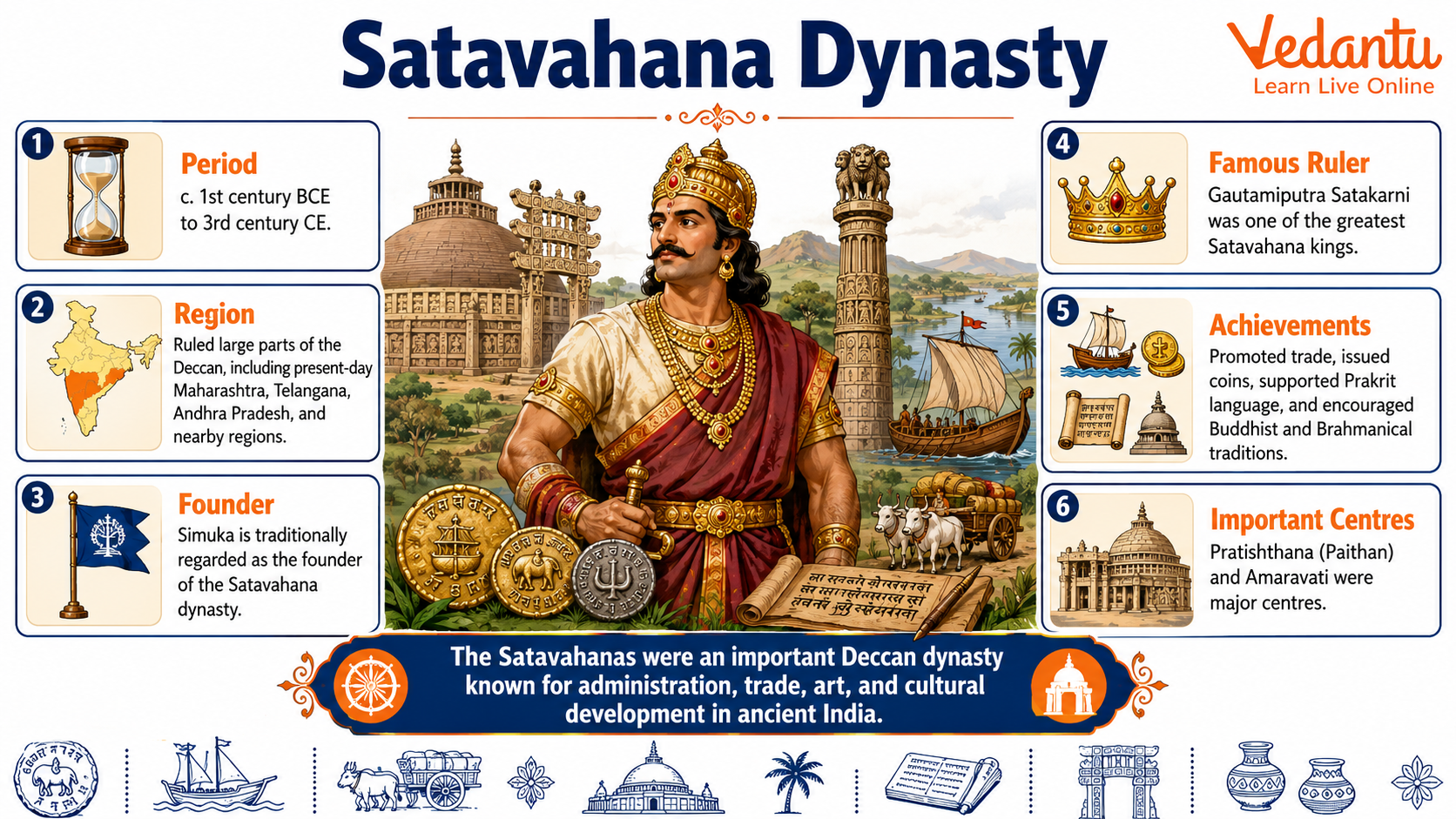
Origin and Founder of the Satavahana Dynasty
The Satavahana Dynasty is believed to have originated in the Deccan region, mainly covering present-day Maharashtra, Telangana, Andhra Pradesh, and parts of Madhya Pradesh and Karnataka. The founder of the dynasty was Simuka, who established Satavahana rule after the decline of the Mauryan Empire.
- Founder - Simuka
- Period - Around 1st century BCE
- Initial capital - Pratishthana (modern Paithan in Maharashtra)
- Major region - Deccan Plateau
The dynasty is also referred to as the Andhra Dynasty in several Puranic texts, as many rulers belonged to the Andhra region.
Important Rulers of the Satavahana Dynasty
1. Simuka
Simuka was the founder and laid the foundation of Satavahana power in the Deccan. He consolidated his rule after the fall of the Mauryan Empire.
2. Satakarni I
Satakarni I expanded the kingdom significantly. He performed Vedic sacrifices like Ashvamedha, which shows the revival of Brahmanical traditions during his reign.
3. Gautamiputra Satakarni
Gautamiputra Satakarni was the most powerful ruler of the Satavahana Dynasty. He defeated the Shakas, Yavanas, and Pahlavas and restored Satavahana prestige. His achievements are recorded in the Nasik inscription, issued by his mother Gautami Balashri.
4. Vashishtiputra Pulumavi
He succeeded Gautamiputra Satakarni and continued administrative and trade policies. During his reign, maritime trade expanded.
Major Satavahana Rulers and Their Contributions
| Ruler | Period | Key Contributions |
|---|---|---|
| Simuka | 1st century BCE | Founder of the dynasty |
| Gautamiputra Satakarni | 1st-2nd century CE | Defeated Shakas and expanded empire |
| Vashishtiputra Pulumavi | 2nd century CE | Promoted trade and administration |
These rulers strengthened the political structure of the Deccan and contributed significantly to economic prosperity and cultural growth.
Administration under the Satavahanas
The Satavahana administration combined centralized monarchy with local autonomy. The king was the supreme authority, but local officials played a crucial role in governance.
- The empire was divided into administrative units called Ahara.
- Officials like Amatyas assisted the king.
- Land revenue was the main source of income.
- Feudatory chiefs were allowed to rule certain areas under Satavahana control.
The administration maintained stability across a vast region and facilitated trade and cultural exchange.
Economic Condition and Trade
The Satavahana period witnessed significant economic prosperity. Agriculture was the backbone of the economy, but trade and commerce flourished greatly.
- Extensive inland and maritime trade networks.
- Trade relations with the Roman Empire.
- Use of lead, copper, and silver coins.
- Development of ports on the western coast.
Roman gold coins found in the Deccan region indicate strong overseas trade connections.
Religion and Culture
The Satavahanas supported both Brahmanism and Buddhism. They performed Vedic rituals while also donating to Buddhist monasteries and stupas.
- Construction of Buddhist caves at Karle and Nashik.
- Patronage to Amaravati Stupa.
- Promotion of Prakrit language in inscriptions.
- Encouragement of art and sculpture.
Their reign represents a blend of religious tolerance and cultural development in the Deccan.
Decline of the Satavahana Dynasty
The decline of the Satavahana Dynasty began in the 3rd century CE due to internal conflicts and external invasions.
- Weak successors after powerful rulers.
- Rise of regional powers like the Ikshvakus and Western Kshatrapas.
- Fragmentation of the empire into smaller kingdoms.
By the mid 3rd century CE, the Satavahana rule came to an end, paving the way for new regional dynasties in the Deccan.
Importance of the Satavahana Dynasty in Indian History
The Satavahana Dynasty holds great importance in Ancient Indian History for several reasons. It acted as a bridge between North and South India and maintained political unity in the Deccan after the Mauryas.
- Established stable governance in the Deccan.
- Promoted trade with foreign regions including Rome.
- Encouraged religious harmony.
- Contributed to art, architecture, and literature.
For competitive exams and general knowledge preparation, understanding the Satavahana Dynasty helps in grasping the political and cultural transformation of post Mauryan India. Their contributions to trade, religion, and regional administration make them a key chapter in Ancient Indian History.
FAQs on Satavahana Dynasty in Ancient India: Complete Student Guide
1. Who were the Satavahanas?
The Satavahanas were an ancient Indian dynasty that ruled large parts of the Deccan region from around 1st century BCE to 3rd century CE. • Also known as the Andhra Dynasty in Puranic texts • Founded by Simuka • Played a key role after the decline of the Mauryan Empire • Promoted trade, Buddhism, and Brahmanism • Important for understanding early historic India, Deccan politics, and ancient Indian administration.
2. Who was the founder of the Satavahana Dynasty?
Simuka is regarded as the founder of the Satavahana Dynasty. • Established rule around 1st century BCE • Overthrew the remnants of the Kanva Dynasty • Laid the foundation of Satavahana power in the Deccan plateau • Mentioned in Puranas and inscriptions • His reign marked the rise of regional kingdoms after Mauryan decline.
3. Who was the greatest ruler of the Satavahana Dynasty?
Gautamiputra Satakarni is considered the greatest Satavahana ruler due to his military and administrative achievements. • Reigned in the 2nd century CE • Defeated the Western Kshatrapas (Sakas) • Restored Satavahana power in western India • Known from the Nasik Prashasti inscription • Upheld varna system and promoted Brahmanical traditions.
4. What were the main sources of information about the Satavahana Dynasty?
Inscriptions, coins, and literary texts are the primary sources of Satavahana history. • Nasik and Nanaghat inscriptions • Satavahana lead and copper coins • References in the Puranas • Accounts in the Periplus of the Erythraean Sea • Archaeological sites like Amaravati and Karle caves.
5. What was the capital of the Satavahana Empire?
Pratishthana (modern Paithan) was the main capital of the Satavahana Empire. • Located in present-day Maharashtra • Another important center was Amaravati in Andhra region • Served as political and trade hubs • Connected to inland and maritime trade routes • Important in Deccan administration and commerce.
6. What was the administrative system of the Satavahanas?
The Satavahana administration was monarchical with provincial divisions for efficient governance. • King held supreme authority • Empire divided into Ahara (districts) • Officials like Amatyas and Maharathis assisted governance • Land grants to Brahmins were common • Reflected features of both centralized and feudal elements in ancient Indian polity.
7. How did the Satavahanas contribute to trade and economy?
The Satavahanas boosted inland and overseas trade, especially with the Roman Empire. • Active trade through western ports like Bharuch • Exported spices, textiles, and precious stones • Issued distinctive lead coins • Mentioned in Roman records and the Periplus • Strengthened the Deccan economy and urban centers.
8. What was the religious policy of the Satavahana rulers?
The Satavahanas followed religious tolerance, supporting both Brahmanism and Buddhism. • Performed Vedic rituals like Ashvamedha • Donated to Buddhist monasteries • Patronized cave architecture at Karle and Ajanta • Encouraged coexistence of Hinduism and Buddhism • Important for studying ancient Indian religion and culture.
9. What were the major achievements of the Satavahana Dynasty?
The Satavahanas made significant political, cultural, and economic contributions in ancient India. • Unified large parts of the Deccan • Promoted Prakrit language in inscriptions • Encouraged art at Amaravati Stupa • Strengthened Indo-Roman trade • Acted as a bridge between North and South India.
10. Why did the Satavahana Dynasty decline?
The decline of the Satavahana Dynasty was due to internal weakness and external invasions in the 3rd century CE. • Continuous conflicts with Western Kshatrapas • Rise of regional powers like the Ikshvakus • Weak successors after strong rulers • Fragmentation of the empire • Led to political instability in the Deccan region.
