






How Gandhi’s Salt Satyagraha Challenged British Rule
The Salt March, also known as the Dandi March, was a major event in the Indian freedom struggle led by Mahatma Gandhi in 1930. It was a non-violent protest against the British salt tax and became a powerful symbol of civil disobedience against colonial rule. The march not only united Indians across regions and communities but also drew global attention to India’s demand for independence. It remains one of the most significant movements in modern Indian history and is frequently asked about in competitive examinations.
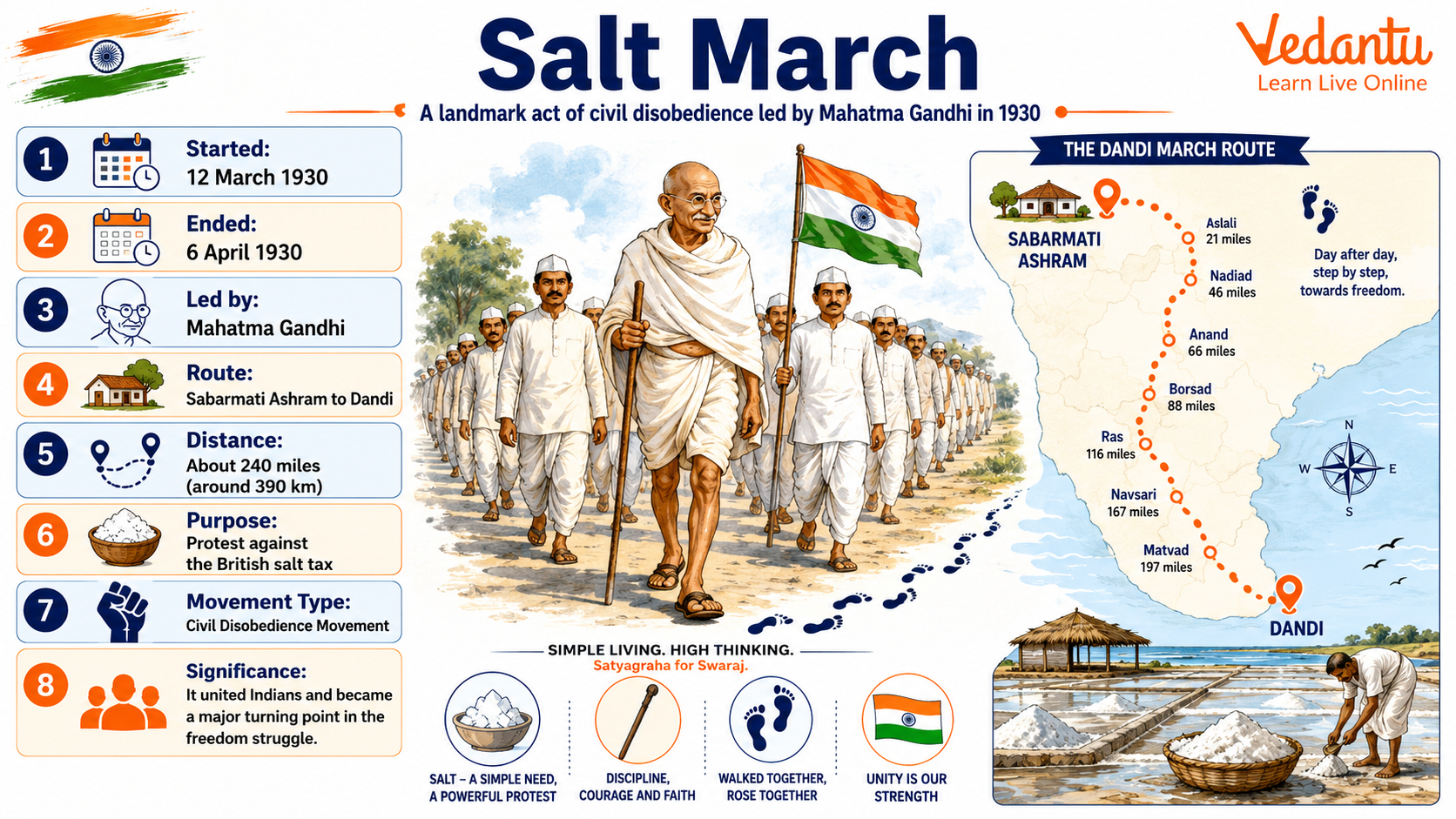
Background of the Salt March
During British rule, Indians were prohibited from collecting or selling salt. The British government imposed a heavy tax on salt, an essential commodity used by all sections of society. This law affected both rich and poor, but it severely impacted the poor who depended on natural salt sources.
Mahatma Gandhi chose the salt tax as a means to challenge British authority because:
- Salt was a basic necessity for every individual.
- The tax symbolized economic exploitation by the British.
- It was a simple issue that could unite Indians across caste, class, and religion.
Launch of the Salt March
The Salt March began on 12 March 1930 from Sabarmati Ashram in Ahmedabad. Mahatma Gandhi, along with 78 carefully selected followers, started the 240 mile march to the coastal village of Dandi in Gujarat.
After walking for 24 days and covering several villages, Gandhi reached Dandi on 6 April 1930. There, he picked up a handful of salt from the seashore, symbolically breaking the British salt law.
Objectives of the Salt March
- To protest against the unjust salt tax imposed by the British government.
- To launch the Civil Disobedience Movement.
- To mobilize mass participation in the freedom struggle.
- To demonstrate the power of non-violent resistance or Satyagraha.
Civil Disobedience Movement and Salt March
The Salt March marked the beginning of the Civil Disobedience Movement in 1930. After Gandhi broke the salt law, millions of Indians began making salt illegally and refused to pay various British taxes. The movement spread across the country and included:
- Boycott of foreign goods.
- Refusal to pay land revenue and other taxes.
- Resignation from government jobs.
- Peaceful protests and demonstrations.
The British government responded by arresting thousands of protesters, including Mahatma Gandhi in May 1930.
Key Facts About the Salt March
| Feature | Details | Year |
|---|---|---|
| Leader | Mahatma Gandhi | 1930 |
| Starting Point | Sabarmati Ashram | 12 March 1930 |
| End Point | Dandi, Gujarat | 6 April 1930 |
The march covered approximately 240 miles and lasted 24 days. It became one of the most influential acts of civil disobedience in world history.
Significance of the Salt March
The Salt March had both national and international impact. It transformed the Indian freedom struggle into a mass movement and strengthened the demand for complete independence.
National Significance
- Encouraged widespread participation of women, peasants, and students.
- Strengthened unity among Indians.
- Demonstrated the effectiveness of non-violent resistance.
International Significance
- Attracted worldwide media attention.
- Inspired other movements for civil rights and freedom.
- Exposed the injustice of British colonial policies.
Aftermath and Gandhi-Irwin Pact
Due to the pressure created by the Civil Disobedience Movement, the British government entered into negotiations with Mahatma Gandhi. This led to the Gandhi-Irwin Pact in 1931, under which political prisoners were released and Gandhi agreed to participate in the Second Round Table Conference in London.
Important Points for Exams
- Salt March is also called Dandi March.
- Started on 12 March 1930 and ended on 6 April 1930.
- It marked the beginning of the Civil Disobedience Movement.
- It was based on the principle of Satyagraha and non-violence.
- It played a crucial role in strengthening India’s struggle for independence.
Conclusion
The Salt March was a turning point in India’s freedom struggle. By choosing salt as a symbol of resistance, Mahatma Gandhi connected the independence movement with the daily lives of ordinary people. The movement proved that disciplined, non-violent protest could challenge even the most powerful empire. The Salt March remains a landmark event in world history and continues to inspire movements based on justice and peaceful resistance.
FAQs on Salt March and Gandhi’s Civil Disobedience Movement
1. What was the Salt March?
The Salt March was a non-violent protest led by Mahatma Gandhi in 1930 against the British salt tax in India. It was a key event in the Indian Freedom Struggle and marked the beginning of the Civil Disobedience Movement.
• Started on 12 March 1930 from Sabarmati Ashram
• Ended at Dandi on 6 April 1930
• Protested the unfair Salt Law imposed by the British
• Became a symbol of non-violent resistance (Satyagraha)
2. Why did Mahatma Gandhi start the Salt March?
Mahatma Gandhi started the Salt March to oppose the unjust British salt tax and colonial economic policies. Salt was a basic necessity, and taxing it affected every Indian.
• Protest against the Salt Act of 1882
• Challenge British monopoly on salt production
• Unite Indians in the freedom movement
• Promote non-violent civil disobedience
3. When and where did the Salt March take place?
The Salt March took place from 12 March to 6 April 1930 and covered about 240 miles in Gujarat, India. It began at Sabarmati Ashram and ended at the coastal village of Dandi.
• Duration: 24 days
• Distance: Approximately 240 miles (390 km)
• Region: Present-day Gujarat
• Led by Mahatma Gandhi and 78 volunteers
4. What was the main objective of the Salt March?
The main objective of the Salt March was to break the British salt laws and demand Swaraj (self-rule) for India. It aimed to mobilize mass participation against colonial rule.
• End the British monopoly on salt
• Launch the Civil Disobedience Movement
• Encourage peaceful protest through Satyagraha
• Strengthen the Indian independence movement
5. What happened at Dandi during the Salt March?
At Dandi, Gandhi broke the Salt Law by picking up natural salt from the seashore on 6 April 1930. This simple act openly defied British authority.
• Symbolic act of civil disobedience
• Inspired nationwide protests
• Thousands made salt illegally
• Marked a turning point in the Indian National Movement
6. How did the British government respond to the Salt March?
The British government responded with arrests and repression to control the growing protest movement. However, the movement gained global attention.
• Arrested over 60,000 protesters
• Imprisoned Mahatma Gandhi
• Used police force to suppress demonstrations
• Faced international criticism for harsh actions
7. What was the significance of the Salt March in Indian history?
The Salt March was a major turning point in India’s struggle for independence as it united people across regions and classes. It strengthened the mass base of the freedom movement.
• Expanded the Civil Disobedience Movement
• Increased participation of women and peasants
• Drew global media attention
• Demonstrated the power of non-violent resistance
8. What is the Civil Disobedience Movement?
The Civil Disobedience Movement was a nationwide protest launched in 1930 to defy unjust British laws peacefully. The Salt March marked its official beginning.
• Led by Mahatma Gandhi and the Indian National Congress
• Included boycott of British goods and institutions
• Refusal to pay taxes
• Demand for Purna Swaraj (complete independence)
9. How long was the Salt March and who participated in it?
The Salt March covered around 240 miles over 24 days and initially involved 78 selected volunteers led by Gandhi. Thousands joined along the way.
• Started with 78 Satyagrahis
• Thousands joined during the march
• Included men and women from different communities
• Became a mass national movement
10. Why is the Salt March important for students and competitive exams?
The Salt March is important for exams because it is a key event in modern Indian history and the freedom struggle. It is frequently asked in GK, UPSC, SSC, and school exams.
• Related to Indian Independence Movement (1930)
• Connected with Mahatma Gandhi and Satyagraha
• Marks the start of the Civil Disobedience Movement
• Symbol of peaceful protest and national unity
