






Ramayana Characters, Major Events, and Moral Lessons Explained
The Ramayana is one of the most important and revered ancient Indian epics. It narrates the life, values, and journey of Lord Rama, the seventh incarnation of Lord Vishnu. Traditionally attributed to the sage Valmiki, the Ramayana is not only a religious scripture but also a cultural and moral guide that has influenced Indian society, literature, art, and politics for centuries. It teaches ideals of duty, righteousness, devotion, and truth, making it an essential topic in General Knowledge for students, competitive exam aspirants, and cultural studies.
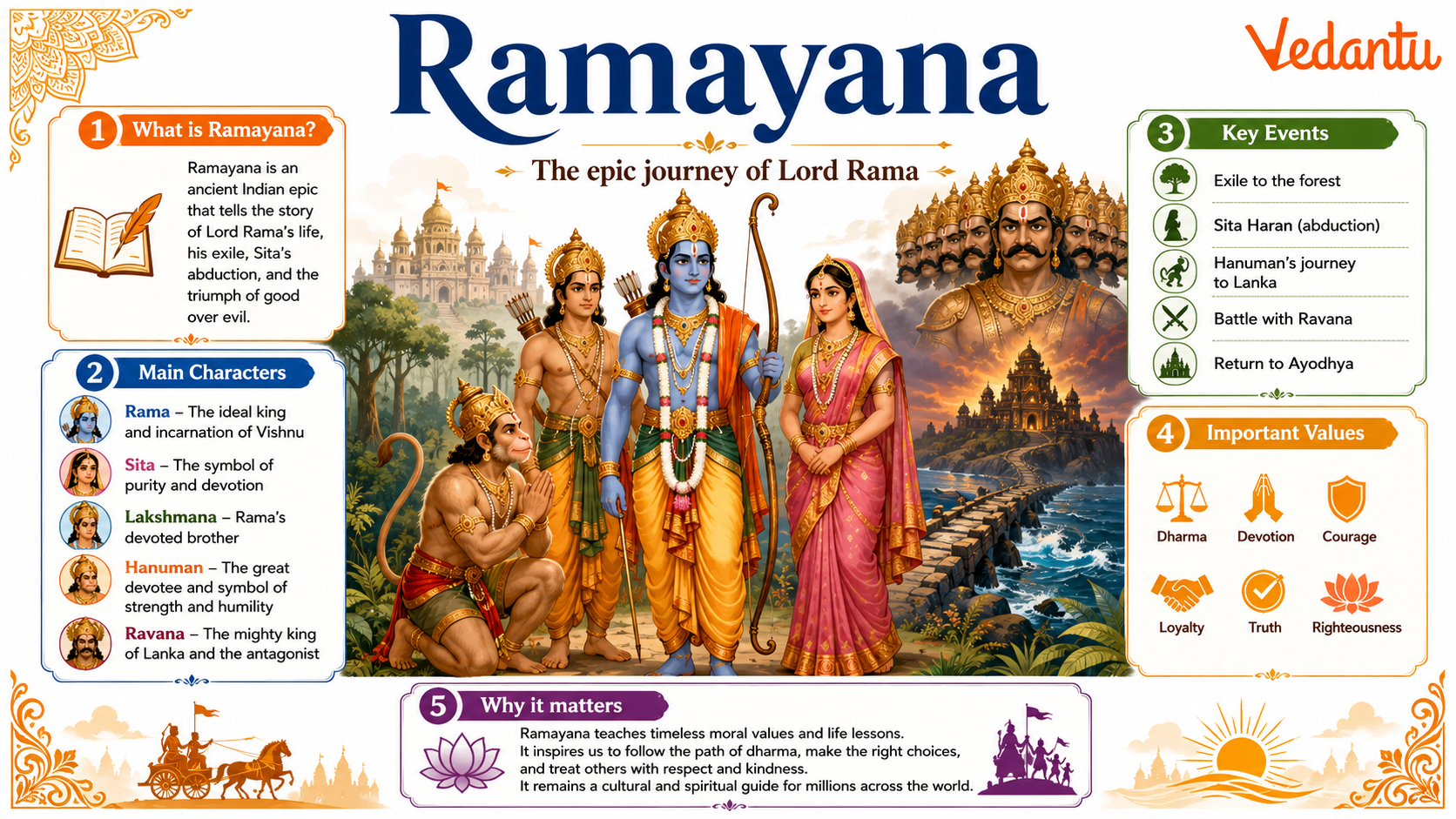
Overview of the Ramayana
The Ramayana is an ancient Sanskrit epic composed by Maharishi Valmiki. It consists of around 24,000 verses divided into seven books, known as Kandas. The epic primarily focuses on the life of Lord Rama, his exile to the forest, the abduction of his wife Sita by Ravana, and the eventual rescue of Sita with the help of Hanuman and the Vanara army.
Basic Facts about Ramayana
| Aspect | Details | Significance |
|---|---|---|
| Author | Maharishi Valmiki | Known as Adi Kavi - first poet |
| Language | Sanskrit | Ancient Indian classical language |
| Total Verses | Approximately 24,000 | One of the longest epics in world literature |
The Ramayana has been translated into many regional and international languages, including Tamil, Hindi, Bengali, Thai, and Indonesian versions. It remains one of the most widely read and performed epics across Asia.
Seven Kandas of the Ramayana
The epic is divided into seven sections called Kandas. Each Kanda describes a specific phase of Lord Rama's life.
- Bala Kanda - Birth and childhood of Rama and his marriage to Sita.
- Ayodhya Kanda - Rama's exile due to Queen Kaikeyi's demand.
- Aranya Kanda - Life in the forest and abduction of Sita by Ravana.
- Kishkindha Kanda - Alliance with Sugriva and meeting Hanuman.
- Sundara Kanda - Hanuman's journey to Lanka and meeting Sita.
- Yuddha Kanda - War between Rama and Ravana and rescue of Sita.
- Uttara Kanda - Rama's return to Ayodhya and later events of his reign.
Major Characters in the Ramayana
The Ramayana includes several important characters who symbolize various virtues and qualities.
- Lord Rama - Symbol of truth, duty, and righteousness.
- Sita - Ideal of purity, devotion, and strength.
- Lakshmana - Brother of Rama, known for loyalty and sacrifice.
- Hanuman - Devotee of Rama, symbol of devotion and courage.
- Ravana - King of Lanka, known for knowledge and power but also arrogance.
Key Themes and Values
The Ramayana is more than a story. It conveys deep moral and philosophical teachings that are relevant even today.
- Dharma - Upholding duty and righteousness in all circumstances.
- Devotion - Exemplified by Hanuman's loyalty to Rama.
- Sacrifice - Rama's exile and Sita's hardships show personal sacrifice for greater good.
- Good vs Evil - The victory of Rama over Ravana symbolizes the triumph of good over evil.
Cultural and Historical Significance
The Ramayana has greatly influenced Indian culture, festivals, art, dance, and drama. Festivals like Diwali and Dussehra are directly connected to events from the epic. The tradition of Ramlila, a dramatic enactment of the Ramayana, is performed across India and has been recognized by UNESCO as an Intangible Cultural Heritage.
Beyond India, the Ramayana has influenced Southeast Asian countries such as Thailand, Cambodia, Indonesia, and Malaysia. Temples, sculptures, and literary works in these regions reflect the epic's impact.
Ramayana in Different Versions
Several versions of the Ramayana exist across regions and languages. While the core story remains the same, interpretations and details may vary.
- Valmiki Ramayana - Original Sanskrit version.
- Ramcharitmanas - Written in Awadhi by Tulsidas.
- Kamba Ramayanam - Tamil version by Kamban.
- Adhyatma Ramayana - Spiritual interpretation of the epic.
Importance of Ramayana in General Knowledge
Questions about the Ramayana frequently appear in competitive exams, quizzes, and interviews. Important areas include the names of Kandas, characters, authors, key events, and cultural relevance. Understanding the Ramayana helps students gain knowledge of Indian heritage, moral philosophy, and classical literature.
Conclusion
The Ramayana is not just an ancient epic but a timeless guide to ethical living and human values. Its teachings on duty, loyalty, courage, and righteousness continue to inspire millions across the world. For students and general readers, studying the Ramayana provides both cultural awareness and moral insight, making it an essential topic in General Knowledge.
FAQs on Ramayana Story in English – Complete Summary and Meaning
1. What is the Ramayana?
The Ramayana is an ancient Indian epic that narrates the life and adventures of Lord Rama, an incarnation of Lord Vishnu.
Key facts about the Ramayana include:
• Written by the sage Valmiki in Sanskrit.
• Comprises about 24,000 verses.
• Divided into seven Kandas (books).
• Focuses on themes of dharma (duty), righteousness, loyalty, and devotion.
The epic is also known as the Valmiki Ramayana and is one of the two major Sanskrit epics of ancient India.
2. Who wrote the Ramayana?
The Ramayana was composed by the sage Maharishi Valmiki, who is known as the Adi Kavi (first poet) of Sanskrit literature.
Important points:
• Written in Sanskrit.
• Believed to be composed around 500 BCE to 100 BCE (approximate scholarly estimate).
• Valmiki also appears as a character in the epic.
Because of his authorship, the epic is often called the Valmiki Ramayana.
3. Who are the main characters in the Ramayana?
The main characters of the Ramayana represent ideals of virtue, devotion, and evil.
Key characters include:
• Lord Rama – Prince of Ayodhya and hero of the epic.
• Sita – Wife of Rama and symbol of purity.
• Lakshmana – Rama’s devoted brother.
• Hanuman – Loyal devotee of Rama and leader of the Vanaras.
• Ravana – Demon king of Lanka and main antagonist.
These characters play central roles in the story of exile, abduction, and the battle between good and evil.
4. What are the seven Kandas of the Ramayana?
The Ramayana is divided into seven Kandas or books that narrate different stages of Lord Rama’s life.
The seven Kandas are:
• Bala Kanda – Childhood of Rama.
• Ayodhya Kanda – Exile of Rama.
• Aranya Kanda – Life in the forest.
• Kishkindha Kanda – Alliance with the Vanaras.
• Sundara Kanda – Hanuman’s journey to Lanka.
• Yuddha Kanda – Battle with Ravana.
• Uttara Kanda – Events after Rama’s return to Ayodhya.
These sections structure the epic chronologically.
5. Why was Lord Rama sent into exile?
Lord Rama was sent into exile due to a promise made by his father, King Dasharatha, to Queen Kaikeyi.
Main reasons include:
• Kaikeyi demanded two boons previously granted to her.
• She asked for Bharata to be crowned king.
• She demanded Rama’s exile for 14 years.
Rama accepted the exile to uphold dharma and respect his father’s word, showcasing his obedience and righteousness.
6. How did Ravana abduct Sita?
Ravana abducted Sita by using deception during Rama’s exile in the forest.
The sequence of events:
• Ravana sent Maricha disguised as a golden deer.
• Rama and Lakshmana left the hut to chase the deer.
• Ravana, disguised as a sage, kidnapped Sita.
This incident in the Aranya Kanda led to the great war between Rama and Ravana in Lanka.
7. What is the significance of Hanuman in the Ramayana?
Hanuman is the symbol of devotion, strength, and loyalty in the Ramayana.
His major contributions include:
• Discovering Sita in Lanka.
• Burning Lanka with his fiery tail.
• Bringing the Sanjeevani herb to save Lakshmana.
Hanuman is considered an ideal devotee of Lord Rama and plays a crucial role in the victory over Ravana.
8. What is the main message or moral of the Ramayana?
The main message of the Ramayana is the triumph of good over evil and the importance of following dharma.
Core teachings include:
• Importance of duty and righteousness.
• Respect for parents and elders.
• Loyalty in relationships.
• Victory of virtue over arrogance.
The epic teaches moral values relevant to students, competitive exams, and general life lessons.
9. What is the difference between Ramayana and Mahabharata?
The Ramayana and Mahabharata are two major Indian epics, but they differ in theme and storyline.
Key differences:
• Ramayana focuses on Lord Rama and his exile.
• Mahabharata centers on the Pandavas and Kauravas.
• Ramayana emphasizes ideal characters; Mahabharata shows complex moral dilemmas.
Both epics highlight dharma, war, and righteousness in ancient Indian literature.
10. Why is the Ramayana important in Indian culture?
The Ramayana is important because it shapes Indian culture, traditions, and moral values.
Its cultural significance includes:
• Celebrated during festivals like Dussehra and Diwali.
• Inspires classical dance, drama, and literature.
• Promotes ideals of family, duty, and devotion.
The epic continues to influence art, religion, and social values across India and Southeast Asia.
