






Major Ethnic and Racial Communities in India Explained
India is one of the most diverse countries in the world in terms of physical features, culture, language, and ethnicity. The racial groups of India refer to the classification of people based on physical characteristics such as skin color, facial features, hair type, and body structure. These classifications were mainly proposed by anthropologists during the colonial period. Although modern genetics shows that race is not a strict biological category, understanding racial groups of India remains important for General Knowledge, competitive exams, and the study of Indian anthropology.
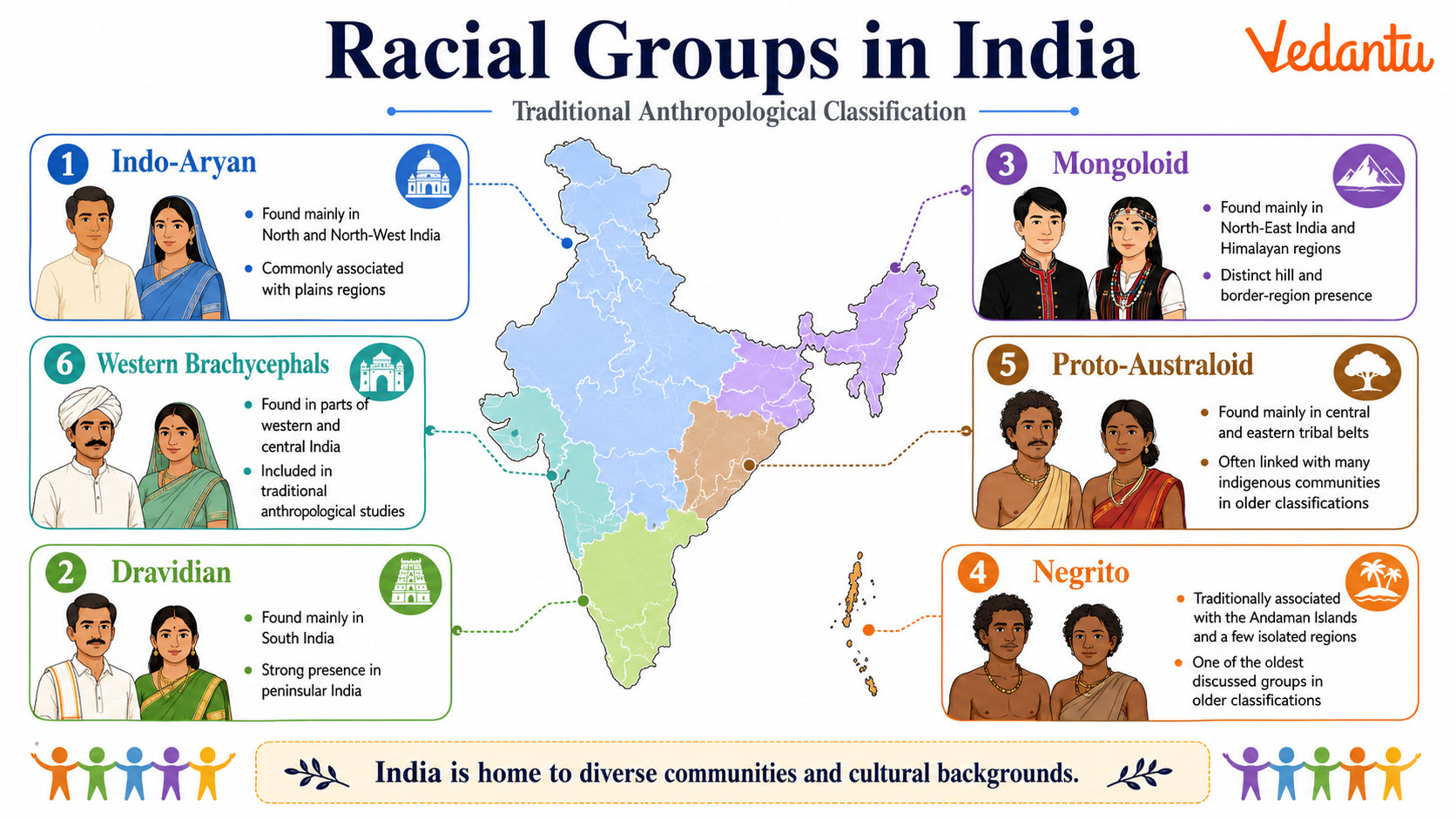
Meaning of Racial Groups
Racial groups are categories used to classify people based on inherited physical traits. In India, racial classification was mainly studied by anthropologists such as Herbert Risley, B.S. Guha, and H.H. Hutton. These classifications were based on observable physical characteristics and geographical distribution.
Basis of Classification
- Skin color
- Hair type and texture
- Shape of nose and head
- Height and body structure
- Geographical distribution
Major Racial Groups of India
According to B.S. Guha, the population of India can be broadly classified into six major racial groups. These groups represent different waves of migration into the Indian subcontinent over thousands of years.
Major Racial Groups of India
| Racial Group | Main Features | Regions Found |
|---|---|---|
| Negrito | Short stature, dark skin, woolly hair | Andaman Islands, parts of South India |
| Proto-Australoid | Dark skin, broad nose, medium height | Central and South India |
| Mongoloid | Yellowish skin, flat face, small eyes | North-East India, Himalayan region |
| Mediterranean | Fair to wheatish skin, long head | North India, Western India |
| Western Brachycephals | Broad head, medium height | Western and Central India |
| Nordic | Fair skin, tall stature, narrow nose | North-West India |
These racial groups do not exist in pure form today. Due to continuous migration and intermixing over centuries, most Indians belong to mixed racial backgrounds.
Detailed Description of Each Racial Group
1. Negrito
The Negrito group is considered one of the earliest inhabitants of India. They are mainly found in the Andaman and Nicobar Islands. They have short stature, dark complexion, and curly hair. Examples include the Jarawas and Onge tribes.
2. Proto-Australoid
This group forms a large portion of India's tribal population. They are mainly found in Central and South India. Physical features include dark skin, broad nose, and medium height. Many Scheduled Tribes belong to this group.
3. Mongoloid
The Mongoloid group is mainly concentrated in North-East India and Himalayan regions such as Arunachal Pradesh, Nagaland, Sikkim, and Ladakh. They have distinct features such as slanting eyes and a flat face.
4. Mediterranean
The Mediterranean group is believed to have contributed significantly to the population of North India. They have wheatish complexion, long head, and narrow nose. This group is associated with early Dravidian and Indus Valley populations.
5. Western Brachycephals
This group is characterized by a broad head and medium build. They are mainly found in Western and Central India. Subtypes include Alpinoid and Dinaric types.
6. Nordic
The Nordic group is associated with tall stature, fair complexion, and sharp features. They are mainly found in North-West India. Some scholars link them with Indo-Aryan migration.
Modern Perspective on Racial Classification
Modern anthropology and genetics suggest that the concept of race is not scientifically rigid. India shows continuous genetic mixing rather than isolated racial groups. Therefore, racial classification is mainly used for historical and academic understanding rather than strict biological categorization.
Importance of Studying Racial Groups of India
- Helps in understanding India's population diversity
- Important for anthropology and sociology studies
- Frequently asked in competitive exams
- Explains migration patterns in ancient India
- Provides insight into tribal and ethnic communities
Key Points for Exam Preparation
- Remember B.S. Guha classification of six racial groups
- Know the physical features of each group
- Understand their geographical distribution
- Be aware that modern science does not support rigid racial divisions
Conclusion
The racial groups of India reflect the long history of migration and settlement in the Indian subcontinent. From the Negrito tribes of the Andaman Islands to the Mongoloid communities of the North-East and the Nordic elements of North-West India, the country represents a unique blend of ethnic diversity. While modern science emphasizes genetic unity over racial division, the study of racial groups remains significant for understanding India's anthropological and historical background.
FAQs on Racial Groups in India – History, Classification and Key Traits
1. What are the major racial groups of India?
The major racial groups of India are classified based on physical and anthropological characteristics. According to traditional classifications by Herbert Risley, the main groups include:
• Indo-Aryan
• Dravidian
• Mongoloid
• Negrito
• Proto-Australoid
• Western Brachycephals
These racial groups of India reflect the country's ethnic diversity, population composition, and ancient migration patterns.
2. Who classified the racial groups of India?
The racial classification of India was mainly done by British anthropologist Herbert Risley in 1901. He classified Indian races based on:
• Nasal index
• Physical features
• Skin color
• Head shape
This classification is important for understanding colonial anthropology and the ethnic groups of India.
3. What are the characteristics of the Indo-Aryan racial group?
The Indo-Aryan racial group is mainly found in North India and is associated with Aryan migration. Key features include:
• Fair to wheatish complexion
• Tall stature
• Sharp facial features
• Long head shape (dolichocephalic)
They primarily inhabit states like Punjab, Rajasthan, Uttar Pradesh, and Bihar.
4. Where are the Dravidian racial groups mainly found in India?
The Dravidian racial group is mainly concentrated in South India. Important regions include:
• Tamil Nadu
• Karnataka
• Kerala
• Andhra Pradesh
Typical characteristics include dark complexion, short stature, and long head shape. They are closely associated with Dravidian languages and ancient South Indian civilization.
5. What are the features of the Mongoloid racial group in India?
The Mongoloid racial group is mainly found in North-East India and Himalayan regions. Their features include:
• Yellowish skin tone
• Broad head (brachycephalic)
• Flat face
• Narrow eyes with epicanthic fold
States like Assam, Nagaland, Manipur, and Arunachal Pradesh have significant Mongoloid populations.
6. Who are the Negrito racial groups in India?
The Negrito racial group is considered one of the earliest inhabitants of India. They are mainly found in:
• Andaman and Nicobar Islands
Physical traits include short stature, dark skin, woolly hair, and broad nose. Tribes such as the Jarawas and Sentinels belong to this group.
7. What is the Proto-Australoid racial group?
The Proto-Australoid racial group is one of the most widespread ethnic groups in India. Key features include:
• Dark complexion
• Broad nose
• Medium to short height
They are commonly found among many Scheduled Tribes in Central and Eastern India, including states like Jharkhand, Odisha, and Chhattisgarh.
8. Why is India considered racially diverse?
India is considered racially and ethnically diverse due to centuries of migration and cultural mixing. Reasons include:
• Ancient Aryan migration
• Dravidian settlement
• Mongoloid influx from East Asia
• Tribal and indigenous communities
This diversity makes India a unique example of unity in diversity in terms of race, ethnicity, and culture.
9. Is the racial classification of India scientifically accepted today?
Modern anthropology does not fully support old racial classifications of India. Today:
• Scientists emphasize genetic diversity rather than rigid racial categories.
• The concept of race is considered socially constructed.
• India is viewed as a population with mixed ancestry.
Thus, traditional racial groups of India are mainly studied for historical and academic purposes.
10. How are racial groups of India important for competitive exams?
The racial groups of India are important for GK, UPSC, SSC, and state PCS exams. Key points to remember include:
• Classification by Herbert Risley (1901)
• Major groups: Indo-Aryan, Dravidian, Mongoloid, Negrito, Proto-Australoid
• Regional distribution of each group
Understanding this topic helps in Indian geography, anthropology, and social diversity questions.
