






Major Types of Indian Pressure Groups with Examples and Functions
Pressure Groups in India are organized groups of individuals or associations that aim to influence public policy and government decisions without directly seeking political power. Unlike political parties, pressure groups do not contest elections but try to shape laws and policies in favor of their interests. They play a significant role in a democratic system like India by acting as a link between the government and the people. Understanding pressure groups is important for students and competitive exam aspirants as it is a key topic in Indian Polity and General Knowledge.
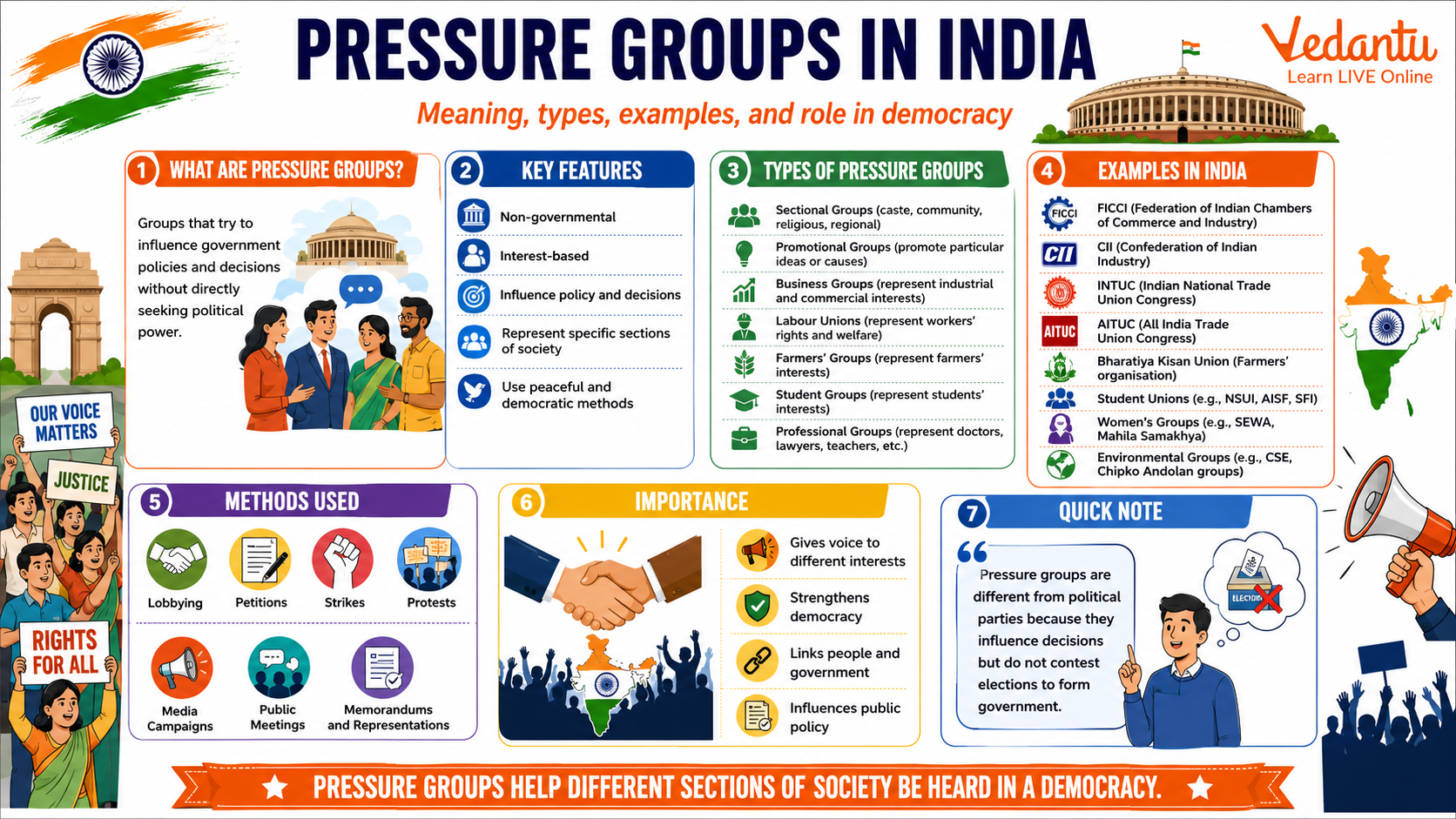
Meaning and Definition of Pressure Groups
A pressure group is an organized body of people who share common interests and seek to influence public policy to protect and promote those interests. These groups attempt to persuade lawmakers, bureaucrats, and other decision-makers to adopt policies favorable to them.
- They do not aim to capture political power.
- They focus on specific issues or interests.
- They operate both inside and outside the political system.
- They influence policies through legal and peaceful methods.
Features of Pressure Groups in India
- Based on common interest such as economic, social, professional, or cultural interests.
- May be formally organized or loosely structured.
- Use various methods like lobbying, public campaigns, petitions, and protests.
- Play a vital role in shaping public opinion.
- Function within the framework of the Constitution of India.
Types of Pressure Groups in India
1. Business and Economic Groups
These groups represent the interests of industrialists, traders, and business communities. They aim to influence economic policies, taxation, trade regulations, and industrial laws.
- Federation of Indian Chambers of Commerce and Industry - FICCI
- Confederation of Indian Industry - CII
- Associated Chambers of Commerce and Industry of India - ASSOCHAM
2. Trade Unions
Trade unions represent the interests of workers and laborers. They fight for better wages, working conditions, and labor rights.
- Indian National Trade Union Congress - INTUC
- All India Trade Union Congress - AITUC
- Bharatiya Mazdoor Sangh - BMS
3. Agrarian or Farmers Groups
These groups represent farmers and agricultural workers. They demand better prices for crops, subsidies, loan waivers, and supportive agricultural policies.
- Bharatiya Kisan Union - BKU
- All India Kisan Sabha - AIKS
4. Professional Groups
Professional pressure groups represent specific professions and work to safeguard their professional interests.
- Bar Council of India
- Indian Medical Association - IMA
- Teachers Associations
5. Caste and Religious Groups
These groups promote the interests of specific caste or religious communities. They often demand reservations, social recognition, and policy changes.
- All India Muslim Personal Law Board
- Various caste-based associations
Methods Used by Pressure Groups
Pressure groups use different methods to influence government decisions and public policies. These methods can be direct or indirect.
- Lobbying government officials and legislators.
- Organizing strikes, demonstrations, and protests.
- Filing Public Interest Litigations in courts.
- Using media campaigns to shape public opinion.
- Submitting memorandums and petitions.
Role of Pressure Groups in Indian Democracy
- Act as a communication link between people and the government.
- Promote democratic participation.
- Help in policy formulation by providing expert opinions.
- Safeguard the interests of marginalized sections.
- Create awareness about social and economic issues.
Difference Between Political Parties and Pressure Groups
| Basis | Political Parties | Pressure Groups |
|---|---|---|
| Main Objective | To capture political power | To influence public policy |
| Participation in Elections | Contest elections | Do not contest elections |
| Scope | Broad national issues | Specific interests |
The table above highlights the clear distinction between political parties and pressure groups. While political parties seek to form the government, pressure groups aim to influence those in power without directly participating in electoral politics.
Advantages of Pressure Groups
- Strengthen democracy by increasing participation.
- Represent diverse interests in society.
- Provide specialized knowledge to policymakers.
- Act as a check on government power.
Limitations of Pressure Groups
- May promote narrow sectional interests.
- Possibility of undue influence on policy decisions.
- Sometimes use disruptive methods like strikes and bandhs.
- Lack of accountability compared to political parties.
Conclusion
Pressure Groups in India are an essential part of the democratic framework. They help articulate public demands, influence policymaking, and ensure that various sections of society are heard. While they have certain limitations, their constructive participation strengthens democratic governance. For competitive exams and General Knowledge preparation, understanding their types, functions, and differences from political parties is crucial.
FAQs on Pressure Groups in Indian Politics: Meaning, Types and Role
1. What are Pressure Groups in India?
Pressure Groups in India are organized groups that influence government policies without directly participating in elections.
- They work to protect and promote specific interests such as economic, social, or political demands.
- Unlike political parties, they do not aim to form a government.
- Examples include trade unions, business associations, farmers’ groups, and student organizations.
- They play a key role in shaping public policy, legislation, and governance in India.
2. What are the main types of Pressure Groups in India?
Pressure Groups in India are classified based on their interests and objectives.
- Business Groups: FICCI, CII.
- Trade Unions: AITUC, INTUC.
- Agrarian Groups: Farmers’ associations.
- Professional Groups: Bar Council, Medical Associations.
- Student and Youth Groups: ABVP, NSUI.
These groups influence public administration and policy-making processes.
3. How do Pressure Groups influence government policies in India?
Pressure Groups influence government policies through various direct and indirect methods.
- Lobbying and meeting political leaders.
- Organizing strikes, protests, and demonstrations.
- Filing Public Interest Litigations (PILs).
- Using media campaigns and public opinion.
These techniques help shape law-making, decision-making, and governance in India.
4. What is the difference between Political Parties and Pressure Groups?
Political Parties seek to gain power, whereas Pressure Groups aim to influence those in power.
- Political parties contest elections; pressure groups do not.
- Parties have broad agendas; pressure groups focus on specific issues or interests.
- Pressure groups act as interest groups or advocacy bodies.
Both are important components of a democratic system in India.
5. Why are Pressure Groups important in a democracy?
Pressure Groups are important in democracy because they represent diverse interests in society.
- They provide a platform for citizen participation.
- They help in promoting accountability and transparency.
- They influence policy reforms and social change.
- They act as a bridge between the government and the public.
Thus, they strengthen democratic governance in India.
6. What are some examples of major Pressure Groups in India?
Major Pressure Groups in India include organizations from various sectors.
- FICCI (Federation of Indian Chambers of Commerce and Industry).
- INTUC (Indian National Trade Union Congress).
- Bharatiya Kisan Union (BKU).
- ASSOCHAM and CII.
These groups actively participate in influencing economic policies, labor laws, and agricultural reforms.
7. Are Pressure Groups constitutional in India?
Pressure Groups are not explicitly mentioned in the Indian Constitution, but they operate under fundamental rights.
- Article 19 guarantees Freedom of Speech and Expression.
- It also ensures the Right to Form Associations or Unions.
- These rights allow citizens to create interest groups and advocacy groups.
Therefore, pressure groups function legally within the constitutional framework of India.
8. What are sectional and promotional Pressure Groups?
Sectional and Promotional Pressure Groups differ based on their objectives.
- Sectional Groups: Protect specific interests (e.g., trade unions, business groups).
- Promotional Groups: Promote a cause or issue (e.g., environmental groups, human rights organizations).
Sectional groups focus on member benefits, while promotional groups aim at public welfare and social reform.
9. What challenges do Pressure Groups face in India?
Pressure Groups in India face several challenges that limit their effectiveness.
- Lack of financial resources and organization.
- Political interference and bureaucratic resistance.
- Limited access to decision-makers.
- Internal conflicts and leadership issues.
These factors affect their role in policy advocacy and governance.
10. How are Pressure Groups relevant for competitive exams?
Pressure Groups in India are an important topic for UPSC, SSC, State PSC, and other competitive exams.
- Frequently asked in Indian Polity and General Studies.
- Linked to topics like democracy, civil society, and governance.
- Helps in understanding policy-making and constitutional rights.
A clear understanding improves answers in mains examinations and interviews.
