






Key Powers and Duties of India’s Prime Minister Under the Constitution
The Prime Minister of India is the real executive authority in the Indian political system. Although the President is the constitutional head of the country, the Prime Minister exercises actual executive powers. The Prime Minister leads the Council of Ministers, directs government policies, and plays a central role in administration, legislation, and foreign affairs. Understanding the powers and functions of the Prime Minister of India is essential for students preparing for competitive exams and for anyone interested in Indian polity.
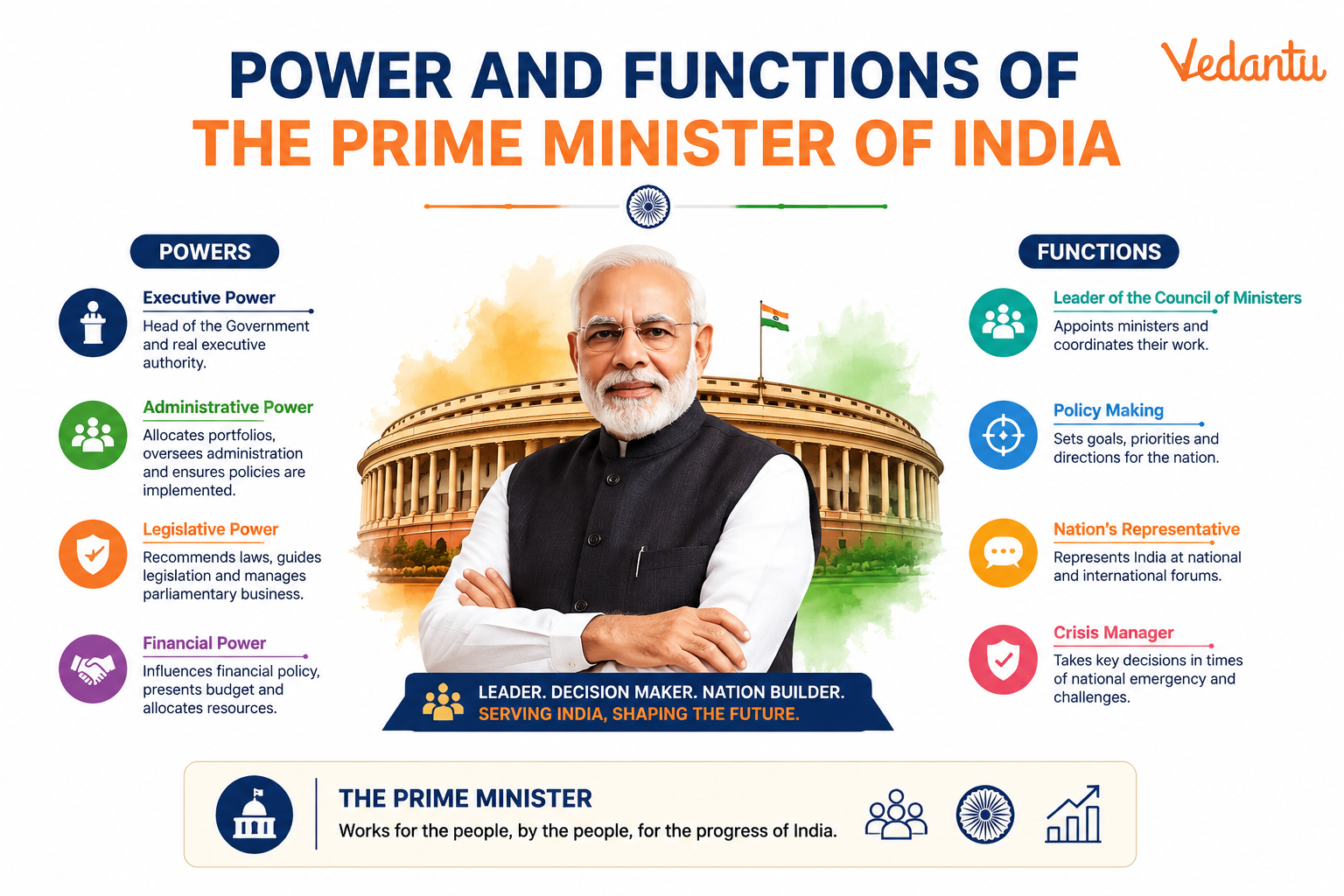
Constitutional Position of the Prime Minister
The office of the Prime Minister is established under Article 74 and Article 75 of the Indian Constitution. Article 74 states that there shall be a Council of Ministers with the Prime Minister as the head to aid and advise the President. Article 75 deals with the appointment, tenure, and responsibilities of the Prime Minister and other ministers.
- Appointed by the President of India
- Leader of the majority party or coalition in the Lok Sabha
- Head of the Council of Ministers
- Holds office during the pleasure of the President
Powers of the Prime Minister of India
1. Executive Powers
The Prime Minister exercises wide executive powers and is the chief decision-making authority in the government.
- Recommends the appointment of ministers to the President
- Allocates portfolios among ministers
- Can ask a minister to resign or advise the President to dismiss a minister
- Chairs meetings of the Cabinet
- Coordinates the work of various ministries
2. Legislative Powers
The Prime Minister plays a key role in the legislative process as the leader of the majority in the Lok Sabha.
- Advises the President to summon and prorogue Parliament sessions
- Advises the President to dissolve the Lok Sabha
- Leads the government in Parliament debates
- Ensures passage of important bills and policies
3. Financial Powers
Though the Finance Minister presents the Budget, the Prime Minister has overall control over financial policies.
- Supervises formulation of the Union Budget
- Guides economic and fiscal policies
- Leads key economic decision-making bodies
4. Diplomatic Powers
The Prime Minister represents India in international forums and shapes foreign policy.
- Represents India at international summits
- Plays a decisive role in foreign relations
- Advises the President on international treaties and agreements
5. Emergency Powers
During national emergencies, the role of the Prime Minister becomes even more significant.
- Advises the President to declare a National Emergency
- Leads crisis management and decision-making
- Coordinates between central and state governments
Functions of the Prime Minister
1. Leader of the Council of Ministers
The Prime Minister is the head of the Council of Ministers and ensures collective responsibility to the Lok Sabha. All ministers are accountable to the Prime Minister for their actions.
2. Link Between the President and the Council of Ministers
The Prime Minister acts as the chief channel of communication between the President and the Council of Ministers. He or she keeps the President informed about government decisions and policies.
3. Leader of the Nation
The Prime Minister is regarded as the political head of the country and represents the aspirations of the people. Major national policies and reforms are generally announced by the Prime Minister.
4. Chief Policy Maker
The Prime Minister determines domestic and foreign policies of the government. All major initiatives in areas such as defense, economy, education, and welfare are shaped under his or her leadership.
Summary of Powers and Functions of the Prime Minister
| Area | Type of Power | Key Role |
|---|---|---|
| Executive | Administrative Control | Heads Council of Ministers and allocates portfolios |
| Legislative | Parliamentary Leadership | Leads majority and ensures passage of bills |
| Diplomatic | Foreign Affairs | Represents India internationally |
The Prime Minister of India holds a pivotal position in the constitutional framework. With extensive executive, legislative, financial, and diplomatic powers, the Prime Minister ensures smooth functioning of the government. A clear understanding of these powers and functions is crucial for competitive examinations and for developing a strong foundation in Indian Polity.
Important Points for Exam Preparation
- Articles 74 and 75 deal with the Prime Minister and Council of Ministers
- Prime Minister is the real executive head of the government
- Council of Ministers is collectively responsible to the Lok Sabha
- Prime Minister acts as the link between the President and the Cabinet
By understanding the powers and functions of the Prime Minister of India in detail, students can effectively answer both objective and descriptive questions in various competitive examinations and strengthen their overall knowledge of the Indian political system.
FAQs on Power and Functions of the Prime Minister of India Explained for Students
1. What are the main powers and functions of the Prime Minister of India?
The Prime Minister of India is the real executive head of the country and exercises wide administrative, legislative, and diplomatic powers.
• Head of the Union Council of Ministers
• Leader of the Lok Sabha (if a member)
• Chief advisor to the President of India
• Chairperson of the Cabinet meetings
• Plays a key role in policy-making, governance, and administration
• Represents India in international forums and foreign affairs
These powers make the Prime Minister the central authority in the Parliamentary system of India.
2. How is the Prime Minister of India appointed?
The Prime Minister of India is appointed by the President of India under Article 75 of the Constitution.
• The President appoints the leader of the majority party in Lok Sabha
• In case of a hung Parliament, the leader who can prove majority support is appointed
• The Prime Minister must be a member of Lok Sabha or Rajya Sabha (within 6 months if not already)
This process ensures democratic functioning within India’s Parliamentary democracy.
3. What is the role of the Prime Minister in the Council of Ministers?
The Prime Minister is the head of the Council of Ministers and controls its formation and functioning.
• Selects and recommends ministers to the President
• Allocates and reshuffles ministerial portfolios
• Presides over Cabinet meetings
• Can ask a minister to resign
• Ensures collective responsibility of the Council to Lok Sabha
Without the Prime Minister, the Cabinet system of government cannot function effectively.
4. What legislative powers does the Prime Minister of India have?
The Prime Minister plays a crucial role in the legislative process of India.
• Leader of the majority party in Lok Sabha
• Advises the President to summon or prorogue Parliament sessions
• Influences the introduction and passage of bills and policies
• Guides government debates in Parliament
These powers make the Prime Minister central to law-making and parliamentary governance.
5. What are the executive powers of the Prime Minister?
The executive powers of the Prime Minister of India relate to administration and implementation of laws.
• Head of the Central Government
• Supervises functioning of various ministries and departments
• Appoints key officials (through committees)
• Chairs important bodies like NITI Aayog
Through these powers, the Prime Minister ensures smooth execution of government policies and decisions.
6. What role does the Prime Minister play in foreign policy?
The Prime Minister is the chief architect of India’s foreign policy and international relations.
• Represents India in international summits and organizations (UN, G20, BRICS)
• Signs important treaties and agreements
• Guides diplomatic relations with other countries
• Works closely with the Ministry of External Affairs
This role strengthens India’s position in global diplomacy and world affairs.
7. What is the relationship between the President and the Prime Minister?
The President of India acts on the advice of the Prime Minister and Council of Ministers in most matters.
• PM is the principal advisor to the President
• President exercises powers based on PM’s advice (Article 74)
• PM communicates decisions of the Cabinet to the President
Thus, while the President is the constitutional head, the Prime Minister is the real executive authority.
8. What is the term of the Prime Minister of India?
The Prime Minister holds office as long as he or she enjoys the confidence of the Lok Sabha.
• No fixed term mentioned in the Constitution
• Maximum duration aligns with the 5-year term of Lok Sabha
• Must resign if a no-confidence motion is passed
This ensures accountability under India’s democratic parliamentary system.
9. Can the Prime Minister be removed from office?
Yes, the Prime Minister can be removed if he or she loses majority support in the Lok Sabha.
• Passage of a No-Confidence Motion
• Failure to prove majority during a floor test
• Resignation due to political or personal reasons
This mechanism maintains collective responsibility and democratic accountability.
10. Why is the Prime Minister considered the most powerful position in India?
The Prime Minister is considered the most powerful authority because he or she controls the executive, influences legislation, and leads national policy.
• Heads the Executive branch
• Dominates the Cabinet and Parliament
• Shapes economic, defense, and foreign policies
• Acts as the chief spokesperson of the Government
Therefore, in India’s Parliamentary democracy, the Prime Minister is the central figure of governance and decision-making.
