






Major Rivers and Key Features of the Peninsular River System in India
The Peninsular River System is one of the two major river systems of India, the other being the Himalayan River System. These rivers originate mainly from the Western Ghats, Central Highlands, and other elevated plateaus of the Peninsular region. They are generally older, seasonal, and flow through broad and shallow valleys. The Peninsular rivers play a crucial role in irrigation, hydroelectric power generation, agriculture, and water supply in southern and central India. Understanding the Peninsular River System is important for school exams, competitive exams like UPSC, SSC, State PSC, and other General Knowledge tests.
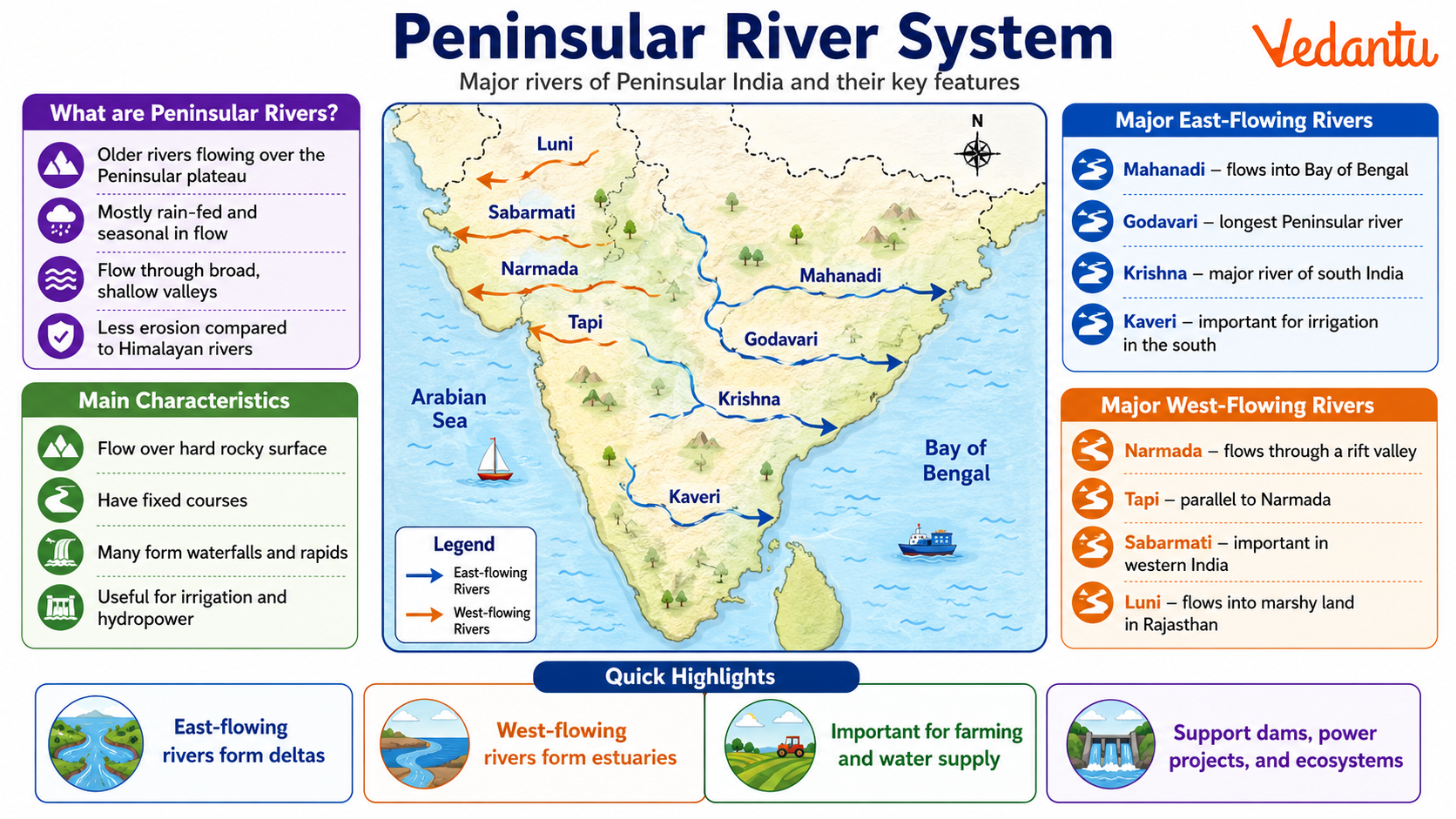
Overview of the Peninsular River System
The Peninsular rivers are considered ancient rivers because they flow over hard crystalline rocks of the Deccan Plateau. These rivers have reached a mature stage of development and usually have broad valleys and shallow beds. Most of them are rain-fed and depend largely on monsoon rainfall.
- Originate mainly from Western Ghats, Central Highlands, and Amarkantak Plateau
- Flow through rocky and uneven terrain
- Mostly seasonal in nature due to dependence on rainfall
- Have shorter courses compared to Himalayan rivers
- Form waterfalls and rapids in upper courses
Major River Systems of Peninsular India
The Peninsular River System can be divided into two main groups based on the direction of flow:
1. East Flowing Rivers
Most Peninsular rivers flow eastwards and drain into the Bay of Bengal. These rivers form large deltas near their mouths due to the deposition of sediments.
- Mahanadi - Originates from Chhattisgarh and forms a large delta in Odisha
- Godavari - Known as Dakshin Ganga, longest Peninsular river
- Krishna - Originates near Mahabaleshwar in Maharashtra
- Kaveri - Originates from Brahmagiri Hills in Karnataka
2. West Flowing Rivers
A few rivers flow westwards into the Arabian Sea. These rivers are generally shorter and do not form large deltas. Instead, they form estuaries.
- Narmada - Flows through a rift valley between Vindhya and Satpura ranges
- Tapi (Tapti) - Also flows through a rift valley
- Sabarmati - Flows through Rajasthan and Gujarat
Major Peninsular Rivers at a Glance
| River | Origin | Drainage |
|---|---|---|
| Godavari | Western Ghats, Maharashtra | Bay of Bengal |
| Krishna | Mahabaleshwar, Maharashtra | Bay of Bengal |
| Narmada | Amarkantak Plateau | Arabian Sea |
The table highlights some of the most important Peninsular rivers, their place of origin, and the sea into which they drain. Godavari is the longest river in the Peninsular region, while Narmada is one of the major west flowing rivers.
Characteristics of Peninsular Rivers
- These rivers are older and have reached the mature stage of erosion
- They have broad and shallow valleys
- Water flow depends mainly on monsoon rainfall
- Less prone to floods compared to Himalayan rivers
- Many dams are constructed for irrigation and hydroelectricity
Economic Importance
The Peninsular River System contributes significantly to the economic development of India. These rivers support agriculture, generate electricity, and provide drinking water to millions of people.
- Irrigation for crops like rice, cotton, sugarcane, and pulses
- Hydroelectric projects such as Nagarjuna Sagar and Hirakud Dam
- Support fisheries and inland water transport in delta regions
- Provide water for domestic and industrial use
Difference Between East and West Flowing Rivers
- East flowing rivers form deltas, while west flowing rivers form estuaries
- East flowing rivers are generally longer than west flowing rivers
- West flowing rivers like Narmada and Tapi flow through rift valleys
Important Points for Competitive Exams
- Godavari is the longest Peninsular river
- Narmada and Tapi flow westwards into the Arabian Sea
- Kaveri dispute is a major inter state river water dispute
- Peninsular rivers are mainly rain-fed and seasonal
Conclusion
The Peninsular River System forms the backbone of southern and central India's water resources. Although these rivers are seasonal and older compared to the Himalayan rivers, they play a vital role in agriculture, power generation, and regional development. A clear understanding of their origin, flow pattern, and economic importance is essential for students preparing for school exams and competitive examinations. Proper knowledge of the Peninsular River System helps in understanding India's physical geography and water resource management.
FAQs on Peninsular River System in India: Complete Guide for Students
1. What is the Peninsular River System in India?
The Peninsular River System refers to the network of rivers that originate in the Peninsular Plateau of India and mostly flow east or west into the seas.
Key Points:
• These rivers are mainly rain-fed (seasonal) and depend on the monsoon.
• They flow over hard igneous and metamorphic rocks of the Deccan Plateau.
• Major rivers include Godavari, Krishna, Kaveri, Mahanadi, and Narmada.
• They are older than the Himalayan rivers and have broad, shallow valleys.
People also ask: What are Peninsular rivers? How are they different from Himalayan rivers?
2. Which are the major rivers of the Peninsular River System?
The major rivers of the Peninsular River System are large east-flowing and west-flowing rivers of South India.
Major East-Flowing Rivers (Bay of Bengal):
• Godavari – Longest Peninsular river
• Krishna
• Mahanadi
• Kaveri (Cauvery)
Major West-Flowing Rivers (Arabian Sea):
• Narmada
• Tapi (Tapti)
These rivers are important for irrigation, hydroelectric power, and agriculture in the Deccan Plateau region.
3. Why are Peninsular rivers called seasonal rivers?
Peninsular rivers are called seasonal rivers because their water flow mainly depends on the Southwest Monsoon rainfall.
Reasons:
• They lack permanent snow-fed sources like the Himalayas.
• Water volume decreases significantly during summer.
• Many rivers experience reduced discharge in dry seasons.
This seasonal nature affects irrigation, water supply, and agriculture in southern India.
4. What is the difference between Himalayan and Peninsular rivers?
The Himalayan rivers and Peninsular rivers differ in origin, flow pattern, and water availability.
Key Differences:
• Origin: Himalayan rivers originate from glaciers; Peninsular rivers arise from plateaus.
• Water Source: Himalayan rivers are perennial; Peninsular rivers are rain-fed.
• Valleys: Himalayan rivers form deep gorges; Peninsular rivers form broad, shallow valleys.
• Age: Peninsular rivers are older than Himalayan rivers.
This comparison is important for GK, UPSC, and geography exams.
5. Which is the longest river in the Peninsular River System?
The Godavari River is the longest river in the Peninsular River System of India.
Key Facts:
• Length: About 1,465 km
• Origin: Trimbak Plateau, Maharashtra
• Drains into the Bay of Bengal
• Known as the "Dakshin Ganga" (Ganga of the South)
It plays a vital role in irrigation and agriculture in Maharashtra, Telangana, and Andhra Pradesh.
6. What are east-flowing and west-flowing Peninsular rivers?
Peninsular rivers are classified based on the direction they flow towards the sea.
East-Flowing Rivers:
• Flow into the Bay of Bengal
• Form large deltas
• Examples: Godavari, Krishna, Kaveri, Mahanadi
West-Flowing Rivers:
• Flow into the Arabian Sea
• Form estuaries instead of deltas
• Examples: Narmada, Tapi
This classification is important in Indian geography and competitive exams.
7. Why do west-flowing Peninsular rivers form estuaries instead of deltas?
West-flowing Peninsular rivers form estuaries because they flow through steep slopes and carry less sediment.
Main Reasons:
• Shorter course and swift flow.
• Hard rock terrain of the Western Ghats.
• Strong tidal action of the Arabian Sea.
Examples include the Narmada and Tapi rivers, which create estuarine mouths rather than large deltas.
8. What are the main features of the Peninsular River System?
The Peninsular River System has distinct physical and geographical characteristics.
Main Features:
• Older rivers flowing over stable landmass.
• Mostly rain-fed and seasonal.
• Fixed courses with fewer changes.
• Broad and shallow valleys.
• Form waterfalls like Jog Falls (Sharavati River).
These features reflect the geological stability of the Deccan Plateau.
9. Where do Peninsular rivers originate?
Peninsular rivers originate mainly from the Western Ghats, Central Highlands, and the Deccan Plateau.
Important Origins:
• Godavari – Trimbak Hills
• Krishna – Western Ghats near Mahabaleshwar
• Narmada – Amarkantak Plateau
• Kaveri – Brahmagiri Hills
Their plateau origin explains their seasonal flow and drainage pattern.
10. Why is the Peninsular River System important for India?
The Peninsular River System is crucial for irrigation, hydroelectricity, and economic development in southern and central India.
Importance:
• Supports major agricultural regions of the Deccan Plateau.
• Provides water for dams like Nagarjuna Sagar and Hirakud.
• Generates hydroelectric power.
• Supports biodiversity and inland fisheries.
These rivers are vital for sustainable development and water management in India.
