






How the Maratha Administration Managed Revenue and Military Power
Maratha Administration refers to the political and administrative system established by the Maratha Empire, especially under Chhatrapati Shivaji Maharaj in the 17th century. It was a well-organized structure designed to ensure efficient governance, strong military control, proper revenue collection, and local autonomy. The administrative framework combined traditional Indian practices with innovative reforms introduced by Shivaji. Understanding Maratha Administration is important for students preparing for competitive examinations as it highlights the evolution of regional governance in medieval India.
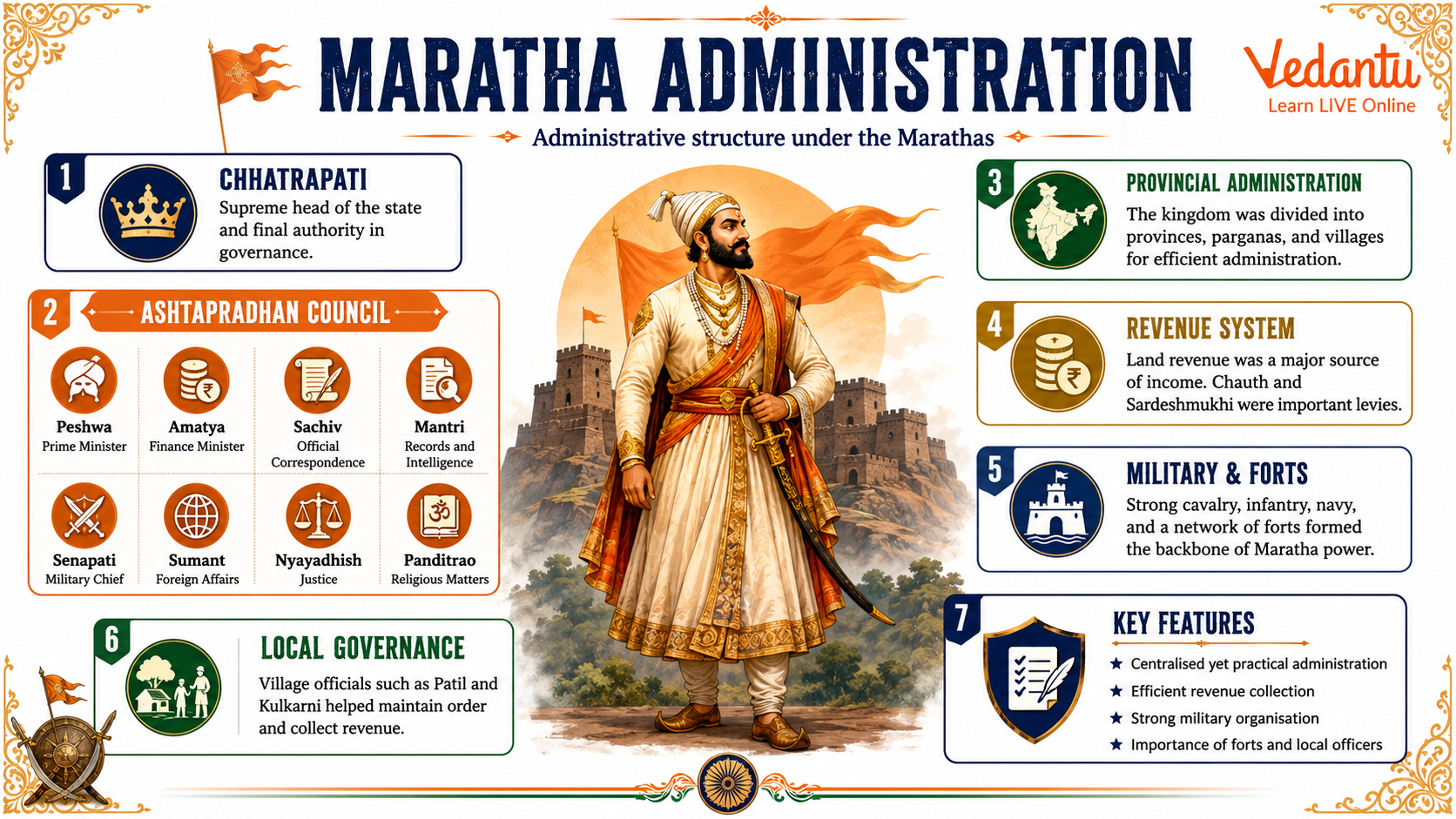
Features of Maratha Administration
The Maratha administrative system was systematic and disciplined. Shivaji aimed to create a centralized monarchy with effective checks and balances. The administration emphasized revenue management, military organization, and justice delivery.
- Strong central authority under the Chhatrapati
- Council of ministers called Ashtapradhan
- Efficient revenue system based on land measurement
- Well-organized military administration
- Decentralized local governance at village level
Central Administration
The central administration was headed by the Chhatrapati, who was the supreme authority in political, military, and judicial matters. However, he was assisted by a council of eight ministers known as the Ashtapradhan.
The Ashtapradhan Council
Members of Ashtapradhan
| Post | Function | Modern Equivalent |
|---|---|---|
| Peshwa | Prime Minister and head of administration | Prime Minister |
| Amatya | Finance Minister and accounts officer | Finance Minister |
| Sachiv | Maintained official records | Secretary |
| Mantri | Intelligence and internal affairs | Home Minister |
| Senapati | Commander of the army | Defense Minister |
| Sumant | Foreign affairs | Foreign Minister |
| Panditrao | Religious matters | Religious Advisor |
| Nyayadhish | Chief Justice | Chief Justice |
The Ashtapradhan was not a democratic body but functioned under the authority of the king. Each minister was directly responsible to the Chhatrapati. Over time, especially under later rulers, the Peshwa became more powerful.
Revenue Administration
Revenue was the main source of income for the Maratha state. Shivaji improved land revenue policies by adopting methods similar to those of Malik Ambar.
- Land was measured carefully to fix tax rates
- Revenue was generally one-third of the produce
- Direct collection from peasants reduced exploitation
- Chauth and Sardeshmukhi were important sources of income from other territories
Chauth and Sardeshmukhi
Chauth was a tax amounting to one-fourth of the revenue collected from neighboring states in return for protection. Sardeshmukhi was an additional ten percent levy claimed by the Marathas as hereditary rights. These taxes significantly increased the income of the Maratha Empire.
Military Administration
The military was the backbone of the Maratha Empire. Shivaji maintained a disciplined and well-trained army.
- Infantry and cavalry were the main components
- Strong naval force to protect the Konkan coast
- Use of guerrilla warfare known as Ganimi Kava
- Fort administration was highly developed
Each fort was managed by three officers to prevent misuse of power. This system ensured security and internal checks.
Provincial and Local Administration
The Maratha Empire was divided into provinces for administrative convenience. Each province was governed by a Prantpati or Subedar.
- Provinces divided into districts and villages
- Village headman called Patil
- Kulkarni maintained village accounts
- Local self governance was encouraged
Judicial System
Justice was based on Hindu law and local customs. The Nyayadhish handled civil cases while the Panditrao dealt with religious disputes. Village panchayats also played a role in resolving minor disputes. The system aimed at quick and fair justice.
Significance of Maratha Administration
The Maratha administrative system was efficient and adaptable. It helped in expanding the empire rapidly across large parts of India. Shivaji’s policies reduced corruption and strengthened local institutions. However, after his death, central control weakened and the Peshwas became dominant, leading to changes in the administrative structure.
- Laid foundation of a strong regional power
- Promoted efficient revenue reforms
- Encouraged decentralized governance
- Influenced later administrative practices in India
Conclusion
Maratha Administration under Shivaji was a well-structured and disciplined system that combined central authority with local participation. Its features such as the Ashtapradhan council, revenue reforms, strong military organization, and efficient village administration contributed to the success of the Maratha Empire. For students and competitive exam aspirants, understanding this administrative framework is essential to grasp the political developments of medieval India.
FAQs on Maratha Administration System and Governance Structure
1. What was the Maratha Administration system?
The Maratha Administration was a well‑organized governance system established by Chhatrapati Shivaji Maharaj in the 17th century to ensure efficient political and military control.
• Founded during the rise of the Maratha Empire
• Based on centralized authority under the Chhatrapati
• Supported by a structured council of ministers called the Ashta Pradhan
• Focused on revenue collection, military strength, and regional governance
This system is often discussed in GK questions about medieval Indian administration and competitive exams.
2. Who were the members of the Ashta Pradhan?
The Ashta Pradhan was an eight‑minister council that assisted Shivaji in administration and policy decisions.
• Peshwa – Prime Minister
• Amatya – Finance Minister
• Sachiv – Chief Secretary
• Mantri – Interior Minister
• Senapati – Commander‑in‑Chief
• Sumant/Dabir – Foreign Affairs Minister
• Nyayadhish – Chief Justice
• Panditrao – Religious Head
This council formed the backbone of the Maratha governance structure.
3. What was the role of the Peshwa in Maratha Administration?
The Peshwa was the Prime Minister and the most powerful official after the king in the Maratha political system.
• Head of general administration
• Managed state affairs and royal correspondence
• Later became the de facto ruler during the 18th century
• Key figures include Balaji Vishwanath and Baji Rao I
The rise of the Peshwas marked a shift from royal to ministerial dominance in the Maratha Empire.
4. How was revenue collected in the Maratha Empire?
The Maratha revenue system was primarily based on land tax and regional levies to strengthen the empire’s economy.
• Chauth – 25% tax on neighboring territories
• Sardeshmukhi – Additional 10% levy
• Land revenue collected directly from peasants
• Officials like Amatya supervised financial records
This taxation policy supported military expansion and administrative expenses.
5. What was the importance of forts in Maratha Administration?
Forts were central to the military and administrative strategy of the Maratha Empire.
• Over 300 forts controlled by Shivaji
• Each fort managed by a Havaldar
• Served as military bases and storage centers
• Ensured defense against Mughals and other rivals
Forts like Raigad and Pratapgad symbolized Maratha strength and governance.
6. How was the Maratha military organized?
The Maratha military was a disciplined and mobile force known for guerrilla warfare tactics.
• Strong cavalry and light infantry units
• Led by the Senapati
• Used Ganimi Kava (guerrilla warfare strategy)
• Focused on swift attacks and strategic retreats
This military organization helped the Marathas challenge the powerful Mughal Empire.
7. What were the judicial features of Maratha Administration?
The judicial system in Maratha rule ensured justice based on Hindu law and local customs.
• Nyayadhish acted as Chief Justice
• Village-level disputes settled by Panchayats
• Religious matters handled by Panditrao
• Emphasis on fair and quick justice
This decentralized judicial setup maintained law and order in the Maratha state.
8. How did Shivaji ensure efficient local administration?
Shivaji strengthened local administration through a structured provincial system.
• Empire divided into Prants (provinces)
• Provinces governed by officials appointed by the king
• Villages managed by Patil and Kulkarni
• Direct supervision to prevent corruption
This hierarchical governance improved accountability and administrative efficiency.
9. What made Maratha Administration different from Mughal Administration?
Maratha Administration differed from Mughal governance in structure, taxation, and military strategy.
• More decentralized compared to Mughal centralization
• Relied on Chauth and Sardeshmukhi taxes
• Emphasized guerrilla warfare over large standing armies
• Council-based decision making via Ashta Pradhan
These differences highlight contrasting models of medieval Indian governance.
10. Why is Maratha Administration important for competitive exams?
Maratha Administration is a key topic in General Knowledge, History syllabus, and competitive exams like UPSC, SSC, and State PSC.
• Frequently asked about Ashta Pradhan and Peshwas
• Important for understanding medieval Indian polity
• Connected to questions on Shivaji Maharaj and the Maratha Empire
• Helps compare administrative systems in Indian history
This topic is essential for students preparing for history and GK examinations.
