






Key Provisions of the 1833 Charter Act and Their Historical Importance
The Charter Act of 1833 was a landmark legislation passed by the British Parliament to regulate the affairs of the East India Company in India. It marked a significant step in the constitutional development of British India and laid the foundation for centralised administration. The Act is particularly important for students preparing for competitive examinations as it introduced major administrative, legislative, and economic changes. It is also known as the Saint Helena Act of 1833. Below are the main features, significance, and impact of the Charter Act of 1833 explained in a clear and structured manner.
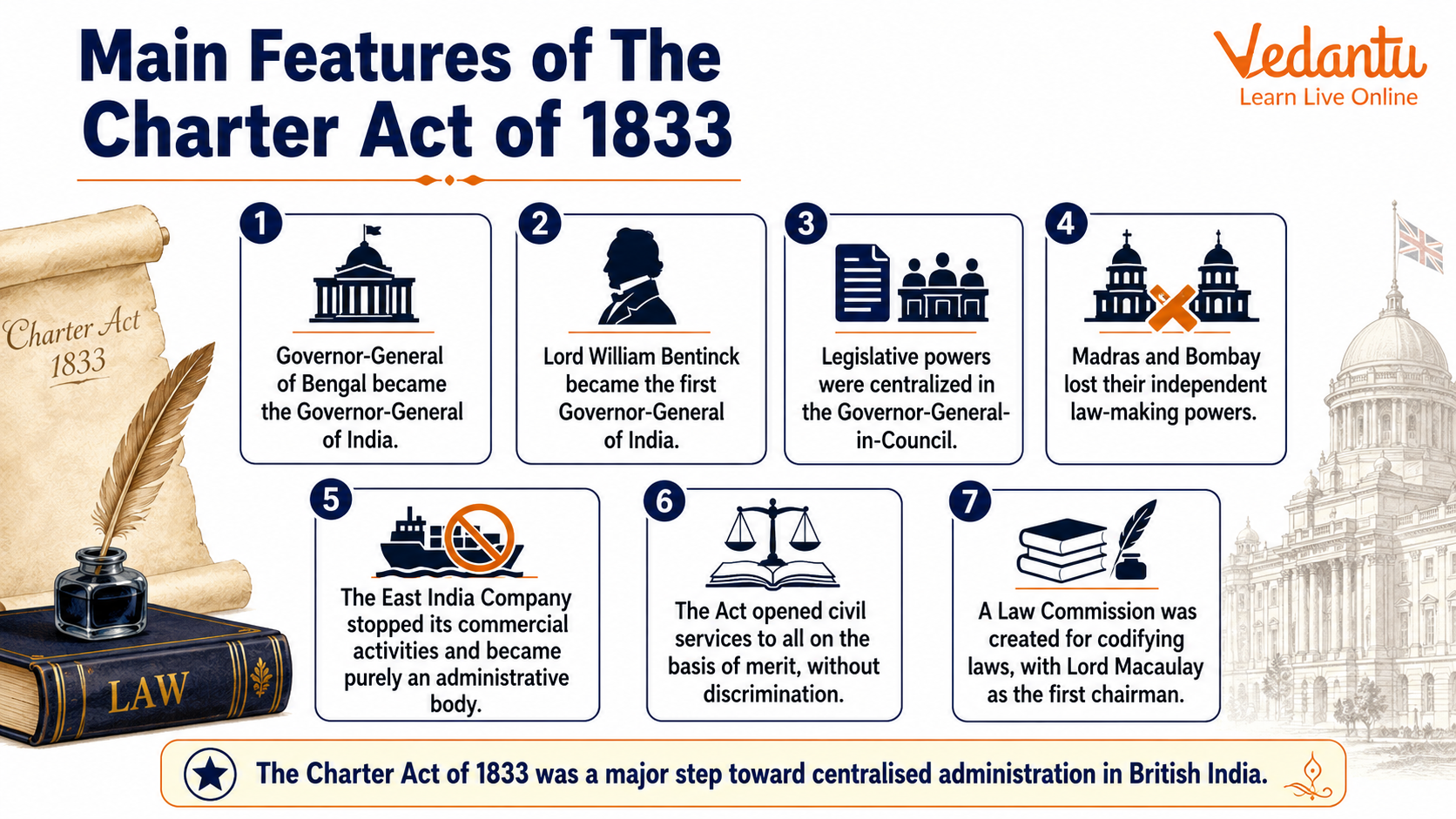
Background of the Charter Act of 1833
The East India Company had been ruling large parts of India under various Charter Acts passed by the British Parliament. The Charter Act of 1813 had ended the Company's trade monopoly except for trade in tea and trade with China. By 1833, British political and economic interests demanded further reforms in administration and governance. As a result, the Charter Act of 1833 was enacted to reorganize the administration of India and redefine the Company's role.
Main Features of the Charter Act of 1833
1. End of the Company's Commercial Activities
- The Act ended the East India Company's commercial functions completely.
- It abolished the Company's monopoly in trade with China and in tea.
- The Company became purely an administrative body managing British territories in India.
2. Governor-General of Bengal Became Governor-General of India
- The Governor-General of Bengal was redesignated as the Governor-General of India.
- Lord William Bentinck became the first Governor-General of India.
- He was given authority over all British territories in India.
3. Centralization of Legislative Powers
- All legislative powers were centralized in the Governor-General in Council.
- The legislative powers of the Bombay and Madras Presidencies were taken away.
- The Governor-General in Council was empowered to make laws for the entire British India.
4. Addition of Law Member
- A fourth member was added to the Governor-General's Council for legislative purposes.
- This member was known as the Law Member.
- Lord Macaulay was appointed as the first Law Member.
5. Attempt to Introduce Open Competition in Civil Services
- The Act stated that no Indian citizen should be denied employment under the Company on the basis of religion, place of birth, descent, or color.
- It laid the foundation for the principle of open competition in civil services.
- However, this provision was not effectively implemented at that time.
6. Separation of Legislative and Executive Functions
The Charter Act of 1833 made a distinction between legislative and executive functions of the Governor-General's Council. While the same council performed both roles, the addition of the Law Member for legislative work marked the beginning of separating these two functions.
7. Creation of Law Commission
- The Act provided for the establishment of a Law Commission.
- The first Law Commission was headed by Lord Macaulay.
- It led to the codification of laws, including the Indian Penal Code.
Key Provisions of the Charter Act of 1833
| Provision | Before 1833 | After 1833 |
|---|---|---|
| Company's Role | Trading and Administrative | Only Administrative |
| Governor-General | Governor-General of Bengal | Governor-General of India |
| Legislative Power | Shared by Presidencies | Centralized in Governor-General in Council |
The above table clearly shows how the Charter Act of 1833 transformed the administrative and legislative structure of British India by introducing centralization and reducing the autonomy of provincial governments.
Significance of the Charter Act of 1833
- It marked the beginning of complete centralization of administration in India.
- It ended the commercial activities of the East India Company.
- It laid the foundation for modern legislative institutions in India.
- It initiated the process of codification of Indian laws.
- It introduced the concept of equality in public employment in principle.
Limitations of the Charter Act of 1833
- The promise of equal opportunity in civil services was not implemented effectively.
- Indians were not given real representation in the legislative process.
- Power remained concentrated in British hands.
Conclusion
The Charter Act of 1833 was a crucial milestone in the constitutional history of India. It transformed the East India Company from a commercial enterprise into a purely administrative body and centralized legislative powers under the Governor-General of India. Although it did not grant political rights to Indians, it laid the groundwork for future administrative and legal reforms. Understanding the main features of the Charter Act of 1833 is essential for students of history and aspirants preparing for competitive examinations, as it represents a major step in the evolution of British governance in India.
FAQs on Charter Act of 1833: Major Provisions and Impact on British India
1. What was the Charter Act of 1833?
The Charter Act of 1833 was a major constitutional reform that centralized British rule in India and ended the East India Company’s commercial activities.
• Also known as the Saint Helena Act, 1833
• Passed by the British Parliament
• Made the Governor-General of Bengal the Governor-General of India
• Ended the East India Company’s trade monopoly
• Marked the beginning of a centralized legislative system in India
2. What were the main features of the Charter Act of 1833?
The main features of the Charter Act of 1833 focused on centralization and administrative reforms in British India.
• Created the post of Governor-General of India (first: Lord William Bentinck)
• Centralized legislative powers under one authority
• Abolished the Company’s commercial functions
• Allowed Indians to hold government jobs without discrimination (in principle)
• Added a Law Member to the Governor-General’s Council
3. Why is the Charter Act of 1833 important in Indian history?
The importance of the Charter Act of 1833 lies in its role in centralizing administration and laying the foundation of modern governance in India.
• First step towards a centralized British Indian administration
• Introduced law-making powers at the central level
• Opened civil services to Indians (theoretically)
• Strengthened parliamentary control over the East India Company
4. Who was the first Governor-General of India under the Charter Act of 1833?
The first Governor-General of India under the Charter Act of 1833 was Lord William Bentinck.
• Previously served as Governor-General of Bengal
• Became head of all British territories in India
• Exercised exclusive legislative powers
• Played a key role in social and administrative reforms
5. How did the Charter Act of 1833 affect the East India Company?
The Charter Act of 1833 transformed the East India Company from a trading body into a purely administrative authority.
• Abolished its trade monopoly completely
• Ended commercial activities in China and India
• Converted it into a governing agency for the British Crown
• Increased parliamentary supervision
6. What changes were made in the legislative system by the Charter Act of 1833?
The Charter Act of 1833 introduced significant legislative reforms in British India.
• Centralized all law-making powers in the Governor-General-in-Council
• Abolished legislative powers of Bombay and Madras
• Added a Law Member (first: Lord Macaulay)
• Initiated codification of laws, leading to the Indian Penal Code
7. Did the Charter Act of 1833 allow Indians to hold government jobs?
Yes, the Charter Act of 1833 declared that Indians could hold government offices without discrimination based on religion, race, or caste.
• Introduced the principle of equality in public employment
• Opened doors to the Indian Civil Services (theoretically)
• However, practical barriers remained due to exams held in England
8. What was the role of Lord Macaulay under the Charter Act of 1833?
Under the Charter Act of 1833, Lord Thomas Babington Macaulay was appointed as the first Law Member of the Governor-General’s Council.
• Headed the First Law Commission
• Drafted the Indian Penal Code (IPC)
• Promoted legal codification and uniform laws
• Influenced English education policy in India
9. How did the Charter Act of 1833 centralize administration in India?
The Charter Act of 1833 centralized administration by concentrating authority in the hands of the Governor-General of India.
• Unified control over British territories in India
• Removed legislative powers from provincial governments
• Established a single central legislative authority
• Strengthened executive control at the national level
10. What is the difference between the Charter Act of 1813 and 1833?
The key difference between the Charter Act of 1813 and the Charter Act of 1833 lies in trade monopoly and administrative centralization.
• 1813 Act ended trade monopoly except with China; 1833 ended it completely
• 1813 allowed Christian missionaries; 1833 centralized governance
• 1833 created the post of Governor-General of India
• 1833 strengthened legislative and administrative reforms
