






Which Is the Longest River in the World? Top 10 List with Lengths
Rivers are among the most important natural features on Earth, supporting life, shaping landscapes, and influencing civilizations for thousands of years. The longest rivers of the world are remarkable not only for their immense length but also for their economic, ecological, and cultural importance. They flow across multiple countries, provide water for agriculture and industry, and sustain diverse ecosystems. Understanding the longest rivers of the world is essential for students, competitive exam aspirants, and geography enthusiasts.
What is a River?
A river is a natural flowing watercourse that usually flows towards an ocean, sea, lake, or another river. Rivers begin at a source, often in mountains or hills, and end at a mouth. The total length of a river is measured from its source to its mouth, which helps determine its ranking among the longest rivers in the world.
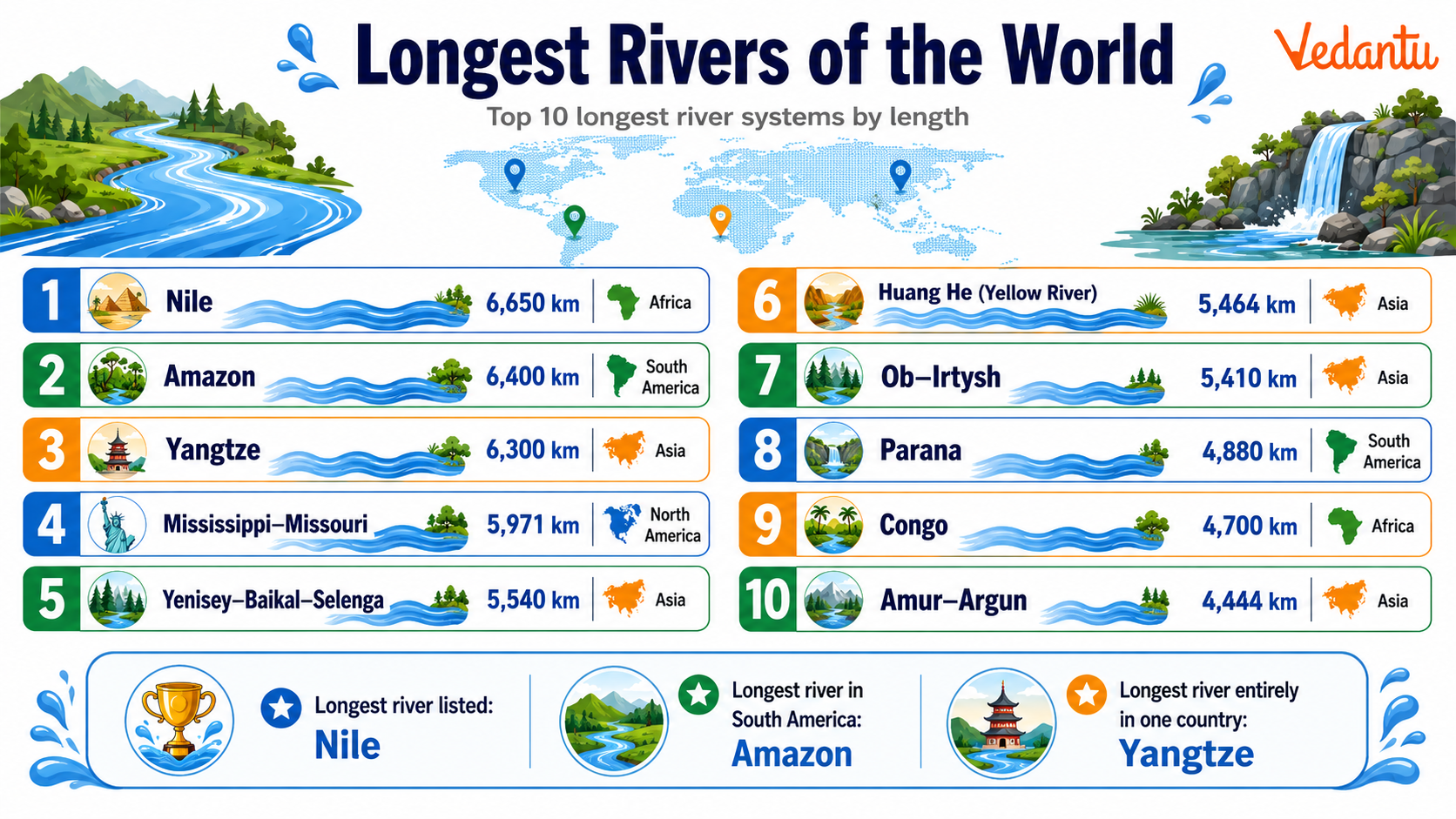
Top 10 Longest Rivers Of The World
| River | Length Approx | Continent |
|---|---|---|
| Nile | 6,650 km | Africa |
| Amazon | 6,400 km | South America |
| Yangtze | 6,300 km | Asia |
| Mississippi-Missouri | 6,275 km | North America |
| Yenisei | 5,539 km | Asia |
| Yellow River | 5,464 km | Asia |
| Ob-Irtysh | 5,410 km | Asia |
| Parana | 4,880 km | South America |
| Congo | 4,700 km | Africa |
| Amur | 4,444 km | Asia |
The Nile River is traditionally considered the longest river in the world, while the Amazon River has the largest drainage basin and water discharge. The Yangtze is the longest river in Asia and plays a vital role in China's economy. Many of these rivers flow through multiple countries and support millions of people.
Brief Overview of Major Rivers
1. Nile River
The Nile River flows through northeastern Africa and is often called the lifeline of Egypt. It flows northward into the Mediterranean Sea and supports agriculture in desert regions.
2. Amazon River
The Amazon River flows through South America, mainly Brazil. It carries the largest volume of water in the world and passes through the Amazon Rainforest, which is rich in biodiversity.
3. Yangtze River
The Yangtze River is the longest river in Asia. It flows entirely within China and is important for transportation, irrigation, and hydroelectric power generation.
4. Mississippi-Missouri River System
This river system is the longest in North America. It plays a major role in trade and agriculture in the United States.
Importance of the Longest Rivers
- Provide fresh water for drinking and irrigation.
- Support agriculture and fisheries.
- Enable transportation and trade routes.
- Generate hydroelectric power through dams.
- Maintain biodiversity and ecological balance.
Interesting Facts About the Longest Rivers
- The Amazon River discharges more water than the next seven largest rivers combined.
- The Nile River flows through 11 countries in Africa.
- The Yangtze River basin is home to nearly one third of China's population.
- The Congo River is the deepest river in the world.
- Some rivers like the Ob-Irtysh system flow through extremely cold regions of Siberia.
Continental Distribution of Long Rivers
Asia has the highest number of long rivers among the top 10, including the Yangtze, Yellow River, Yenisei, Ob-Irtysh, and Amur. Africa is home to the Nile and Congo. South America has the Amazon and Parana, while North America features the Mississippi-Missouri system. This distribution shows how river systems are spread across different climatic and geographical regions.
Why This Topic is Important for Exams
The longest rivers of the world are frequently asked in general knowledge quizzes, competitive exams, and school tests. Questions may focus on ranking, continent, unique features, or comparison between the Nile and Amazon. Students should remember the top five rivers along with their approximate lengths and continents.
Conclusion
The longest rivers of the world are vital natural resources that shape human civilization and the environment. From the Nile in Africa to the Amazon in South America and the Yangtze in Asia, these rivers play a crucial role in agriculture, trade, biodiversity, and energy production. A clear understanding of their length, location, and importance helps students strengthen their geography knowledge and perform well in competitive examinations.
FAQs on Longest Rivers in the World and Their Key Facts
1. What are the longest rivers in the world?
The longest rivers in the world are ranked based on their total length from source to mouth.
• Nile River – About 6,650 km (Africa)
• Amazon River – About 6,400 km (South America)
• Yangtze River – About 6,300 km (China)
• Mississippi–Missouri River System – About 6,275 km (USA)
• Yenisei River – About 5,539 km (Russia)
These major world rivers are important for transportation, agriculture, biodiversity, and civilization development.
2. Which is the longest river in the world?
The Nile River is traditionally considered the longest river in the world at approximately 6,650 km.
• Flows through 11 African countries
• Empties into the Mediterranean Sea
• Major tributaries: White Nile and Blue Nile
However, some studies argue that the Amazon River may be slightly longer, making this a common GK debate topic.
3. Why is the Amazon River important?
The Amazon River is important because it is the largest river by water discharge and supports vast biodiversity.
• Flows through Brazil, Peru, and Colombia
• Drains the Amazon Rainforest
• Has the greatest water volume in the world
• Home to unique species like the pink river dolphin
It plays a crucial role in global climate regulation and ecology.
4. Which is the longest river in Asia?
The Yangtze River is the longest river in Asia, stretching about 6,300 km.
• Located entirely in China
• Also called the Chang Jiang
• Hosts the Three Gorges Dam
• Vital for agriculture, trade, and hydroelectric power
It is the third-longest river in the world after the Nile and Amazon.
5. What is the longest river in North America?
The Mississippi–Missouri River System is the longest river system in North America.
• Total length: About 6,275 km
• Flows through the United States
• Drains into the Gulf of Mexico
• Important for transportation and agriculture
This river system is a frequent topic in geography GK and competitive exams.
6. How are the longest rivers in the world measured?
The length of the longest rivers in the world is measured from their source to their mouth.
• Identifying the farthest source point
• Measuring the river’s total channel length
• Using satellite mapping and surveys
• Considering seasonal and geographical changes
Differences in measurement methods often cause debates, especially between the Nile and Amazon.
7. Which is the longest river in Africa?
The Nile River is the longest river in Africa and possibly the world.
• Length: About 6,650 km
• Flows through countries like Egypt, Sudan, and Uganda
• Forms the fertile Nile Delta
• Crucial for ancient Egyptian civilization
It remains one of the most historically significant rivers globally.
8. Which river has the largest drainage basin in the world?
The Amazon River has the largest drainage basin in the world.
• Covers about 7 million square kilometers
• Drains much of South America
• Contains thousands of tributaries
• Supports dense tropical rainforest ecosystems
This makes it the most voluminous and ecologically rich river system.
9. What is the longest river in Europe?
The Volga River is the longest river in Europe.
• Length: About 3,530 km
• Flows entirely within Russia
• Empties into the Caspian Sea
• Important for transport and hydroelectric power
It is often asked in GK quizzes and geography exams.
10. Why are the longest rivers important for civilizations?
The longest rivers of the world are important because they support human settlements, trade, and agriculture.
• Provide fresh water for drinking and irrigation
• Enable transportation and trade routes
• Support fertile plains like the Nile Valley
• Generate hydroelectric power
Many ancient civilizations, including those along the Nile, Indus, and Yangtze, developed around major rivers.
