






Bharat Ratna Award Winners Year-Wise with Their Major Contributions
The Bharat Ratna is the highest civilian award of India. It is awarded in recognition of exceptional service or performance of the highest order in any field of human endeavor. Instituted in 1954, the award honors individuals who have made outstanding contributions to the nation in areas such as art, literature, science, public service, sports, and social work. The List of Bharat Ratna Award Winners is an important topic for General Knowledge, competitive exams, and academic studies because it highlights India’s most distinguished personalities and their achievements.
About Bharat Ratna Award
The Bharat Ratna was established by the Government of India on 2 January 1954. Initially, it was limited to achievements in arts, literature, science, and public services, but in 2011, the criteria were expanded to include any field of human endeavor. The award is conferred by the President of India.
- First awarded in 1954
- Highest civilian award of India
- Given for exceptional service of the highest order
- Awarded to Indian citizens and, in some cases, foreigners
- Maximum of three awards can be given in a year
Design of the Bharat Ratna Medal
The Bharat Ratna medal is in the shape of a peepal leaf. It is made of toned bronze and features a sun with the words Bharat Ratna inscribed in Devanagari script. On the reverse side, the State Emblem of India and the national motto Satyameva Jayate are engraved.
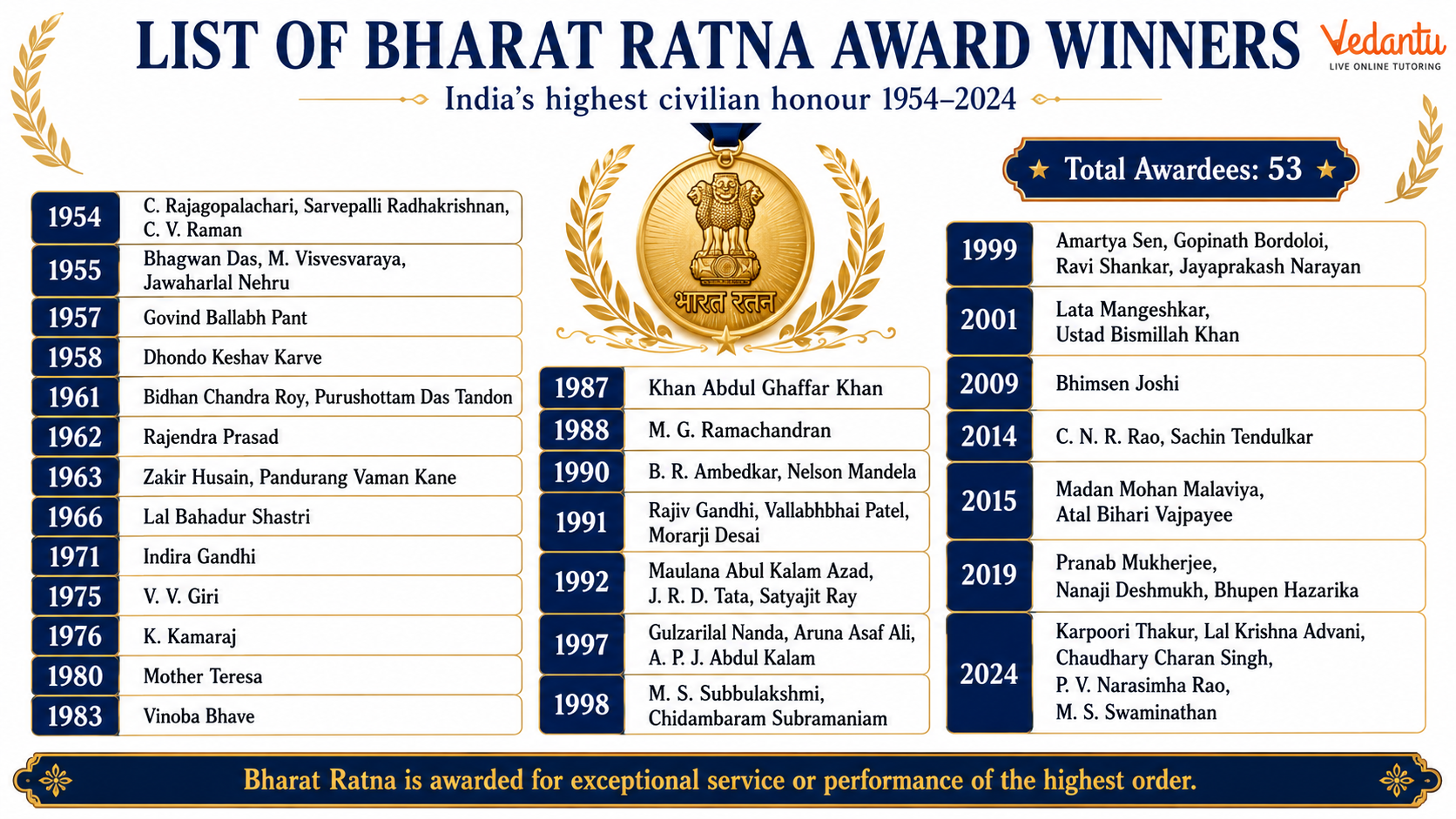
List Of Bharat Ratna Award Winners (1954 - 2024)
| Year | Name | Field |
|---|---|---|
| 1954 | C. Rajagopalachari | Public Affairs |
| 1954 | Dr. S. Radhakrishnan | Education |
| 1954 | Dr. C. V. Raman | Science |
| 1955 | Jawaharlal Nehru | Public Affairs |
| 1957 | Govind Ballabh Pant | Public Affairs |
| 1961 | Dr. Bidhan Chandra Roy | Medicine |
| 1963 | Dr. Zakir Husain | Education |
| 1971 | Indira Gandhi | Public Affairs |
| 1980 | Mother Teresa | Social Service |
| 1990 | Dr. B. R. Ambedkar | Social Reform |
| 1991 | Rajiv Gandhi | Public Affairs |
| 1997 | Aruna Asaf Ali | Freedom Struggle |
| 1998 | M. S. Subbulakshmi | Music |
| 1998 | Chidambaram Subramaniam | Public Affairs |
| 2001 | Lata Mangeshkar | Music |
| 2001 | Ustad Bismillah Khan | Music |
| 2014 | Sachin Tendulkar | Sports |
| 2014 | Prof. C. N. R. Rao | Science |
| 2019 | Pranab Mukherjee | Public Affairs |
| 2019 | Bhupen Hazarika | Arts |
| 2024 | Lal Krishna Advani | Public Affairs |
The above table highlights some of the most notable Bharat Ratna award winners from 1954 to 2024. The award has been conferred on leaders, scientists, artists, musicians, social reformers, and sportspersons who have significantly contributed to India’s development and global reputation.
Important Facts About Bharat Ratna Winners
- Dr. C. V. Raman was one of the first recipients and a Nobel Prize winner in Physics.
- Mother Teresa was the first naturalized Indian citizen to receive the award.
- Sachin Tendulkar is the youngest recipient of the Bharat Ratna.
- The award can be given posthumously.
- Foreign nationals like Nelson Mandela have also received the Bharat Ratna.
Eligibility and Selection Process
There is no formal application process for the Bharat Ratna. Recommendations for the award are made by the Prime Minister to the President of India. The award does not carry any monetary grant but includes a certificate signed by the President and a medallion.
Eligibility Criteria
- Open to all individuals regardless of race, occupation, position, or gender
- Can be awarded posthumously
- Limited to a maximum of three recipients per year
Why Bharat Ratna Winners Are Important for GK and Exams
Questions about Bharat Ratna award winners are frequently asked in competitive exams such as UPSC, SSC, Banking, Railways, and state-level examinations. Students should remember important winners, the first recipients, recent awardees, and special facts such as the youngest or foreign recipients. Understanding the achievements of these personalities also helps in essay writing, interviews, and general awareness sections.
The List Of Bharat Ratna Award Winners reflects the rich diversity of talent and leadership in India. From scientists and politicians to musicians and sportspersons, the award celebrates excellence and dedication toward national progress. Learning about these awardees not only strengthens General Knowledge but also inspires individuals to contribute meaningfully to society.
FAQs on List of Bharat Ratna Award Winners in India (1954–2024) – Complete Names and Key Facts
1. What is the Bharat Ratna Award?
The Bharat Ratna is the highest civilian award of India, given for exceptional service towards the nation.
• Instituted in 1954 by the Government of India
• Awarded for excellence in arts, literature, science, public services, and sports
• Conferred by the President of India
• Includes a Peepal leaf-shaped medal and a certificate (Sanad)
It is one of the most prestigious national honours and is often searched under terms like India’s highest civilian award and Bharat Ratna meaning.
2. Who was the first Bharat Ratna award winner?
The first Bharat Ratna awardees were three distinguished Indians honored in 1954.
• C. Rajagopalachari – Last Governor-General of India
• Dr. Sarvepalli Radhakrishnan – Philosopher and second President of India
• Dr. C. V. Raman – Nobel Prize-winning physicist
These leaders are frequently mentioned in GK questions about first Bharat Ratna recipients and early award winners.
3. How many people have received the Bharat Ratna Award?
As of recent updates, over 45 individuals have been awarded the Bharat Ratna.
• Includes leaders, scientists, artists, and social reformers
• Some awards were given posthumously
• A maximum of three awards per year can be given
This is a common question in competitive exams under total Bharat Ratna winners and list of awardees.
4. Who was the first woman to receive the Bharat Ratna?
The first woman Bharat Ratna awardee was Indira Gandhi in 1971.
• Served as the Prime Minister of India
• Honored for her leadership and political contributions
• Played a key role in the 1971 Indo-Pak War
She is often searched under female Bharat Ratna winners and women award recipients.
5. Who was the first sportsperson to receive the Bharat Ratna?
The first sportsperson to receive the Bharat Ratna was Sachin Tendulkar in 2014.
• Legendary Indian cricketer
• Youngest Bharat Ratna recipient
• Honored for outstanding contribution to Indian cricket
This is a popular GK query related to Bharat Ratna sports category and cricketer Bharat Ratna winner.
6. Can the Bharat Ratna be awarded posthumously?
Yes, the Bharat Ratna can be awarded posthumously to honor deceased individuals.
• Provision added in 1955
• Many leaders like Sardar Vallabhbhai Patel and Lal Bahadur Shastri received it after their death
• Recognizes lifelong national contribution
This question is common under posthumous Bharat Ratna awards and rules of Bharat Ratna.
7. Who was the first foreigner to receive the Bharat Ratna?
The first foreign national to receive the Bharat Ratna was Khan Abdul Ghaffar Khan in 1987.
• Freedom fighter from present-day Pakistan
• Known as the Frontier Gandhi
• Promoted non-violence and unity
Other foreign recipients include Nelson Mandela, making this a key topic in foreign Bharat Ratna awardees.
8. What are the eligibility criteria for the Bharat Ratna Award?
The Bharat Ratna is awarded for exceptional service of the highest order without restriction of race, occupation, or gender.
• Open to Indian citizens and foreigners
• Recognizes excellence in arts, science, literature, public service, and sports
• Recommendations are made by the Prime Minister to the President
This is often searched as Bharat Ratna eligibility and criteria for highest civilian award.
9. Who are some recent Bharat Ratna Award winners?
Recent Bharat Ratna awardees include prominent political leaders and social reformers.
• Pranab Mukherjee (2019) – Former President of India
• Bhupen Hazarika (2019) – Renowned singer and composer
• Nanaji Deshmukh (2019) – Social activist
Such questions appear in GK sections as latest Bharat Ratna winners and current award recipients.
10. What is the significance of the Bharat Ratna Medal design?
The Bharat Ratna medal design symbolizes India’s cultural heritage and honor.
• Shaped like a Peepal leaf
• Inscribed with the words “Bharat Ratna” in Devanagari script
• Features the State Emblem of India on the reverse side
The design reflects national pride and is frequently asked in exams under Bharat Ratna medal features and award design details.
