






Major mountain ranges of the world by continent and their highest peaks
Mountain ranges are large chains or groups of mountains that stretch over long distances and play a vital role in shaping the Earth's physical features, climate, rivers, biodiversity, and human settlements. The major mountain ranges of the world are not only important geographical landmarks but also significant for economic activities, tourism, culture, and environmental balance. Understanding the list of major mountain ranges of the world is essential for students preparing for school exams, competitive examinations, and general knowledge tests.
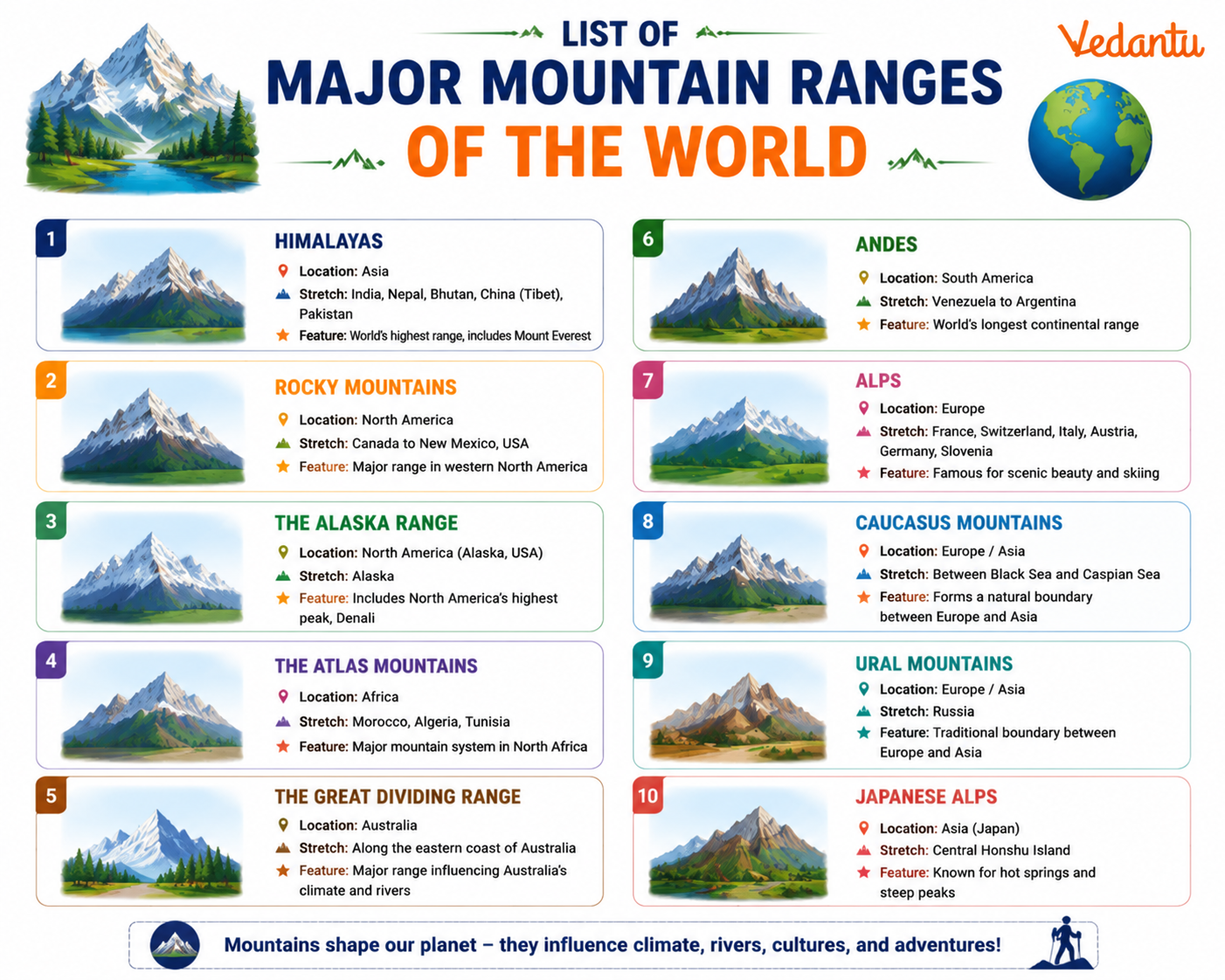
What is a Mountain Range?
A mountain range is a series of connected mountains formed by geological processes such as tectonic plate movement, volcanic activity, or folding and faulting of the Earth's crust. Most major mountain ranges were formed due to the collision or separation of tectonic plates over millions of years.
- They often act as natural boundaries between countries.
- They influence rainfall patterns and climate.
- They are sources of major rivers.
- They support unique flora and fauna.
List of Major Mountain Ranges of the World
| Mountain Range | Continent | Highest Peak |
|---|---|---|
| Himalayas | Asia | Mount Everest |
| Andes | South America | Mount Aconcagua |
| Rocky Mountains | North America | Mount Elbert |
| Alps | Europe | Mont Blanc |
| Atlas Mountains | Africa | Mount Toubkal |
| Ural Mountains | Europe and Asia | Mount Narodnaya |
| Great Dividing Range | Australia | Mount Kosciuszko |
| Appalachian Mountains | North America | Mount Mitchell |
The above mountain ranges are among the most significant in terms of height, length, geographical impact, and global recognition. Each range has unique physical characteristics and historical importance.
Detailed Overview of Major Mountain Ranges
1. The Himalayas
The Himalayas are the highest mountain range in the world, stretching across India, Nepal, Bhutan, China, and Pakistan. Mount Everest, the world's highest peak at 8848.86 meters, lies in this range. The Himalayas are the source of major rivers like the Ganga, Brahmaputra, and Indus.
2. The Andes
The Andes are the longest continental mountain range in the world, running along the western coast of South America. Mount Aconcagua is the highest peak in the Andes and the highest mountain outside Asia.
3. The Rocky Mountains
The Rocky Mountains extend from Canada to the United States. They are known for their scenic beauty, wildlife, and mineral resources. Mount Elbert is the highest peak in this range.
4. The Alps
The Alps are located in Europe and pass through countries like France, Switzerland, Italy, Germany, and Austria. Mont Blanc is the highest peak. The Alps are famous for winter sports and tourism.
5. The Atlas Mountains
The Atlas Mountains are located in northwestern Africa, mainly in Morocco, Algeria, and Tunisia. They act as a barrier between the Sahara Desert and the Mediterranean region.
6. The Ural Mountains
The Ural Mountains form a natural boundary between Europe and Asia. Though not very high, they are rich in mineral resources.
7. The Great Dividing Range
Located in eastern Australia, the Great Dividing Range is the longest mountain range in Australia. It plays an important role in influencing Australia's climate.
8. The Appalachian Mountains
The Appalachian Mountains are one of the oldest mountain ranges in the world. They extend along the eastern part of North America and are known for their rich forests and coal deposits.
Importance of Major Mountain Ranges
- Source of fresh water through glaciers and rivers.
- Influence weather and climate patterns.
- Provide natural resources like minerals and forests.
- Support biodiversity and unique ecosystems.
- Promote tourism and adventure activities.
Key Points for Competitive Exams
- Himalayas are the highest mountain range in the world.
- Andes are the longest continental mountain range.
- Ural Mountains divide Europe and Asia.
- Mount Everest is the highest peak in the world.
- Mount Aconcagua is the highest peak outside Asia.
Conclusion
The list of major mountain ranges of the world is an important topic in geography and general knowledge. These mountain systems shape continents, influence climate, support ecosystems, and hold cultural and economic importance. A clear understanding of their locations, highest peaks, and unique features helps students strengthen their geographical awareness and perform better in academic and competitive examinations.
FAQs on List of the Major Mountain Ranges of the World with Locations and Heights
1. What are the major mountain ranges of the world?
The major mountain ranges of the world are large elevated landforms formed mainly by tectonic plate movements. Key mountain ranges include:
• Himalayas (Asia) – Home to Mount Everest
• Andes (South America) – Longest continental mountain range
• Rocky Mountains (North America)
• Alps (Europe)
• Atlas Mountains (Africa)
• Ural Mountains (Russia) – Natural boundary between Europe and Asia
• Appalachian Mountains (North America)
These famous mountain ranges are important in geography GK, competitive exams, and world physical features.
2. Which is the longest mountain range in the world?
The Andes Mountains are the longest continental mountain range in the world. Key facts include:
• Length: About 7,000 km
• Location: Along the western coast of South America
• Highest peak: Mount Aconcagua (6,961 m)
• Countries covered: Chile, Argentina, Peru, Bolivia, Ecuador, Colombia, and Venezuela
The Andes are frequently asked in GK questions, geography quizzes, and UPSC exams.
3. Which mountain range has the highest peak in the world?
The Himalayan Mountain Range contains the highest peak in the world, Mount Everest. Important points:
• Height: 8,848.86 meters
• Located between: Nepal and China (Tibet)
• Formed by: Collision of the Indian and Eurasian tectonic plates
The Himalayas are known as the young fold mountains and are crucial in world geography and general knowledge.
4. What are the oldest mountain ranges in the world?
The oldest mountain ranges in the world are highly eroded due to millions of years of weathering. Major examples include:
• Aravalli Range (India)
• Appalachian Mountains (North America)
• Ural Mountains (Russia)
These old fold mountains are lower in height compared to young mountains like the Himalayas and are common in geography GK and exam preparation.
5. Where are the Rocky Mountains located?
The Rocky Mountains are located in North America and extend from Canada to the United States. Key details:
• Stretch from British Columbia (Canada) to New Mexico (USA)
• Part of the North American Cordillera
• Highest peak: Mount Elbert
The Rockies are significant in physical geography, climate studies, and GK exams.
6. What is the difference between fold mountains and block mountains?
The main difference between fold mountains and block mountains lies in their formation process.
• Fold Mountains: Formed by compression of tectonic plates (e.g., Himalayas, Alps)
• Block Mountains: Formed due to faulting and uplifting of land blocks (e.g., Vosges, Black Forest)
Fold mountains are usually higher and younger, while block mountains result from fault movements in the Earth’s crust.
7. Which mountain range separates Europe and Asia?
The Ural Mountains act as the natural boundary between Europe and Asia. Important facts:
• Located in Russia
• Extend from the Arctic Ocean to the Caspian Sea
• Rich in mineral resources
The Urals are frequently mentioned in questions about continental divisions and world geography.
8. Which are the major mountain ranges in Europe?
The major mountain ranges in Europe are important physical features of the continent. These include:
• The Alps (France, Switzerland, Italy, Austria)
• The Pyrenees (Spain–France border)
• The Carpathians (Central and Eastern Europe)
• The Ural Mountains (Eastern boundary)
These ranges influence Europe’s climate, rivers, tourism, and biodiversity.
9. What are the major mountain ranges in Africa?
Africa has several important mountain ranges that shape its physical geography. Major ranges include:
• Atlas Mountains (Northwest Africa)
• Drakensberg Mountains (South Africa)
• Ethiopian Highlands
• Rwenzori Mountains (Uganda–DR Congo)
These mountain systems are significant in climate patterns, river origins, and African GK topics.
10. Why are mountain ranges important in world geography?
Mountain ranges are important because they influence climate, biodiversity, and human settlements. Their significance includes:
• Source of major rivers (e.g., Ganga, Amazon tributaries)
• Affect rainfall and monsoon patterns
• Rich in minerals and natural resources
• Promote tourism and adventure sports
Understanding major mountain ranges helps in geography exams, competitive tests, and general knowledge studies.
