






Major Deserts of the World by Continent and Climate Type
Deserts are vast dry regions that receive very little rainfall and have extreme climatic conditions. They cover nearly one-third of the Earth’s land surface and are found on every continent. Deserts are not always hot - some are extremely cold with freezing temperatures. Understanding the major deserts of the world is important for Geography and General Knowledge examinations as it helps in learning about climate zones, physical features, biodiversity, and global distribution patterns. This topic is frequently asked in competitive exams and is essential for building a strong foundation in world geography.
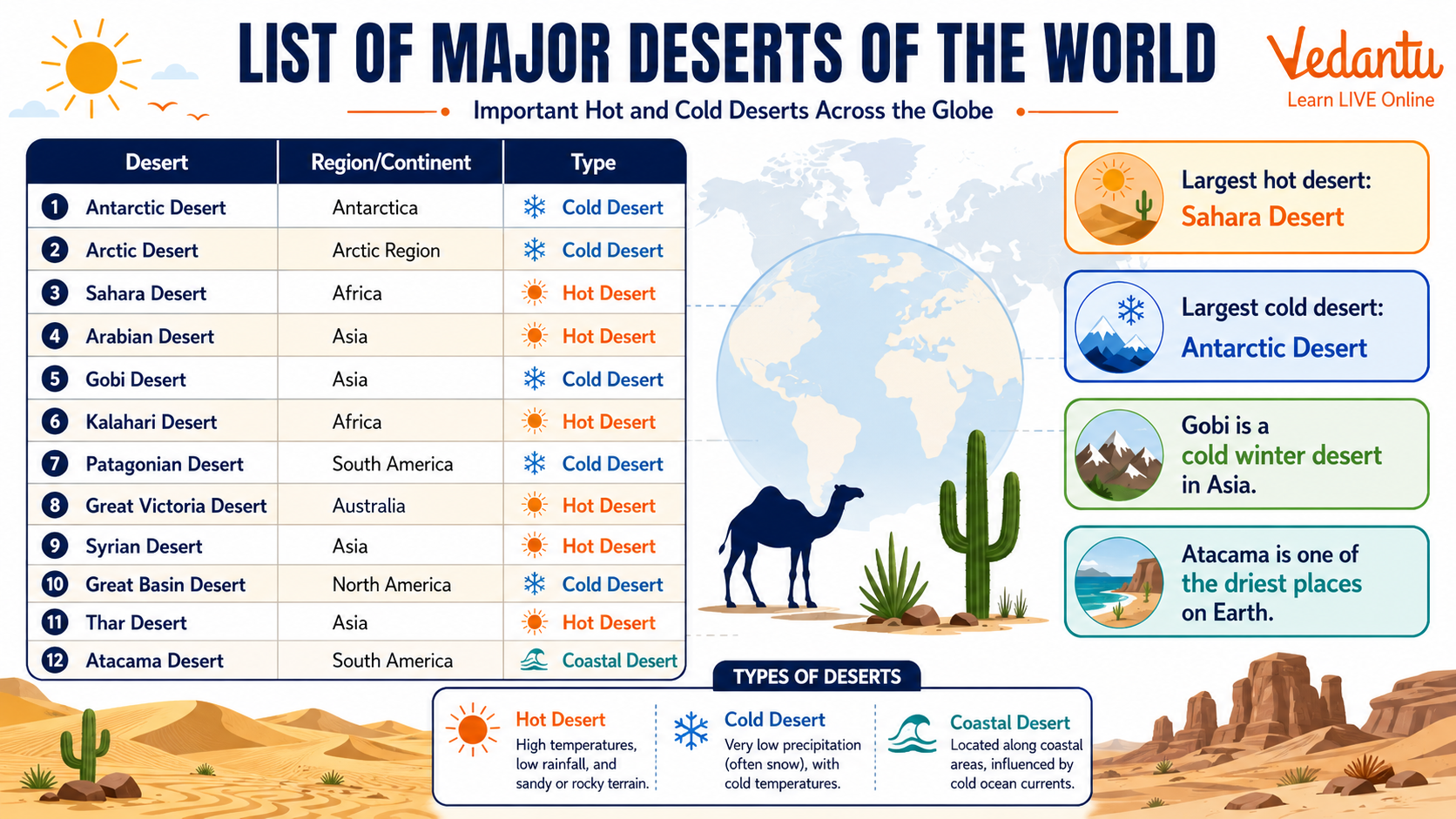
What is a Desert?
A desert is a barren area of landscape where precipitation is very low, usually less than 25 cm per year. Due to low rainfall, deserts have sparse vegetation and limited animal life. Deserts can be classified into hot deserts and cold deserts depending on their climatic conditions.
- Hot deserts - High temperatures during the day and very low rainfall.
- Cold deserts - Extremely cold winters with low precipitation.
- Coastal deserts - Located near coastlines with dry conditions due to cold ocean currents.
- Semi-arid deserts - Receive slightly more rainfall than true deserts.
List of Major Deserts of the World
| Desert Name | Location | Type |
|---|---|---|
| Antarctic Desert | Antarctica | Cold Desert |
| Arctic Desert | Arctic Region | Cold Desert |
| Sahara Desert | Africa | Hot Desert |
| Arabian Desert | Western Asia | Hot Desert |
| Gobi Desert | Mongolia and China | Cold Desert |
| Kalahari Desert | Southern Africa | Semi-arid Desert |
| Patagonian Desert | Argentina | Cold Desert |
| Thar Desert | India and Pakistan | Hot Desert |
| Atacama Desert | Chile | Coastal Desert |
| Great Victoria Desert | Australia | Hot Desert |
The above deserts are among the largest and most significant deserts in the world. The Antarctic Desert is the largest desert globally, while the Sahara Desert is the largest hot desert. Each desert has unique climatic conditions and ecological characteristics.
Brief Description of Major Deserts
1. Antarctic Desert
The Antarctic Desert is the largest desert in the world. It is a cold desert covered with ice sheets and experiences extremely low temperatures and minimal precipitation.
2. Sahara Desert
The Sahara Desert is the largest hot desert in the world, covering much of North Africa. It is known for sand dunes, rocky plateaus, and extreme heat during daytime.
3. Arabian Desert
Located in Western Asia, the Arabian Desert covers most of the Arabian Peninsula. It has vast sand dunes and limited water resources.
4. Gobi Desert
The Gobi Desert is a cold desert located in Mongolia and northern China. It experiences harsh winters and is known for its fossil discoveries.
5. Thar Desert
Also called the Great Indian Desert, the Thar Desert lies in northwestern India and southeastern Pakistan. It is one of the most densely populated deserts in the world.
6. Atacama Desert
The Atacama Desert in Chile is one of the driest places on Earth. Some regions have recorded almost no rainfall for years.
Key Features of Deserts
- Very low annual rainfall.
- Extreme temperature variations between day and night.
- Sparse vegetation such as cacti and shrubs.
- Specially adapted wildlife.
- Presence of sand dunes, rocky plains, and salt flats.
Importance of Studying Major Deserts
Learning about major deserts of the world helps students understand global climate patterns, environmental adaptations, and physical geography. Questions about the largest desert, the hottest desert, or the location of specific deserts are commonly asked in competitive exams such as SSC, UPSC, State PSC, Railways, and other government examinations.
- Improves map-based knowledge.
- Helps in understanding climate change impacts.
- Strengthens world geography preparation.
Conclusion
The major deserts of the world are spread across different continents and vary in climate, size, and physical features. From the icy Antarctic Desert to the scorching Sahara Desert, each desert has unique characteristics. A clear understanding of their locations, types, and features is essential for General Knowledge and competitive exam preparation. Regular revision of desert names and their geographical positions will help students answer related questions accurately and confidently.
FAQs on Major Deserts of the World and Their Key Features
1. What are the major deserts of the world?
The major deserts of the world are large arid regions known for extreme climates and low rainfall. Key examples include:
• Sahara Desert (Africa) – Largest hot desert
• Antarctic Desert (Antarctica) – Largest cold desert
• Arabian Desert (Asia)
• Gobi Desert (Asia)
• Kalahari Desert (Africa)
• Great Victoria Desert (Australia)
• Patagonian Desert (South America)
These deserts are frequently asked in GK questions, competitive exams, UPSC, SSC, and school quizzes.
2. Which is the largest desert in the world?
The Antarctic Desert is the largest desert in the world by area. It covers about 14 million sq. km and is classified as a cold desert due to extremely low precipitation. Key facts:
• Located in Antarctica
• Covered with ice sheets
• Receives less than 250 mm rainfall annually
It is often confused with the Sahara Desert, which is the largest hot desert.
3. Which is the largest hot desert in the world?
The Sahara Desert is the largest hot desert in the world. It covers approximately 9.2 million sq. km across North Africa. Important features include:
• Spreads across 11 countries
• Extremely high daytime temperatures
• Sand dunes (ergs), rocky plateaus, and oases
This desert is commonly asked in Geography GK and competitive exams.
4. What is the difference between hot deserts and cold deserts?
The main difference between hot deserts and cold deserts lies in temperature and location. Key differences:
• Hot Deserts: High temperatures (e.g., Sahara, Arabian)
• Cold Deserts: Extremely low temperatures (e.g., Antarctic, Gobi)
• Both receive very low rainfall
• Vegetation is sparse in both types
This distinction is important in physical geography and climatology studies.
5. Where is the Gobi Desert located?
The Gobi Desert is located in Northern China and Southern Mongolia. It is a large cold desert known for extreme temperature variations. Key facts:
• Fifth-largest desert in the world
• Experiences snow in winter
• Important site for dinosaur fossil discoveries
The Gobi is frequently mentioned in Asian geography GK questions.
6. Which is the largest desert in Asia?
The Arabian Desert is the largest desert in Asia. It covers around 2.3 million sq. km in Western Asia. Important details:
• Located mainly in Saudi Arabia
• Contains the vast Rub' al Khali (Empty Quarter)
• Characterized by sand dunes and arid climate
This desert is significant in Middle East geography and GK exams.
7. Which desert is located in South America?
The major desert in South America is the Patagonian Desert. It is the largest desert in the continent. Key points include:
• Located in Argentina
• Cold desert with strong winds
• Lies east of the Andes Mountains
Another notable desert is the Atacama Desert, one of the driest places on Earth.
8. Which is the largest desert in Australia?
The Great Victoria Desert is the largest desert in Australia. It spans across Western and South Australia. Key features:
• Composed of sand dunes and grasslands
• Sparse population
• Part of the Australian desert region
Australia is known as the driest inhabited continent, making this a common GK topic.
9. Why are deserts important in world geography?
Deserts are important because they influence climate, biodiversity, and human adaptation. Their significance includes:
• Unique plants and animals (cactus, camels)
• Rich mineral and oil resources
• Impact on global wind and weather systems
• Study of desertification and climate change
They are widely covered in environmental studies and physical geography.
10. Which deserts are commonly asked in competitive exams?
The deserts most commonly asked in competitive exams include major hot and cold deserts worldwide. Frequently asked names are:
• Sahara Desert – Africa
• Antarctic Desert – Largest overall
• Arabian Desert – Asia
• Gobi Desert – Asia
• Kalahari Desert – Africa
• Thar Desert – India & Pakistan
These are important for UPSC, SSC, Railways, State PSC, and school GK exams.
